JOINT BASE BALAD, Iraq — A surgeon and his team made medical history at the Air Force Theater Hospital, March 30.
Lt. Col. (Dr.) Wilmer Jones, 332nd Expeditionary Medical Group vascular surgeon, and his team performed only the ninth medically documented transposition of the internal carotid artery, the artery that provides blood to the brain.
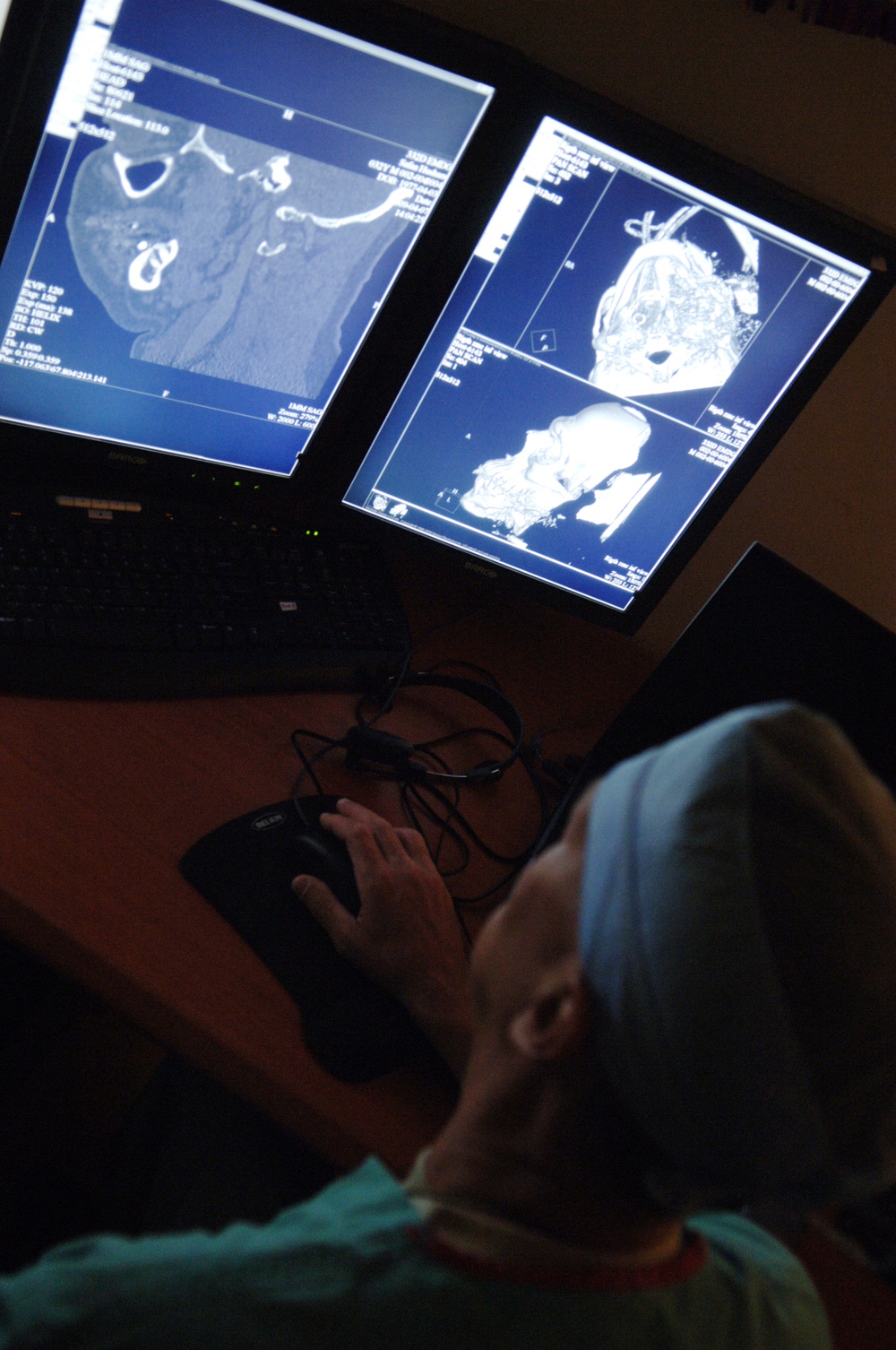
"A 42-year-old lady was seen at the [Iraqi] Balad hospital by Iraqi physicians," Dr. Jones said. "She had a six-month history of headaches and a throbbing mass in her neck. [The Iraqi doctors] did an ultra-sound down at the Balad hospital and saw what looked like an aneurism of the carotid artery, which is the artery that goes to the brain and the face.
"Hers was actually the portion of the artery that went to the brain, so it was much more serious," continued the doctor deployed here from Wilford Hall Medical Center in San Antonio. "If it was just the artery going to the face, you could simply tie it off, ligate it, and that would take care of it. Since it was going to the brain, you can't really do that because if you ligate it, one-third of those people have a massive stroke."
Furthering the woman's need for the surgery was the size of the aneurism.
"The normal artery going to the brain is about eight-tenths of a centimeter in diameter and hers was three centimeters," Dr. Jones explained. "It was larger than a golf ball. The problem with those types of aneurisms is they have a tendency to form clots in them, and the clot goes to the brain and causes a stroke. If you don't do anything, 50 percent of those people will have a stroke."
Due to the seriousness of the woman's condition, the Iraqi doctors reached out to the medical staff here.
Approval was granted by higher headquarters to proceed with the elective surgery since it was not a battle-related injury.
Although Dr. Jones had previous experience performing similar surgeries, he did research, seeking other cases like hers to further his knowledge on this particular kind of vascular surgery.
"On reviewing the literature before treating her, I found there are eight other documented cases of repairing a true aneurism of the internal carotid artery," he said. "At home, we do a lot of stroke-preventive surgery called carotid endarterectomy, which is probably one of the most performed surgeries. Also, when anybody gets injured in Iraq that involves anything in their neck or in their arterial artery I treat them, so I had a lot of experience working with the carotid artery. In this case, instead of being an injury it was a disease process, but it's something I was used to dealing with."
A carotid endarterectomy is a vascular-surgery procedure that removes plaque from the lining of the carotid artery.
Upon receiving approval from the Multi-National Forces - Iraq commanding general, Gen. Raymond Odierno, Dr. Jones and his team of skilled professionals took to the operating room.
The doctors began prepping the Iraqi woman for surgery, explaining the procedure to her through an interpreter.
"With someone back home you can say, 'hey, we are going to do this, we are going to do that,'" said Capt. (Dr.) Chad Stine, 332nd MDG anaesthesiologist. "It's a little more difficult with someone that you don't speak the same language as.
Surpassing the language barrier, they were able to walk the patient through the pre-surgery process and perform the surgery.
During the surgery, Dr. Jones and his team, to include a cardiovascular specialist, Lt. Col. (Dr.) Jerry Pratt, took the artery going to her face, which was normal, and used that to replace the aneurismal portion of the diseased artery going to her brain.
"We just moved [the carotid artery providing blood to her face] over and attached it to the normal portion [of the artery] going to her brain," Dr. Jones said. "It's similar to a by-pass; it's called a transposition because the artery was there; we just moved it over and sewed it over above the aneurism and [removed] the aneurism."
Despite performing the delicate surgery in Iraq, the doctors did not encounter any problems.
"In the operating room here at Balad, we have pretty much anything we need to handle any emergency or surgery just like back in the States. We've been very well-supported as far as vascular surgery," concurred Dr. Jones. "The main difference here is we try not to put in anything that is not the person's own tissue because there is probably a higher risk of infection here. Types of bacteria are different from what we see back in the States. We try to not put anything that is not their own tissue into place and that's one of the reasons why we transposed her [Iraqi woman] own vessel."
Nearly two hours later, upon completing the surgery, the Iraqi woman's life was not completely out of harm's way.
"Within the first five minutes of her waking up, we wanted to get a very good neuro-exam on her," said Dr. Stine. "By neuro-exam, I mean we want her to follow commands, we want her to move all four extremities. We want her to do stuff purposefully. That signifies to us that during that procedure she didn't get a part of her brain that had a stroke.
"She woke up very well; I used an anesthetic that wore off quickly," added the doctor, deployed here from Eglin Air Force Base, Fla. "We were able to have her follow commands before we even removed the breathing tube."
Dr. Jones shared his feelings on his patient's state after the surgery, "it worked out very well and she went home three days later and is at home with her family. She is back to normal completely. Her brain is getting supplied. The only thing she has now is a small neck incision, which is healing nicely."
"We will see her back in a few weeks," Dr. Jones continued. "She was very appreciative that she was going home to her family and this problem was taken care of. Her stroke risk was lowered to that of a normal person. I think that within the next couple of years, had we not done the surgery, she would have had a massive stroke and that's supported in the literature."
Despite the medically historic significance of the surgical procedure, Dr. Jones and his team remain humble.
"It's neat to have done that particular procedure," Dr. Stine said. "At the time, when we were doing it, I didn't think, 'oh, this is a historic thing.' It really didn't seem like that.
"Performing the surgery was great," Dr. Jones said. "It is the reason we came into the business to take care of and help people. Certainly, I think we helped her a lot."

 Subscribe






