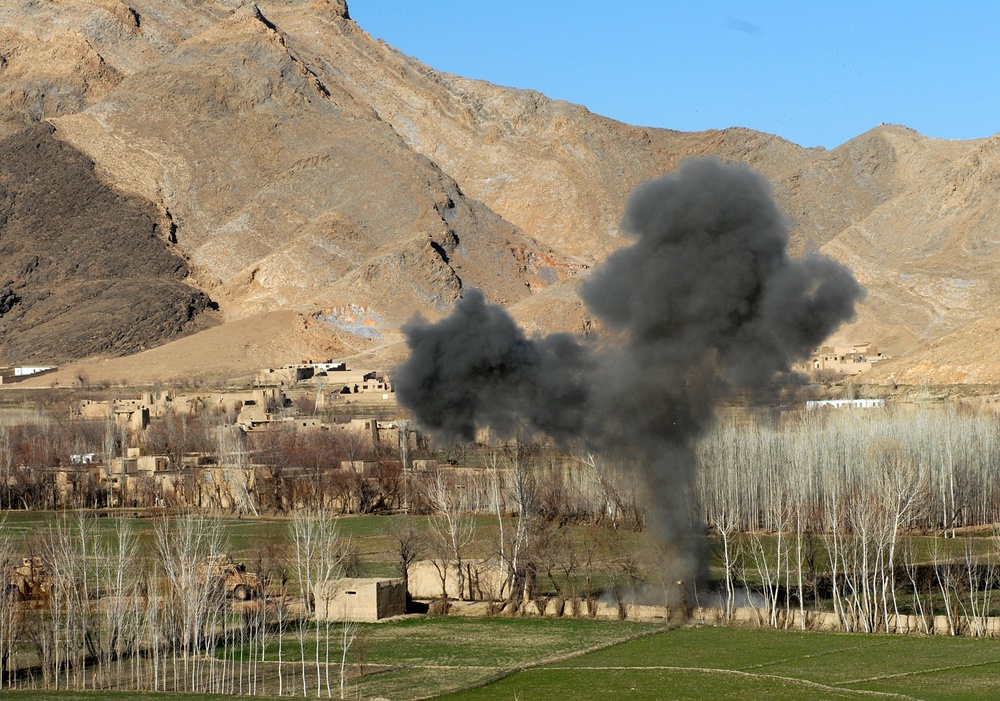
BAGRAM AIR FIELD, Afghanistan - Shockwaves reverberated through the mountains and a large black cloud of smoke rose from the road as an improvised explosive device was detonated, March 9.
Once again the engineers of Alpha Company, 3rd Brigade Special Troops Battalion, 10th Mountain Division, had beaten the insurgents to the punch.
"Our mission is to go out before the infantry to look for IEDs," said Army Staff Sgt. Jeremy Claus, 3rd BSTB, Task Force Spartan. "We ensure they have safe passage so they can do their mission."
Just a few hours prior, a low tone transmitted through the speakers of the eight-vehicle convoy, alerting the team that an IED could be close by. One by one, the vehicles rolled to a stop.
Around the side of the lead vehicle, two Soldiers emerged. Their task was to inspect the side of the road for indicators of wires and to look for trigger-men who could be close by waiting to ambush their team.
"These guys are essential," added Army Staff Sgt. John Rankin, a squad leader with 3rd BSTB. "We need them on the ground for their eyes and experience."
The meticulous actions of the team are vital when they attempt to confirm a hidden explosive is nearby. They follow step-by-step guidelines precisely to ensure safety for everyone.
"You always have to assume they have direct eyes on you," said Army Cpl. Mark Colborn, team leader for 2nd squad, 3rd BSTB. "You have to be efficient when you walk up and make sure you do a thorough job so no one gets hurt."
A few minutes later, Colborn radioed in his report. They found no command wires leading off the road. However, just because they didn't see anything doesn't mean something wasn't there.
The next move was to bring out Army Pfc. Matthew Swanson, a gunner on the dismount team, and his metal detector, to sweep the road for any signs that something could be buried. Swanson reflected that there's always a thought in the back of his mind that something could happen when he approaches a suspicious area.
"I hope I don't get blown up," he said, as matter of fact. "It's my job to go out there to see if the detector can find something. If it registers, that's a pretty good indication that something is down there."
However, Swanson is just one half of a team to identify potential explosives.
The military has a new ally in their search for IEDs in Afghanistan; canines of the Lucky Dog Program. The program trains dogs to detect dangerous materials and chemicals known to be associated with IEDs.
Assigned to the engineers, for this mission, were Army Sgt. Stephen Netzley and his partner "Lady." When she and Swanson key in on the same area, it provides a solid case for the explosive ordnance disposal team to unpack their gear.
"She'll pick up a scent," said Netzley. "If I know something, I'll lead her to it. I watch her reaction."
When Lady responds with the appropriate cue, EOD knows it's time for them to take over.
"The dogs help us a lot because they can pinpoint exactly where something is," added Army Cpl. Adam Kodras, a Soldier of 3rd Squadron, 71st Cavalry Regiment Counter-IED team.
After performing numerous checks and securing the area, EOD detonates the charge placed over the area, and a resounding boom echoes up and down the road.
"What we are able to do here is a testament to our training," added Colborn. "We execute our mission with proficiency and professionalism to ensure the people around here don't get hurt."
As the black smoke billowed through the air, the impact of their efforts was evident.
"We probably saved a Humvee full of Soldiers," Kodras said.
| Date Taken: |
03.15.2009 |
| Date Posted: |
03.15.2009 02:23 |
| Story ID: |
31124 |
| Location: |
BAGRAM AIR FIELD, AF |
| Web Views: |
440 |
| Downloads: |
397 |
PUBLIC DOMAIN

This work, Spartan Engineer non-commissioned officers save lives by clearing improvised explosive devices, by SFC Robert Frazier, identified by DVIDS, must comply with the restrictions shown on https://www.dvidshub.net/about/copyright.

 Subscribe






