
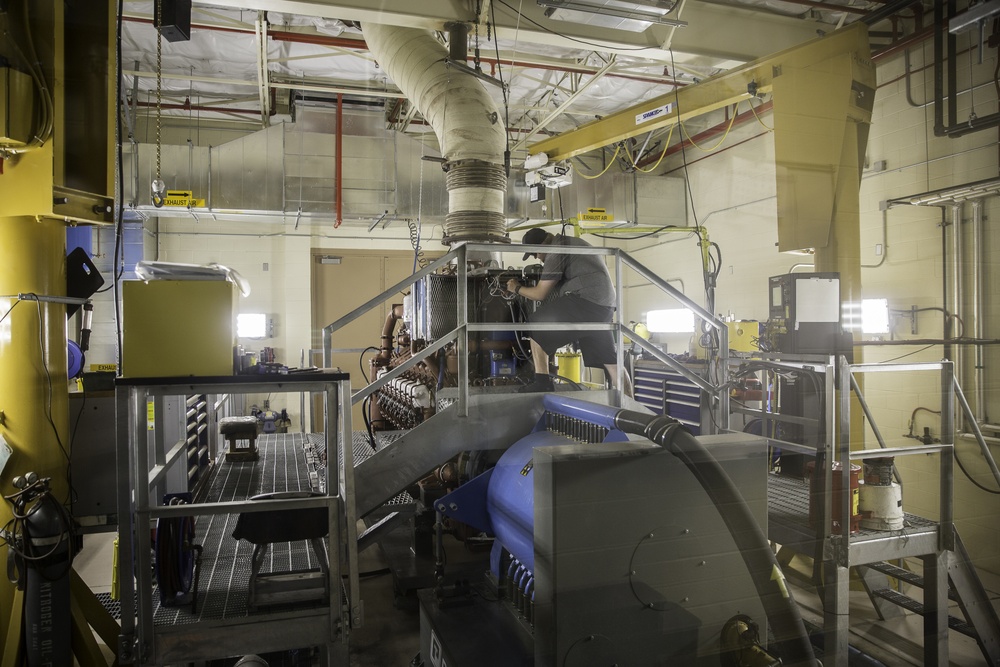
Photo By Jack Adamyk | Chris Ware, heavy mobile equipment mechanic supervisor, checks components of the...... read more read more
With five shops and 75 employees, the Secondary Depot Repairables Branch at Production Plant Barstow, Marine Depot Maintenance Command, is a mechanic’s haven on the Yermo Annex aboard Marine Corps Logistics Base Barstow, Calif.
The SDR Branch encompasses the following shops: Hydraulics, Transmissions, Engines, Powertrain and Paxman.
“In the Hydraulic Shop, we get anything associated with hydraulics for any of the vehicles or equipment that come in and we rebuild and/or refurbish it, depending on what needs to be done,” explained John Thorne, Hydraulic Shop supervisor. “We also work fire-bottles or fire extinguishers that come in as well.”
The fire-bottles are worked on in a special portion of the shop where they work with three types of fire suppression chemical compounds: Halon, HFC-125 (Pentafluoroethane), FM 200 (heptafluoropropane). The chemical agents are preferred over waterbased systems for myriad reasons to include zero ozone depletion, minimal impact on electronics, rapid dispensation, and low-cost clean-up. They must also be handled with utmost care.
“We conduct a static test on each piece of equipment that’s brought in,” said Miguel Reyes, HMEM, working in the Fire Bottle section.
“The containers then go to Blast and Paint. They’re prepped and cleaned, weighed empty, then refilled to proper specifications.”
Meanwhile in another portion of Hydraulic Shop, Jose Rivera, HMEM, uses a heavier hand during disassembly to remove a shaft from a hydraulic cylinder with a mallet.
As equipment and components move through the Branch, other artisans demonstrate honed skills in their respective functions. In the Engines Shop, Transmissions, Paxman and Powertrain area, wrenches and specialty tools work away.
“Anything that makes a vehicle move comes through these areas,” said Chris Ware, HMEM supervisor for the Engine and Paxman Shop. “We work on engines for M88s, HMMWV, LAVs (Light Armored Vehicles), AAVs (Amphibious Assault Vehicles), LVSRs (Logistic Vehicle System Replacement), M917 dump trucks, MTVRs (Medium Tactical Vehicle Replacement) and MATVs (Military All Terrain Vehicle). We also work on the Paxman Engines for both the Navy and Coast Guard.”
The Paxman engines are approximately 8 feet tall and 20 feet long, with 16 cylinders. The U.S. Coast Guard Patrol Coastal Boats uses two; where Navy boats requires four per asset of the Paxman engines, explained Ware.
“The power pack, which includes the engine and transmission and relative components of a vehicle are pulled, and sent to the Engine Shop; wedged (i.e. disassembled) then we break down the transmissions in our shop,” said Isaac Parsell, supervisor for the Transmission Shop and Powertrain Shop. “We do an IROAN, Inspect and Repair Only As Necessary, for equipment that is stipulated as an IROAN only within the SOW (statement of work) and complete rebuild on our rebuild lines. We disassemble, clean, rebuild and reassemble everything and prepare it to be put back in the vehicles.”
“The IROAN process can take a matter of hours for some standard components and equipment,” Ware said. “It can take up to on average 80 days for M88 engines to120 days for a Paxman asset.” All equipment goes through a stringent dyno process once completed. Engines and Transmissions get tested to spec separately; in some cases, power packs get tested in conjunction prior to install. In both dyno areas, they have received recent upgrades. Transmission shop has recently received two new inline transmission dynos. Engine Shop has recently received a new facility along with new dynos to support required testing and support for most commodities of vehicles supported by not only the Marine Corp but multiple other branch services.
The shops work closely together and ensure that each component is carefully labeled, tracked, and worked to specification. Each piece is carefully inspected throughout the process to ensure that they are not compromised.
“Once it’s disassembled, cleaned and has gone through its cleaning process, it goes to Non-Destructive Testing to check for cracks in the transmission housing,” said Ben Yates, HMEM.
“These vehicles have received power upgrades throughout the years, torque load and pressure changes have risen, with these changes being made we have seen spider webbing and cracking through these transmission housings, where during our build of these transmissions the NDT process has been an integral part of our process,” said Christopher Ware and Issac Parsell.
Malissa Santos, Supervisory Industrial Specialist in charge of the SDR Branch, said, "My team works hard to ensure that all of the equipment is repaired and rebuilt to original equipment manufacturing, or better, specifications.”
The artisans each specialize in their own specific area, but Santos noted that they are also often cross-trained and allowed the opportunity for career growth.
“I’ve been here 26 years, and worked my way up through various shops,” Santos said. She has a degree in electrical engineering, noting a love for mathematics as her original motivator. “I was allowed a great opportunity here to get hands-on experience, learn, grow and move up. That opportunity is available for anyone who wants it.”
Now she oversees the SDR Branch and ensures that the artisans have everything they need in order to perform their functions effectively.
| Date Taken: | 09.13.2018 |
| Date Posted: | 09.13.2018 12:32 |
| Story ID: | 292627 |
| Location: | MARINE CORPS LOGISTICS BASE BARSTOW, CALIFORNIA, US |
| Web Views: | 40 |
| Downloads: | 0 |

This work, SDR Branch keeping things moving, by Laurie Pearson, identified by DVIDS, must comply with the restrictions shown on https://www.dvidshub.net/about/copyright.


No keywords found.





