
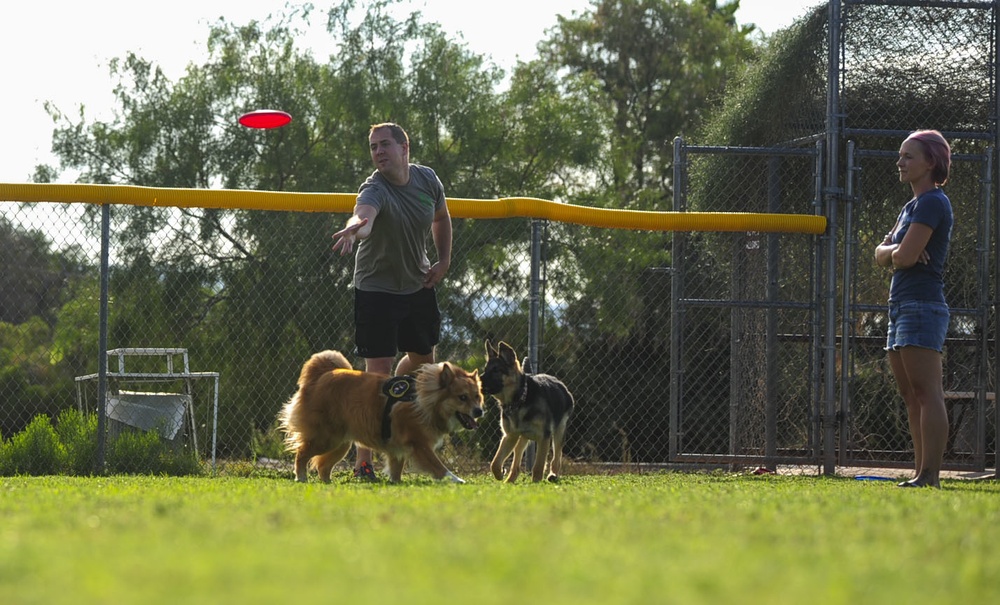
Photo By Airman 1st Class Frankie Moore | U.S. Air Force Capt. Daniel Hale, 563rd Rescue Group officer in charge of plans and...... read more read more
 Subscribe
Whether they are kept for a few weeks or a lifetime, sheltered animals around the nation rely on dedicated and caring individuals that can help them find a home.
To ensure these animals receive the support they need, U.S. Air Force Capt. Daniel Hale, 563rd Operation Support Squadron officer in charge of plans and scheduling, and his wife Dr. Kristen Hale, veterinarian, decided to take on the responsibilities that comes with fostering rescue animals.
The Hales began their animal rescue efforts with their dog Squish.
“When I worked emergency, Squish came in at four-weeks-old after sustaining injuries from being trapped under a couch,” Dr. Hale said. “We decided to take him in as a foster and he’s been with us ever since.”
After adopting Squish into their family, the Hales continued to foster companion animals. In the past three years, the couple has fostered over 20 sheltered pets.
Unfortunately, not all fostered pets in the care of the Hales are immediately adopted by families due to the medical condition of the animals.
“A lot of the pets we take in require specific medical needs,” Dr. Hale said. “Without a foster family to give them the individual attention they need, many of the animals would have never found homes because they would have been put down.”
Thanks to the help of local rescue shelters, foster families don’t have to worry about paying for the medical expenses of the animals while the rescue pet is in the family’s care.
Because of the nature of some of these medical conditions, the time it takes to nurse the animals to full health can vary.
“We’ve had animals anywhere from three days to six weeks,” Capt. Hale said. “After we’ve made sure they are ready to be adopted, we get them as much exposure as we can through local rescue shelters to increase their chances of finding a family.”
Because of the efforts of families like the Hales, shelter adoption rates have steadily climbed over the years leading to fewer overcrowded facilities.
According to the American Society for the Prevention of Cruelty to Animals, adoption rates have risen roughly 18 percent from 2011 to 2017 and shelter animal euthanasia rates have decreased approximately 42 percent.
“If you can’t keep an animal around for long or are not ready to make the commitment to permanently care for a pet, you can still make a difference by providing them with a foster home,” Dr. Hale said.
To find out more information on fostering and adopting companion animals, visit your local animal shelters.
| Date Taken: | 08.30.2018 |
| Date Posted: | 08.30.2018 12:54 |
| Story ID: | 290949 |
| Location: | TUCSON, ARIZONA, US |
| Web Views: | 34 |
| Downloads: | 0 |

This work, Couple provides support for foster animals, by A1C Frankie Moore, identified by DVIDS, must comply with the restrictions shown on https://www.dvidshub.net/about/copyright.


No keywords found.




