By Spc. Dustin Roberts
2nd Brigade Combat Team, 1st Infantry Division
BAGHDAD – The liaison for the United States Agency for International Development, embedded with the 2nd Brigade Combat Team 'Dagger', 1st Infantry Division, Multi-National Division – Baghdad is set to return to the states Dec. 21 after two years of service to the citizens of northwest Baghdad.
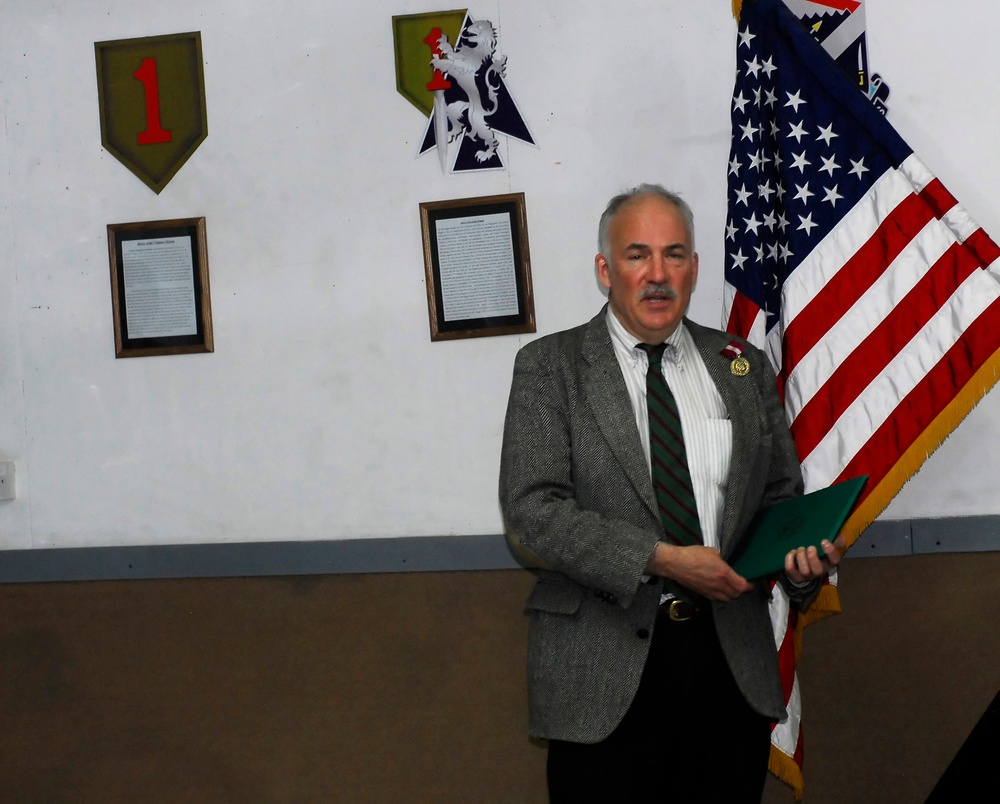
John Crihfield, who worked with Iraqi institutions in governance and economics with the U.S. Army Expanded provincial reconstruction team since December 2006, was awarded the Superior Civilian Service Medal on Dec. 19. The award is the equivalent to the Meritorious Service Medal awarded to Soldiers.
"John is very good at what he does and we could not do what we do without him," said Col. Joseph Martin, commander, 2nd HBCT, 1st Inf. Div., MND-B. "It's a bitter-sweet day for us knowing that he is leaving."
In the two years of his service here, John's responsibility was to influence the citizens that many believe will help strengthen the economy.
"What my role in particular for this specifically is to represent USAID and we are here to help manage those programs that are active in northwest Baghdad," said Crihfield. "There has definitely been an interest for the programs we have started here."
On the government side, Crihfield said the ePRT for northwest Baghdad concentrated on strengthening essential services provided to the people.
The essential services branches, known as Belladiyahs, take care of services such as trash pickup, sewage removal and the distribution of clean water.
The Dagger Brigade continually engages local leaders to find ways to make the four Belladiyahs in the brigade's area of operation more efficient.
"In early 2006 the Belladiyah just stopped providing services to the western part of the Mansour district; people weren't getting any essential services," Crihfield said. "What we did was reach out and help the Belladiyahs through the western parts of Mansour through Public Work Sub Stations."
Crihfield said the PWSS concept has been a success among the citizens because they are scattered throughout northwest Baghdad, bringing essential services closer to the people.
"What we did was build on the institution and provide them resources in terms of labor; not to create a new department of public works, which has been tried and suggested elsewhere in Baghdad," he said. "We worked with what's already there and built it up so eventually the local governance will take over through a memorandum of understanding."
In addition to Iraqi governance, Crihfield and the EPRT brought many economic suggestions to the table.
"On the economics side we have done our best to try to help the economy get itself going because even in a war zone people have to eat and they still have to buy things," Crihfield said. "Many markets basically were closed in May of 2007 and if you were to drive around in the most difficult parts of Western Mansour, all the markets were closed."
He added that in the later part of 2007, when the surge of troops in Iraq was starting to take hold, the awakening movement that started in Baghdad began to stabilize the areas where al- Qaeda had once been strong.
"A lot of things were happening all at once and markets started to pop up on their own," he said. "People were able to put money back into their shops."
While with the 2nd Brigade Combat Team, 101st Airborne Division (Air Assault), which occupied northwest Baghdad prior to the Dagger Brigade, Crihfield's team helped set up hundreds of small business grants throughout the area, providing people in business the funds they needed to set up or improve their shops.
For a more permanent fix, Crihfield said USAID established institutions such as the Small Business Development Center in Karada.
The development center, built in the summer of 2007, has provided more than 300 businessmen and women in northwest Baghdad economic training and financial tips, equipping them with credibility to start or improve businesses.
"Basically we have given them a voucher that gives them free access to the training," he said. "Another 500 are potential candidates and we've reached out to hundreds to take the course. We've been able to get a new microfinance institution engaged in parts of Baghdad that we have never gone before."
In what Crihfield called a "business road show" The ePRT team has conducted more than 30 meetings with northwest Baghdad shop owners and entrepreneurs since over a year ago, bringing representatives from new Iraqi-led financial institutions.
"We are putting before the people of the business community other Iraqis to tell them what some of the services are," he said. "These programs are longer-run development tools and so far they have been fairly well received; they have been getting a lot of interest both for the training and the microfinance. With these microfinance institutions and training we are hoping to nurture the economy and we hope that they will be able to continue on their own once we leave."
Crihfield will head to Washington to learn Arabic before returning to the Middle East to help the citizens of Palestine in private enterprise for four years.
"We are going to miss John, and we are very happy that he is moving on to this next opportunity," said Martin. "He has helped accomplish a lot and we want him to know how thankful we are."
| Date Taken: |
12.20.2008 |
| Date Posted: |
12.20.2008 19:57 |
| Story ID: |
27954 |
| Location: |
BAGHDAD, IQ |
| Web Views: |
233 |
| Downloads: |
103 |
PUBLIC DOMAIN

This work, Foreign service officer to return home after two years in northwest Baghdad, by SGT Dustin Roberts, identified by DVIDS, must comply with the restrictions shown on https://www.dvidshub.net/about/copyright.

 Subscribe






