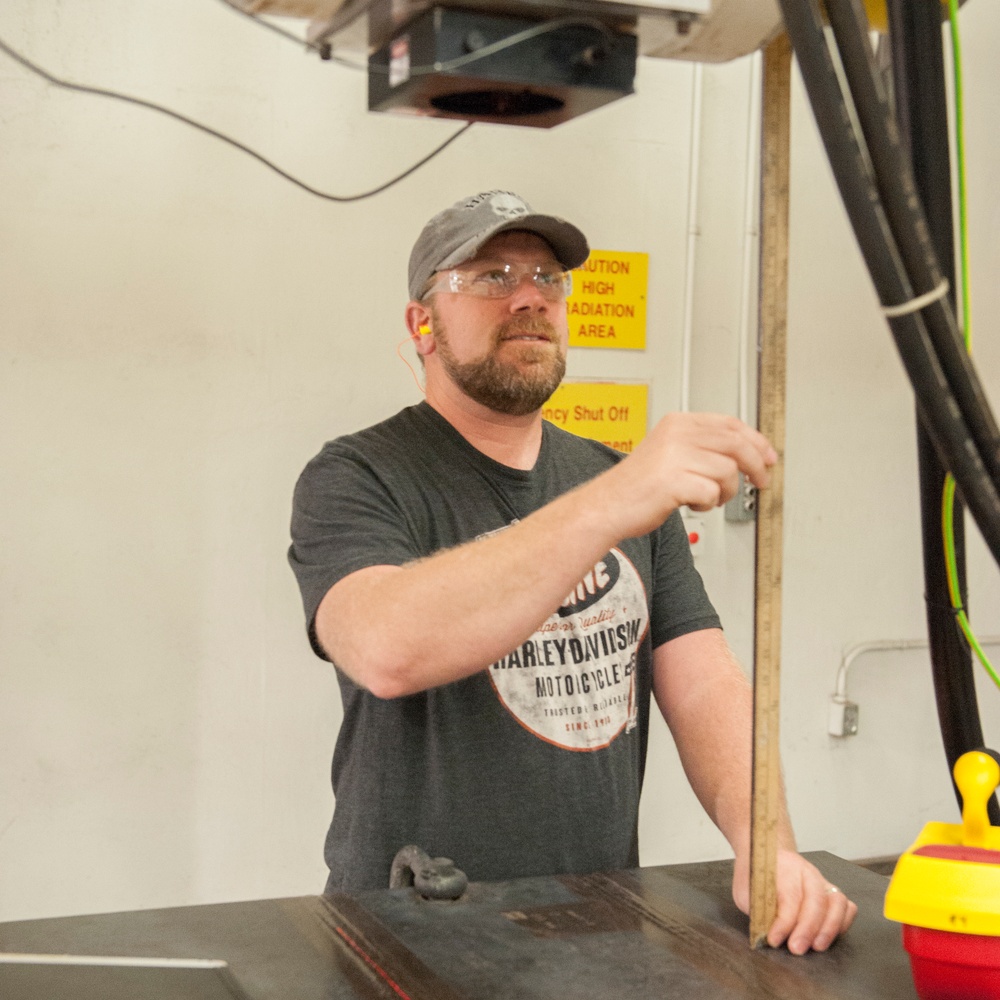
ANNISTON ARMY DEPOT, Ala. -- In 2016, Anniston Army Depot's Directorate of Engineering and Quality split into two organizations - the Directorate of Production Engineering and the Quality Assurance Office.
Within the DPE are the areas responsible for enacting engineering controls to assist the industrial shops. From helping with the design of new weapons systems to aiding the layout of new equipment or a building renovation as well as support for various production processes, whenever the question of how to make something work within the industrial arena arises, DPE can provide the solution.
Though comprised of six divisions, the DPE team coordinates to ensure any program or project can be completed, is developed with safety in mind and will enhance the production shops, not hinder them.
Computer Integrated Manufacturing Division
As machining processes have become highly computerized, the Computer Integrated Manufacturing Division ensures records for all the computer-aided machining programs are properly developed and maintained.
"We support the machinists on the shop floor," said Garry "Butch" Hathorne, engineering technician for the Computer Integrated Manufacturing Division.
In 1994, the depot began using RAMP, a program capable of telling machining equipment what to do to create a part or alter a part. Since that time, approximately 19,000 different processes have been created using RAMP.
The division is always looking for ways to machine products more efficiently and with better quality, according to Hathorne.
They have been instrumental in the purchase of more than 30 new pieces of machining equipment since 2011, increasing the installation's machining capacity.
The division also schedules and coordinates preventative maintenance on all machining equipment with the original equipment manufacturers. This ensures longevity of the equipment, many of which have been in service on the depot for more than 20 years.
Enterprise Excellence Division
Continuous process improvement is the goal for the Enterprise Excellence Division. Through Lean events, Six Sigma projects, value engineering and the Army's suggestion program, the organization is always looking to increase quality and production throughout the installation while keeping costs down.
Since 2002, there have been 1,189 Lean events at ANAD.
These events are often initiated at the shop floor level.
"If a supervisor has a recurring problem, they will contact us and request a Lean event," said Barry Smith, chief of the Enterprise Excellence Division.
Utilizing those in the shop who know the way work is performed there as well as employees who are well-versed in process improvement, the team reviews every step of the workflow through the facility, looking for ways to safely improve efficiency while remaining true to quality standards.
Currently, ANAD holds its own Lean training and events. The depot is soon slated to have a master Black Belt for the Six Sigma program, which will enable the Enterprise Excellence Division to hold in-house Six Sigma training.
Just as Six Sigma projects are similar to Lean events, only on a much larger scale, many of the division's value engineering projects begin as recommendations for shop improvements.
"A lot of the value engineering projects we have had in the past started out in the Army suggestion program, but turned out to be much bigger," said Smith, adding that employees often see something which can be improved in their work center and don't realize it can be applied across several production areas.
Process Engineering Division
Whenever a safety measure is implemented in a shop or production environment on the depot or whenever there are ergonomic issues or unsafe chemicals being utilized in a process, the depot turns to the Process Engineering Division for correction of the issues in a way that doesn't affect production.
"Our group is responsible for having a positive impact on the key performance indicators of production," said Chris Coss, chief for the Process Engineering Division.
The organization integrates technology, whether in the form of equipment or new types of chemicals and products to reduce hazards, fill gaps in capacity and increase productivity.
Whenever changes to production processes occur or alterations to facilities are proposed, this division reviews those changes from a safety, ergonomic, fire prevention compliance and process flow standpoint to reduce the depot's environmental impact, improve safety and increase production.
"We should be reducing our footprint, reducing our consumables and making sure we are as cost-effective as possible, while maintaining quality," said Coss.
Process Management Division
Changes to the buildings which house production shops, or the equipment installed in the buildings, are coordinated with the Process Management Division.
This organization establishes and maintains the calibration specifications and schedule for equipment throughout the industrial area as well as the drawings for equipment placement and requirements in each building.
This enables the Process Management personnel to have a unique understanding of how each facility is capable of functioning, or what its capacity is.
Capacity drawings indicate the number of employees who can work in the building at maximum capacity and how much work can be accomplished if the building is at maximum capacity. The calculations are performed using data such as the square footage of a building, workstations in the facility, the amount of equipment housed there and the personnel required to operate that equipment.
In order to maintain those records, the division also must be involved in any renovations performed throughout the shops.
"Our office works closely with the Directorate of Public Works on their projects in the industrial area, so the work doesn't disrupt production," said Dennis Montgomery, chief for the Process Management Division.
Technical Publications Division
When a process on the shop floor needs to be documented for a standard operating procedure, a depot maintenance work requirement or a national maintenance work requirement, the depot calls upon the Technical Publications Division.
The team of writers, photographers, videographers and graphic designers are able to create everything from manuals to computerized instructions or video shop instructions.
The division maintains a library of all the manuals, SOPs, DMWRs, NMWRs and other work instructions used by employees on the shop floor.
Additionally, the library maintains list of locations which use the various manuals and work instructions. This ensures the most up-to-date information is distributed to the shops which need it.
"Instructions are critical for employees on the shop floor to ensure required processes are followed and quality evidence and data is recorded," said Bob Searle, chief for the Technical Publications Division.
And it's the job of the Tech Pubs team to ensure each employee has within reach all the work instructions they may need.
Weapon System Engineering Division
The engineers in the Weapon System Engineering Division provide technical support of new modifications or variants of existing weapon systems, component test equipment and manufacturing technology.
"We provide design support using the computer-aided drafting systems at ANAD. We receive customer model files and pull images, dimensions, then provide feedback to the design agency when conflicts occur," said Brian Anderson, chief of the Weapon System Engineering Division. "We also provide interpretations of drawing dimensions and specifications for production machining, welding and assembly operations."
According to Anderson, these procedures often entail communication of real world manufacturing experiences to program managers and design engineers.
Engineers and technicians in this division support component testing and test equipment located throughout the industrial area.
The various machines required for individual component testing are unique and expensive, but essential, parts of the overhaul process. The test stands replicate operational conditions and collect data related to how an overhauled part will perform under those conditions.
Story was originally published on page 1 of the April 6, 2017, issue of "TRACKS."
| Date Taken: |
04.06.2017 |
| Date Posted: |
10.11.2017 17:16 |
| Story ID: |
251296 |
| Location: |
ALABAMA, US |
| Web Views: |
46 |
| Downloads: |
0 |
PUBLIC DOMAIN

This work, Divisions work together to ensure projects, programs work in depot shops, by Jennifer Bacchus, identified by DVIDS, must comply with the restrictions shown on https://www.dvidshub.net/about/copyright.