By Pfc. Howard Ketter
Desert Voice
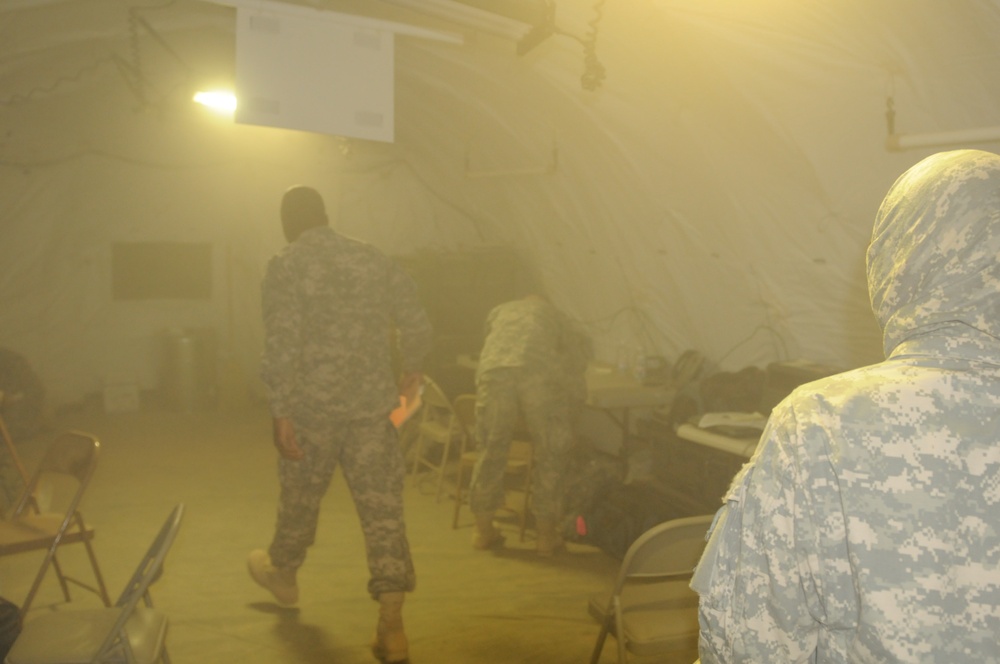
U.S. Army Central staff training in the Lucky Warrior exercise endured two dust storms at Camp Buehring, Kuwait, Sept. 8 and 9, 2008.
"The dust storms occurred as a result of collapsing thunderstorms," said Air Force Master Sgt. Steven Harmon, Staff Weather Office, USARCENT, a Macon, Ga., native. "When a thunderstorm collapses, cold air from the upper levels of the storm race down to the surface and produce high winds that kick up the dust."
The storm on Sept. 8 knocked over both of the command group's portable latrines and collapsed one of the Special Troops Battalion's tents.
Sgt. Precious Braylock, STB, said she was outside taking a break when the storm began.
"I couldn't see anything," said Braylock. "I went to the access control point to readjust, then made my way to my tent where I noticed one of our tents collapsed."
There were chairs and tables tossed around the area and Soldiers from other sections came to help clean up the mess, said the Okolona, Miss., native.
"After the storm ceased, we set our tent back up and our battalion commander and command sergeant major came to check out what happened and make sure everyone was okay," added Braylock.
Braylock said that STB Soldiers placed additional sandbags and stakes to tether their tent in place, preparing themselves for the second storm.
"We use a combination of things to detect dust storms," said Harmon. "Two of the most helpful are weather observations from upstream stations and satellite images."
"If you know there is a dust storm coming, it is important that you block any possible entries such as air ducts and tent entrances," said Capt. Jonathan Y. Ji, field surgeon USARCENT, a New York, native.
Spc. Zachariah T. Ellingson, joint network node operator, 40th Expeditionary Signal Battalion, a Janesville, Wis., native, said he was in the 40th ESB operations tent, monitoring equipment during the first storm.
The 40th ESB operations tent started to detach from its shelter, but otherwise there was no equipment damage, said Ellingson.
"I had on goggles, gloves and a scarf around my face," added Ellingson.
The 40th ESB Soldiers also put sandbags around their tent to keep dust out and better secure their tent in preperation for the second storm.
Servicemembers, of all ranks, dusted and swept sand from the inside of the Current Operations Information Center. The sand covered several computers, communications equipment and desks.
When the storms subsided, Soldiers from the Aid Station policed the area around the site for loose debris.
"Ideally, Soldiers should wear kevlar and individual body armor if objects are flying in the air," said Ji. "Some sort of damp handkerchief or bandana should be worn to cover the mouth and nose. This provides an effective filter for dust."
According to Ji, excessive inhalation of dust can lead to breathing difficulties.
Unexpected incidents such as dust storms are one of the reasons Soldiers are trained to be prepared, with the right equipment and protective gear for any situation and is another way Soldiers in USARCENT stay mission ready.

 Subscribe






