By Sgt. Daniel Blottenberger
18th Military Police Brigade
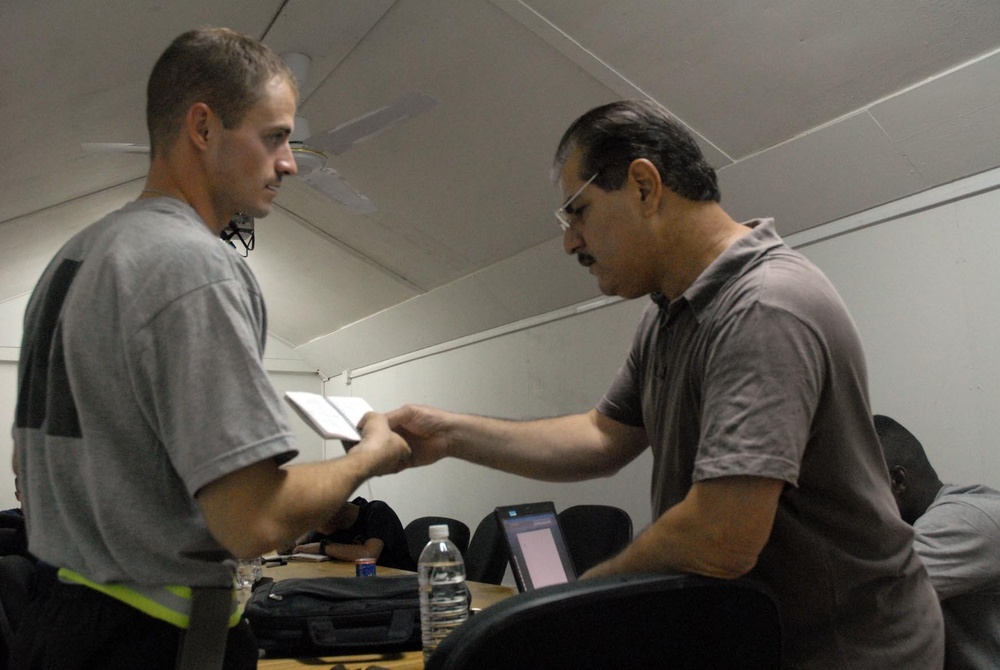
BAGHDAD, Iraq – "Kalo," said the instructor in an Iraqi dialect to 10 Soldiers who spontaneously began searching through their notes.
"Your mom's brother," answered one of the students.
"Correct," said the instructor, as the class continued. "Next word, 'Abn Amme.'"
A student instantly responded with, "Your cousin from your dad's side of the family."
This word familiarization exercise lasted for another 10 minutes or more, Sept. 19, 2008, during the 716th Military Police Battalion's cultural awareness class, which teaches anywhere from 10 to 20 Police Transition Team Soldiers a week on various subjects pertaining to Iraqi culture.
The instructor Fred Fachou, an interpreter with the battalion, and native of Troy, Mich., teaches the 10-week class.
"They use what I teach here, while conducting their daily Police Transition Team missions at Iraqi police stations," said Fachou, who lived in Iraq his entire life before moving to the United States in 1977. "I teach them a lot of the basics, because that is what they use every day at the stations to communicate."
The course, which is 40 hours of classroom instruction, educates students about the Iraqi language, how to use and recognize the Iraqi number system, how to recognize and pronounce Iraqi time, how to refer to someone's relatives in Arabic, and how to pronounce days of the week in Arabic while teaching the Soldiers Iraqi customs and traditions in order for the Soldiers to have better situational awareness while on mission.
The course provides immediate effects on the unit's mission success, by allowing the Soldiers to have better situational awareness through understanding the culture of their IP counterparts.
"The cultural awareness class has a direct impact on the capability of the PTTs mission," said Capt. Nathan Brookshire, commander, Headquarters and Headquarters Detachment, 716th MP Bn. "Understanding the complex cultural environment the Soldiers work in with the added benefit of communicating in the native language enables the PTTs to build enduring relationships with their IP counterparts."
The course also is a direct impact on the overall IP development mission.
"The relationships created by investing in cultural awareness training increases the battalion's impact on police professionalism and effectiveness," said Brookshire.
The course is taught once a week on Fridays, which is normally a day the Soldiers' use to recover from the countless missions during the week. The battalion uses Friday to recover; which works well as it coincides with the Iraqi weekend, which starts on Fridays.
The Soldiers that have attended the class said that applying what they have learned at class has been very beneficial to them when conducting their missions.
"It helps us be able to direct traffic and communicate in Arabic while we are on mission," said Pfc. Vanessa Enos, a MP Soldier, 978th Military Police Company, assigned to the 716th MP Bn. "The class teaches us the things not to do when dealing with the Iraqi people to make sure we show them the proper courtesies according to their customs."
To help the Soldiers further understand Iraqi customs and courtesies, in one of the recent classes, Fachou taught topics related to Ramadan and customs Soldiers need to be aware of to ensure they display the proper respect to the Iraqi people during the religious observance.
Ramadan is the Muslim religious observance that takes place during the ninth month of the Islamic calendar, which is believed to be the month in which the Qur'an was revealed to the angel Gabriel, to deliver it to the prophet Muhammad. It is the Islamic month of fasting, in which participating Muslims do not eat or drink anything from true dawn until sunset.
During this serious month of worship it is important for the Soldiers to understand and respect the religious observance of their counterparts.
"We had a class just before Ramadan that told us what not to do when we are out on mission," said Enos. "We would not want to offend any Iraqis during their holy month."
During the cultural class, which meets for a one hour class per week, consists of: reviewing homework from the previous week, lessons of verbal communication and writing of different Iraqi words and reviewing common phrases the Soldiers would most likely use when operating at local IP stations.
"The Soldiers ask what they need to know from the experiences they have had out on missions," said Fachou. "I try to answer all of their questions, so they are more prepared the next time they go out."
Soldiers will ask questions like: Why do Iraqis do this? When is Ramadan over? Would it be disrespectful to do this to an Iraqi?
"Anything they ask me, I tell them what it means in Arabic and how to write it," said Fachou.
"If they ask me something, then that means they will use it a lot when they are out there," added Fachou.
At the end of the class the Soldiers receive their homework assignment for the next week, which is usually a review from what they went over in class that day.
The Soldiers then have an opportunity all week to practice their newly learned Arabic as they head out into the streets while conducting PTT operations.
The 716th MP Bn., is deployed from Fort Campbell, Ky., and is currently assigned to the 18th MP Bde., Multi-National Division – Baghdad.
| Date Taken: |
09.22.2008 |
| Date Posted: |
09.22.2008 06:46 |
| Story ID: |
23986 |
| Location: |
BAGHDAD, IQ |
| Web Views: |
204 |
| Downloads: |
156 |
PUBLIC DOMAIN

This work, Multi-National Division – Baghdad Soldiers take cultural awareness onto the streets of Baghdad, by SGT Daniel Blottenberger, identified by DVIDS, must comply with the restrictions shown on https://www.dvidshub.net/about/copyright.

 Subscribe






