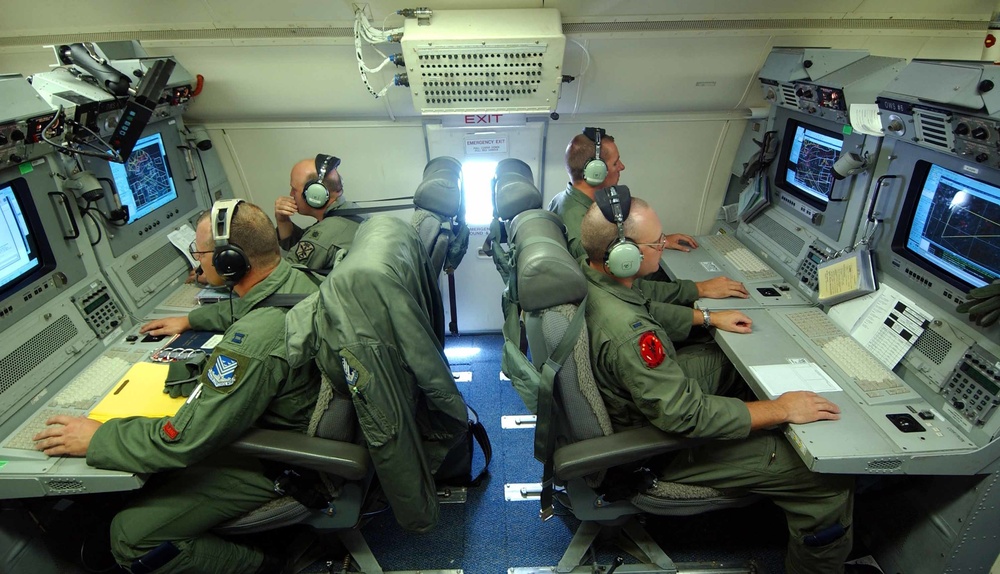
ROBINS AIR FORCE BASE, Ga. -- The sun never sets when it involves the JSTARS delivering combat power across the globe.
An unrivaled platform unlike any other in the Department of Defense inventory, the Joint Surveillance
Target Attack Radar System team based at Robins has been a part of every major conflict since the early 1990s, and deploying continuously for the better part of 15 years.
Its worldwide fleet flew its one millionth flight hour in September. While it may be just a number, every hour represents numerous stories, and years of being away from family members and friends in sacrifice of protecting American interests abroad as well as in the homeland.
“It’s just a number, but behind that number is a lot of combat power that has been delivered to every combatant commander around the globe since JSTARS was born,” said Col. John Cooper, 461st Air Control Wing commander.
Its unique command and control capabilities make it one of the most sought-after DOD platforms. And what makes it even more special is its total force comprised of active duty, as well as National Guard and Army members. JSTARS includes the 461st ACW, which became an active associate wing in 2011, the Georgia Air National Guard’s 116th ACW and the Army’s Military Intelligence Detachment
(MI Det)-JSTARS, which includes the 138th Military Intelligence Company.
“The Army detachment historically has been a contributing team partner in Team JSTARS,” said
Lt. Col. Jarred Lang, MI Det. commanding officer. “Our focus is on insuring synchronization of the ground component commanders’ mission intent with the air component commander. They do pre-mission coordination with supported units on the ground, and have been involved since very early in the
JSTARS mission as well.”
One area JSTARS has had heavy influence in is the U.S. Central Command’s area of responsibility. Thus far, the team has amassed over 125,000 combat flying hours in direct support of numerous operations.
Its global support of combatant commanders spans U.S. Pacific, Northern, Southern, Africa, European and Central commands. CENTCOM’SAOR covers such countries as Afghanistan and Iraq, Pakistan, Qatar, Iran and Syria.
The 7th Expeditionary Airborne Command and Control Squadron at Al Udeid Air Base in Qatar has the sole mission of conducting E-8C JSTARS missions in the CENTCOM theater, with the team flying some 3,000 combat hours this year in support of coalition operations throughout the region.
“Simply put, JSTARS finds things and solves operational problems in the air and on the ground,” said Lt. Col. William Hartman, 7th EACCS commander. “JSTARS battle managers use our ground surveillance radar to detect, disrupt and ultimately destroy Daesh forces in Iraq and Syria in partnership with our air coalition strike assets every day, while also providing support and overwatch of friendly forces in
Afghanistan.”
Because the fleet of Boeing 707s was already in operation prior to being modified to its existing platform, it takes a Herculean effort by maintainers to keep it safely flying.
“Whether it’s through rain, sleet or shine, there are airmen out there 24 hours a day, seven days a week turning wrenches; these are active duty and Air National Guard maintainers working side by side. That’s one of the benefits of total force integration, those synergistic efforts when you have seasoned maintainers alongside younger airmen,” said Col. Thomas Grabowski, 116th ACW vice commander. “Then when you have the Army as an important part of that piece, this is really a great assignment no matter what uniform you wear.”
He added, “We are busy. So the million hours translates into ‘What are we doing for combatant commanders?’ We’re out there getting it done every day of the week. We’ve not had all of our people home at Robins for over a decade – there’s always somebody on the road.”
Meeting that insatiable demand for JSTARS’ worldwide capabilities is the job of those at Robins, according to Cooper.
“Whatever number we can make available will be consumed eagerly by those combatant commanders. That aircraft has that much impact to each fight we’re in around the globe,” he noted.
Arriving at Robins in 2015 from the 607th Air Operations Center in Korea, Cooper enjoys a unique perspective of understanding how an air war is conducted to now being charged with leading an active associate wing that helps to lead that war-winning capability.
“The Air Operations Center is the command and control element that puts together an air war in order to achieve the end results of the overall commander. What is interesting to me about JSTARS is we are a smaller version of that. It is in many respects an extension of the AOC,” said Cooper.
Added Grabowski, “The key to winning wars is that the team that has the ability to cut through the fog and friction of war first will win the battle. That’s what JSTARS does – it finds problems and it solves problems, doing it in real time over the battlefield.”
| Date Taken: |
10.21.2016 |
| Date Posted: |
11.07.2016 15:10 |
| Story ID: |
212609 |
| Location: |
ROBINS AIR FORCE BASE, GEORGIA, US |
| Web Views: |
78 |
| Downloads: |
4 |
PUBLIC DOMAIN

This work, Combat power never sleeps: JSTARS reaches 1 million flight hours, by Jenny Gordon, identified by DVIDS, must comply with the restrictions shown on https://www.dvidshub.net/about/copyright.