An average day at William Beaumont Army Medical Center consists of over 25 inpatient admissions. For the majority of beneficiaries, the only other place they’d rather be is home.
Prior to going home, the patient must be discharged. A recent process improvement initiative has contributed to continuously and efficiently decreasing discharge times by improving care coordination throughout WBAMC.
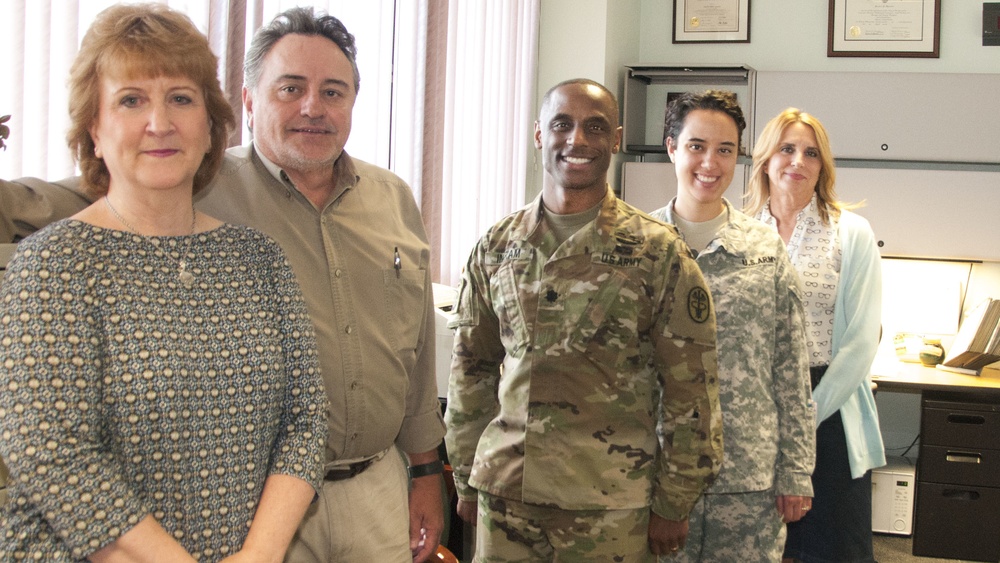
“What drives us is that discharge planning begins on day one,” said Lt. Col. Toddy Ingram, chief, Multiservice Nursing, WBAMC.
According to Ingram, the continuous decrease in discharge times is a result of combined efforts in the hospital including WBAMC’s Interdisciplinary Case Management Team (ICMT), which provides follow-on care planning and referrals if necessary for patients prior to discharge. While patients are getting home faster, the speedy releases also maximize bed utilization which decreases out-of-network referrals.
The process improvement analysis identified delays in the inpatient discharge process resulting in multiple initiatives to decrease discharge times, from centrally positioning the ICMT closer to medical teams in order to maximize coordination to implementing a live-notes system to allow instant communication across a patient’s healthcare team. The results of the initiatives decreased inpatient discharge times from an average of four to six hours to less than two hours.
“It’s working well,” said Ingram. “People have been getting out on time and getting home before dark.”
One of the initiatives, the live-notes system, provides continuous updates over the network on a patient’s discharge plan. This communicates patient care and plans within the hospital in addition to physicians who may need to approve follow-on or specialized care requests.
“It’s just better communication and a more effective process to give the patient the best care they can have,” said Capt. Hannah Betts, discharge planner and Registered Nurse at WBAMC. “(Patients deserve) to have a good experience when they come in as well as when they leave.”
The system also helps veterans receiving inpatient care at WBAMC by instantly coordinating follow-on care recommendations with the El Paso Veterans Affairs Health Care System.
“It helps facilitate everything, we have different processes for veterans,” said Tony Tate, a WBAMC social worker/ discharge planner who works closely with inpatient veterans. “Through the process of communicating in the (live-notes) system, some of the (care) for patients may be expedited regardless of the health care system they belong to.”
Other developments include communicating other aspects of patient care such as crisis intervention for trauma patients, financial burdens or medical equipment needed via the live-notes system to speed up referrals or orders regarding patient follow-on care.
“When patients come in, we begin assessing them and see if there are any needs right then and there,” said Sandy Sposato, social worker/ discharge planner. “We get them what they need, coordinate between agencies, and let doctors know what (they need) to get it sooner.”
The ICMT’s efforts are apparent in the improved communication between discharge planners and medical teams with more than 50 percent decreases for inpatients, meaning patients are getting home in half the time.
According to Betts, medical personnel have found the live-notes system easier to work with because they are able to find everything they need in one click.
| Date Taken: |
10.21.2016 |
| Date Posted: |
10.21.2016 15:31 |
| Story ID: |
212606 |
| Location: |
FORT BLISS, TEXAS, US |
| Web Views: |
152 |
| Downloads: |
0 |
PUBLIC DOMAIN

This work, WBAMC streamlines discharge for inpatient services, by Marcy Sanchez, identified by DVIDS, must comply with the restrictions shown on https://www.dvidshub.net/about/copyright.

 Subscribe





