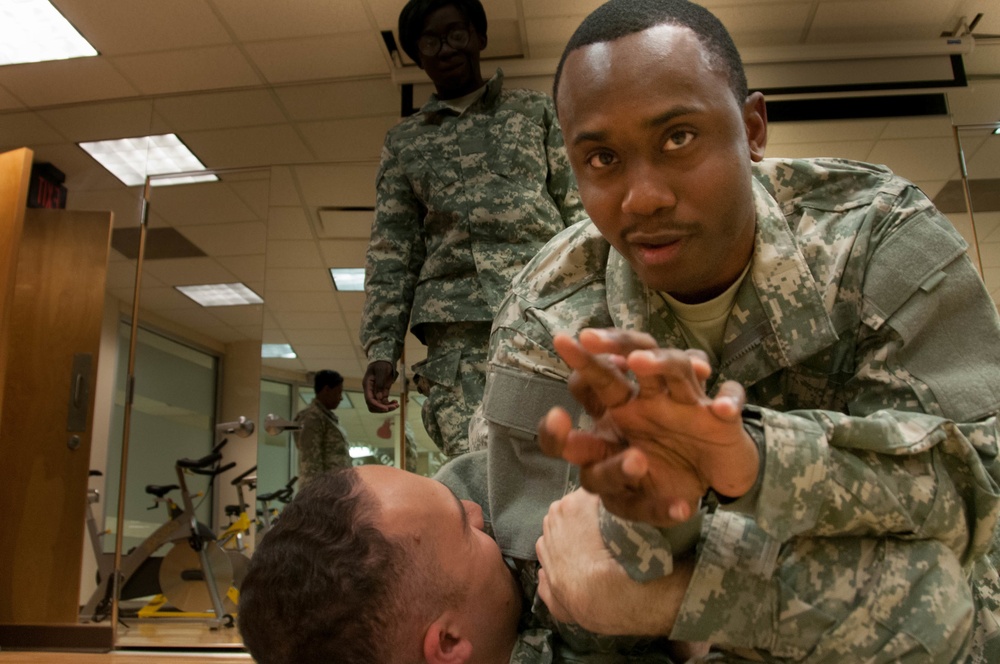
WASHINGTON, D.C. (April 17, 2016) — I arrived early to what looked like a newly renovated boxing gym earlier this week. It was unlike any gym I experienced when I boxed as a teenager. I was accustomed to the stereotypical dingy, raw-looking type of gym setting that smelled of old furniture. Where you could hear buzzing noises coming from flickering fluorescent lights and the angst of boxing gloves as they hit heavy bags. This gym was clean, as I expected an Army facility at Fort Belvoir would be, especially one used to instruct the Army Basic Combatives Course (Level 1).
As I waited, an older man, a few inches taller than me entered, wearing a baseball cap. With little introduction, he began doing sprawling drills, an exercise I remembered from my high school wrestling days. He stopped every so often to look at me and then continued his drills. While waiting I searched the Internet on my phone for information about the course to see exactly what I was getting myself into.
I found out that Modern Army Combatives Program started in 1995 by the 2nd Ranger Battalion and had a connection to the first ever Ultimate Fighting Championship, “UFC 1”. It was interesting how a commercialized sport would influence how the Army trains it Soldiers. Before searching, I had only heard about the injuries people received such as concussions and bruised ribs.
Time passed, and more Soldiers and Airmen came in. They ranged in gender, age, weight and body frames. We made small talk. Most students were active duty and stationed at or near Fort Belvoir.
Our conversations ended when an instructor entered and announced, “It’s time to warm up.
Welcome to Combatives Level 1.” Then class began.
He spoke fast and direct as he showed us the warm-up exercise. The physical training focused on core muscles and stretching. Next, the instructors demonstrated grappling techniques and then explained we would be facing each other in constantly rotating four-minute rounds. The rounds continued until there was a winner by submission.
This combatives course was only a week long, but made light of it after the first few hours. I could see it in everyone’s face, as it was probably reflected in my own, that this course wasn’t going to be the conventional, Army-mandated, combative training. The instructors ended the first day by telling us what we could expect for the remaining four days.
On the first day, half the class wanted to quit from either fatigue or soreness but I actually found it refreshing to be this tired, knowing how much we had already accomplished. I never got to the point of quitting, but could definitely could see how others considered it. Although we were tired and sore, our instructors asked us to perform at 100 percent. So that’s what we did.
The third day, was the hardest and most satisfying because we learned clinches. Clinches are grappling techniques used to subdue unruly combatants. The instructors brought in Level 3 and Level 4 Combative Instructors to be our opponents. The students were given mouth guards and the instructors were given boxing gloves. Truthfully, I had mixed emotions about the clinch drill.
“Time to knuckle up,” the instructor said jokingly, while sliding on our opponent’s gloves. “The quicker it starts, the quicker it ends,” said the other instructor.
Those were my thoughts exactly.
I was nervous about the drill. No one normally volunteers to be hit in the face. But I was also excited because this phase presented one of the more challenging moments and most realistic of the techniques I could see myself using.
It was challenging to push through the soreness and high-intensity cardio. We spent most of the 8-hour days learning or engaging in hand-to-hand combat, taking an hour for lunch.
There was a medic nearby who checked us for injuries after each iteration. Each student had to get four clinches to pass the class. Students are evaluated on their ability to gain and maintain positive control over their opponents. My first opponent was fast, the next was slower but had longer arms. The strategy varied for different opponents.
For me, the techniques were easy to pick up. I was able to apply what I learned and conduct a section of training for my unit that drill weekend.
I’m glad I attended the class. I left understanding the importance of why we do combatives and have a new found respect for those who teach it.
| Date Taken: |
04.17.2016 |
| Date Posted: |
04.20.2016 16:35 |
| Story ID: |
195815 |
| Location: |
WASHINGTON, DISTRICT OF COLUMBIA, US |
| Web Views: |
89 |
| Downloads: |
0 |
PUBLIC DOMAIN

This work, Learning to teach others to fight, by SFC Tyrone Williams, identified by DVIDS, must comply with the restrictions shown on https://www.dvidshub.net/about/copyright.