By Lance Cpl. Richard Blumenstein
3rd Marine Expeditionary Force Public Affairs
CENTRAL TRAINING AREA, OKINAWA, Japan — Cooperative local citizens and captured enemy insurgents in Iraq and Afghanistan are the main source for those collecting information on terrorist activities.
To stay proficient in their ability to gather this intelligence, Marines with Counter Intelligence/Human Intelligence Company, 3rd Intelligence Battalion, III Marine Expeditionary Force, conducted human intelligence training March 31- April 4 that focused on the challenges these Marines face in a combat zone.
Since counter/human intelligence Marines have access to the highest level of classified information and must often work covertly, those interviewed for this story will remain nameless for security reasons.
"Intelligence drives operations," said a CI/HUMINT officer who will be referred to as Capt. Smith. "An infantry or combat commander cannot send his Marines out anywhere without having some kind of intelligence to guide him in that area."
As their occupational field description indicates, the Marines' job consists of two main areas.
The human intelligence side of the Marines' job is what they focused on during the training. This mission requires them to gather information from civilians and detainees to support commanders' ability to make combat decisions.
During the training, the Marines took part in numerous scenarios that mirrored actual events that have taken place in Iraq, according to Smith.
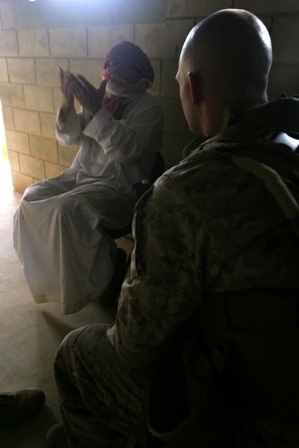
To add realism to the exercise, Marine and civilian volunteers acted as Iraqi citizens and enemy insurgents during the training.
The Marines practiced their verbal interrogation skills on fellow counter-intel" Marines acting as captured insurgents. The Marines questioned the captives for information that proved vital to the success of their mission in the scenarios.
"A captured insurgent could know a plethora of information," Smith said. "They could know about future attacks on coalition forces or Iraqi citizens."
During the training exercise, the Marines also had to implement their understanding of the Iraqi culture to build rapport with the role players acting as local citizens.
"You cannot ignore the culture - that is paramount," Smith said. "If you ignore the culture, you are going to disrespect the people and shut off that flow of information."
An example of adhering to the culture that was included in the training was asking the man-of the-house for permission to enter. If the CI/HUMINT Marines made the mistake of asking the woman in the home for permission, a conflict ensued making it harder for the Marine to gather information.
"It's always (difficult) trying not to ruin rapport and not burn bridges," one Marine said, noting that one small mistake can negate weeks or months of progress in a community.
The Marines also faced strong language barriers during the training. Role players who could speak a second language such as Spanish used it during the scenarios. This forced the Marines to communicate though a translator; similar to how they operate in Iraq.
"We base our training on information provided by teams that recently came back from Iraq and the new (tactics techniques and procedures) that have been implemented in Iraq," Smith said. "Scenarios we exercise out here are coming from real life experiences from other CI/HUMINT Marines."
| Date Taken: |
04.11.2008 |
| Date Posted: |
04.10.2008 19:01 |
| Story ID: |
18302 |
| Location: |
|
| Web Views: |
256 |
| Downloads: |
59 |
PUBLIC DOMAIN

This work, Counter, human intel Marines on Okinawa conduct training in Combat Town, by Richard Blumenstein, identified by DVIDS, must comply with the restrictions shown on https://www.dvidshub.net/about/copyright.

 Subscribe





