By Spc. Ricardo Branch
1st Brigade Combat Team, 3rd Infantry Division Public Affairs
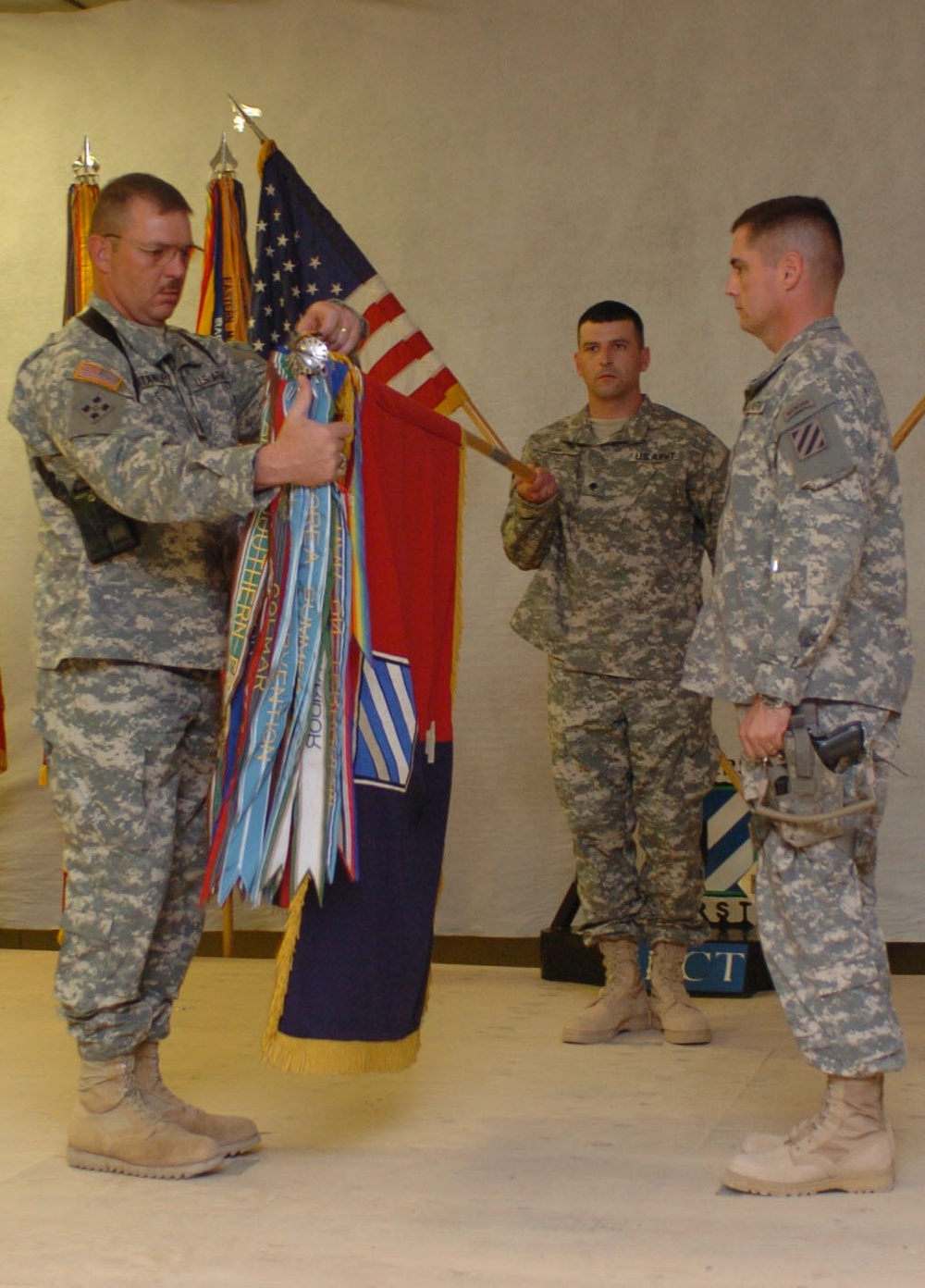
Soldiers of the 1st Brigade Combat Team, 3rd Infantry Division held a casing of the colors ceremony on March 20 at the morale, welfare and recreation building on Camp Ramadi.
The ceremony marked the end of the deployment for the 1st BCT as well as a transfer of authority to Regimental Combat Team 1, who will be controlling the Ramadi area after the brigade's departure.
"Today is a very important day, today is a day the members of the 1st Brigade thought would never happen," said 1st Marine expeditionary force ground combat element commander, Brig. Gen. Richard Mills. "After 15 long, hard months they are going home with the mission accomplished, and many thought they'd never go home on a day where there is security in Al Anbar province."
He said security came from the brilliant performance by the Soldiers and members of this brigade.
"This unit was brilliant on the battlefield; within days of taking over, they were in urban combat in a tough fight in the city of Ramadi," Mills said. "Their brilliant performance was signified by their continued success against the enemy."
1st BCT commander Col. John Charlton echoed the word of security along with the brigade's other goal for their mission in Ramadi.
"When we arrived here last year, we had two goals: one was to clear Ramadi of terrorists in eight weeks, and the other was to make this area secure enough, so we would be the last brigade combat team to serve in central Anbar," he said.
Charlton said the brigade didn't achieve their goals like they planned because it took them only six weeks instead of eight, and the success was in large part due to the partnership with the Iraqi security forces.
"We have always said that together we can do anything, and we proved that," he said. "This effort did not come without a cost. During our deployment, 29 coalition troops, 13 Iraqi army soldiers and 59 Iraqi policemen paid the ultimate sacrifice."
In January 2007, downtown Ramadi laid in ruins. Half of the buildings were destroyed, and just about every structure in Ramadi showed signs of battle damage. The insurgents had such a stranglehold on this city; they conducted a parade in downtown Ramadi, declaring it the capital city for Al Qaida in Iraq.
"Central Al Anbar averaged between 30 to 35 attacks a day," Charlton said. "Ramadi was easily the most dangerous city in Iraq, if not the entire world."
Today, the city of Ramadi and Al Anbar province have been reborn. In a little over a year, the city has gone from the most dangerous to one of the safest in Iraq.
All of the major damage has been repaired, and only a few small signs of the fighting remain. The electrical system has been completely restored, and hundreds of water and sewer pipes have been fixed. Children play outside and go to school, and the economy is growing at a massive rate in the city.
Charlton credits the success of Anbar to the people standing up against the oppression and violence brought about by terrorists.
"To understand how this happened, we must start with the tribes of Anbar," he said. "Starting in 2006, and led by Sheik Sittar Abu Risha and many other brave sheiks, the sons of Anbar stood in defiance of the terrorists and fought back to protect their land, their families and their way of life."
Many including Sheik Sittar gave their lives for the cause of freedom, which inspired the people to join the Iraqi security forces.
"They joined by the thousands," Charlton said. "Tribes of Anbar formed a close friendship with the coalition forces, and together we fought the terrorists."
Terrorists received no support from the people in the province after the tribes joined with the coalition. The combined efforts of the partnership got rid of the hold Al Qaida had in the province.
Charlton said, "Without question it was the tribal leaders of Al Anbar who created the 'awakening' that is now spreading across the country and giving hope for a united and peaceful Iraq."
He went on to talk about the coalition and Iraqi security force units, which helped take back Ramadi and the countryside from terrorists before reminiscing about the strong emotions this deployment has caused.
"This has been a tremendous experience for the Raider Brigade, but we leave here with mixed feelings," Charlton said. "It's a happy day for us because the Soldiers will soon go home to their families after a tough 15-month combat tour. For many of these Soldiers, it's their third deployment to Iraq, and they and their families have sacrificed much; however, it's also a sad day because we leave behind so many of our Iraqi friends."
He added, "We all have developed many close friendships with all of the Iraqis that we've worked with, and it will be tough to say goodbye. We know that our friends will be in good hands ... and that the close partnership between the Iraqis and coalition forces will grow even stronger."

 Subscribe






