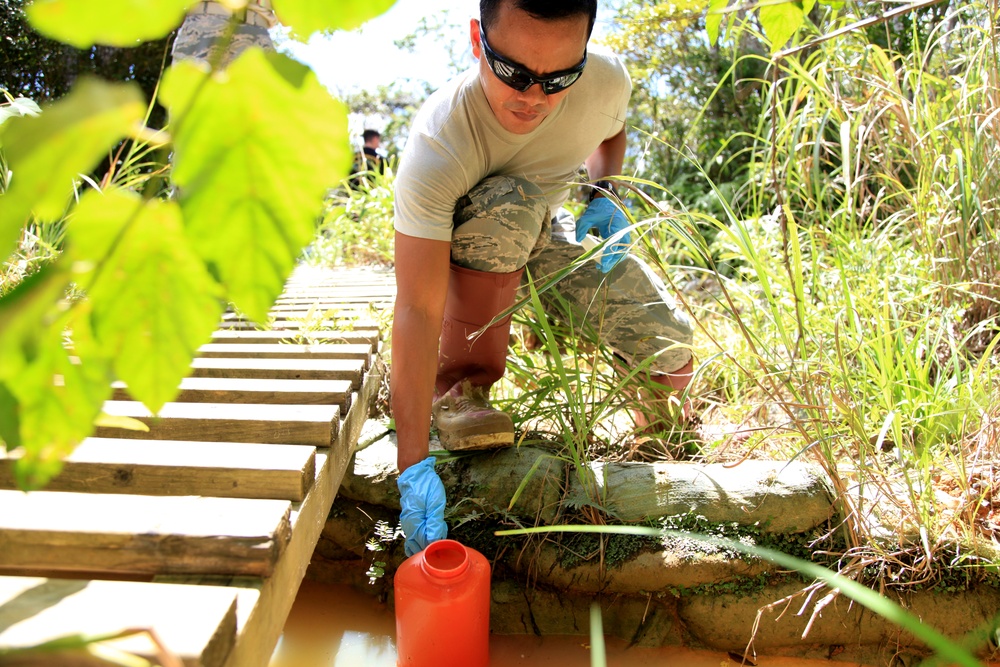
JUNGLE WARFARE TRAINING CENTER, OKINAWA, Japan– Military public health officials assigned to Navy Environmental and Preventative Medicine Unit Six, U.S. Naval Hospital Okinawa, III Marine Expeditionary Force, and biological environmental engineer technicians with Detachment 3, U.S. Air Force School of Aerospace Medicine, gathered samples of water to test for the bacteria that may cause leptospirosis Sept. 15 at the Jungle Warfare Training Center, Camp Gonzalves, Marine Corps Base Camp Smedley D. Butler, Marine Corps Installations Pacific.
Health officials are investigating a potential connection between the stagnant bodies of water at the training center and a spike in presumed leptospirosis cases among active-duty personnel who have used the training facility recently.
Leptospirosis is a bacterial disease that affects humans and animals, and is caused by bacteria genus leptospira according to the Centers for Disease Control and Prevention. Some of the symptoms of leptospirosis include fever, chills, severe head and muscle aches, nausea and vomiting, jaundice (yellowing of the skin and whites of the eyes), abdominal pain, diarrhea and a skin rash.
“Due to increased rain, there may be an increase in the mongoose population. Mongooses are known carriers of leptospirosis, and the organism (spirochete) concentrates in their urine. If they urinated in or near the water, the bacteria could be in the water,” said Lt. Cmdr. Joy Dierks, preventative medicine officer, III MEF.
An estimated 64 Marines were affected, and some hospitalized, after reports of several leptospirosis-like symptoms, said Dierks. All but one of the Marines has been released from medical care and they are doing well.
“We are conducting this investigation by testing the medication that was given to the Marines, testing the water at the “pit and pond” and “culvert” areas, as well as conducting surveillance for leptospirosis in the mongoose population,” said Dierks.
Okinawa’s Jungle Warfare Training Center is the only center specifically designed for jungle warfare training in the entire Department of Defense, and more than 3,000 service members train there annually.
Service members continue to use JWTC, but training has been adjusted to avoid submersion water.
“We have recommended the “pit and pond” be closed until we can understand why this outbreak occurred and establish the cause,” said Dierks.
According to III Marine Expeditionary Force and Marine Corps Installations Pacific Order 5101.1 Recreational Water Activities, due to the suspected presence of the bacteria that causes Leptospirosis and the risk it poses to humans, it is recommended that personnel refrain from accessing fresh bodies of water north of Camp Hansen for recreational purposes, which involve bodily entry into the water.
USNH Okinawa Public Health Department advises people to avoid swimming in fresh water, lakes, streams and waterfalls on Okinawa. If anyone believes they may be affected by leptospirosis, they should seek medical help immediately.
| Date Taken: |
09.15.2014 |
| Date Posted: |
10.02.2014 19:48 |
| Story ID: |
144126 |
| Location: |
JUNGLE WARFARE TRAINING CENTER , OKINAWA, JP |
| Web Views: |
193 |
| Downloads: |
1 |
PUBLIC DOMAIN

This work, Commands investigating source of illness, by SSgt Jose O. Nava, identified by DVIDS, must comply with the restrictions shown on https://www.dvidshub.net/about/copyright.

 Subscribe






