NEW RIVER, N.C. - Nearly 40 Marines with India Company, 3rd Battalion, 6th Marine Regiment, 2nd Marine Division, attached to the 24th Marine Expeditionary Unit, participated in a weeklong Tactical Recovery of Aircraft and Personnel course aboard Marine Corps Air Station New River, North Carolina, Aug. 25–29.
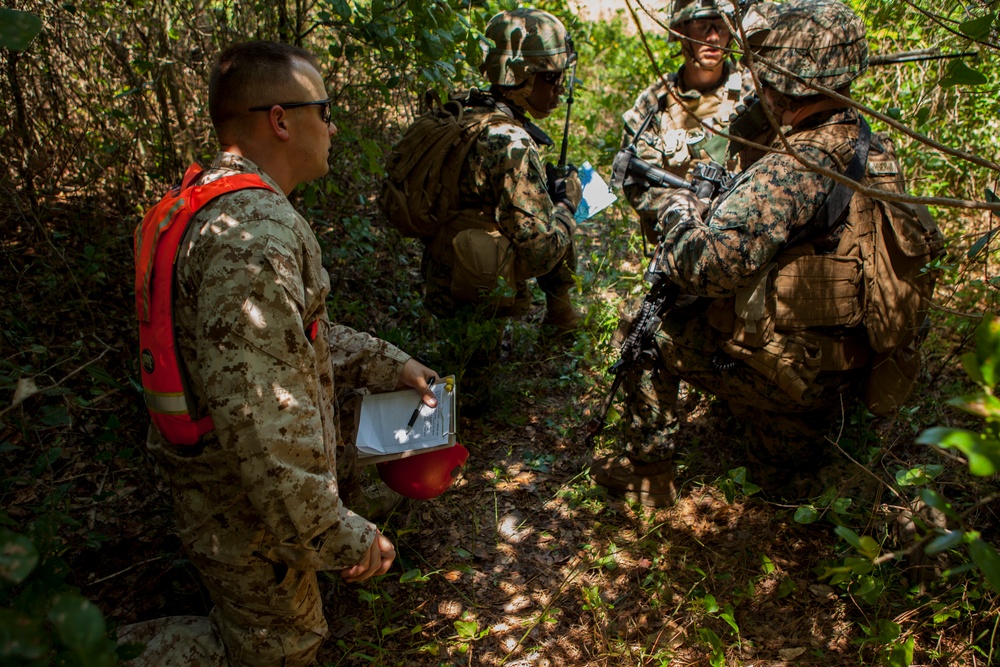
The course, hosted by instructors from Expeditionary Operations Training Group, 2nd Marine Expeditionary Force, consisted of formal classroom instruction, and practical application and evaluated training exercises. The course was implemented to provide designated TRAP forces tactical training and evaluation in order to conduct search and recovery of aircraft and personnel operations for the unit’s upcoming deployment.
The Marines completed eight hours of classroom instruction before being evaluated on skills such as combat preparation, aviation support and combat trafficking fundamentals.
“We’re giving them something that they’re not thinking about,” said Staff Sgt. Michael Cahill, an instructor for the course. “Marines think that it’s just a raid, which isn’t what TRAP is, so this is kind of back to the basics. TRAP is all of the small things that they tend to forget while they’re doing all of that other high-speed stuff. It re-focuses them on getting those little things done.”
Cahill said the instructors strive to come up with different scenarios to challenge the TRAP force and the course starts off with low intensity scenarios and increases from there. Cahill said this gives the deploying unit several different experiences to draw from if they ever have to complete a real world mission.
According to Pfc. Matthew LeCompte, a student in the course, the TRAP techniques will benefit his unit in the unlikely case that they would have to recover personnel.
“By participating in this course, our unit has learned how to work as a TRAP force, and simultaneously accomplish our mission in a timely manner,” said LeCompte. “This course has made me realize that our job as TRAP force is a vital asset to the MEU and has a great possibility of being put to use on our upcoming deployment.”
Cahill said all of the skills the Marines have learned throughout the week come together toward the end of the week during practical application exercises.
As a culmination exercise, Marines were evaluated during a simulated scenario in which Marines delivered humanitarian aid supplies and were left behind by a convoy. While conducting their lost Marine plan, one of the Marines was injured.
The students of the course received a mission order to locate lost Marines and were flown in on MV-22 Ospreys to recover them.
Once the Marines ensure the safe and proficient retrieval of the lost Marines, they then flew them to a safe zone.
“At the beginning of the week, the Marines are going too fast,” said Cahill. “By the end of the week they are slowing down and going through what they know how to do. You can really see that they’re grasping the concept.”
LeCompte said along with learning how to safely recover aircraft and personnel, he took away from the course that recovering aircraft and personnel is a race against time and it is important that the unit conducts their job quickly and efficiently.
| Date Taken: |
08.28.2014 |
| Date Posted: |
09.05.2014 13:43 |
| Story ID: |
141268 |
| Location: |
NEW RIVER, NORTH CAROLINA, US |
| Web Views: |
242 |
| Downloads: |
1 |
PUBLIC DOMAIN

This work, SOTG, 24th MEU Marines fine-tune skills in TRAP course, by Cpl Krista James, identified by DVIDS, must comply with the restrictions shown on https://www.dvidshub.net/about/copyright.

 Subscribe






