By Staff Sgt. W. Wayne Marlow
2nd Brigade Combat Team, 2nd Infantry Division Public Affairs
FORWARD OPERATING BASE LOYALTY, Iraq – In the battle against insurgents, Iraqi security volunteers receive relatively little attention compared to coalition and Iraqi security forces.
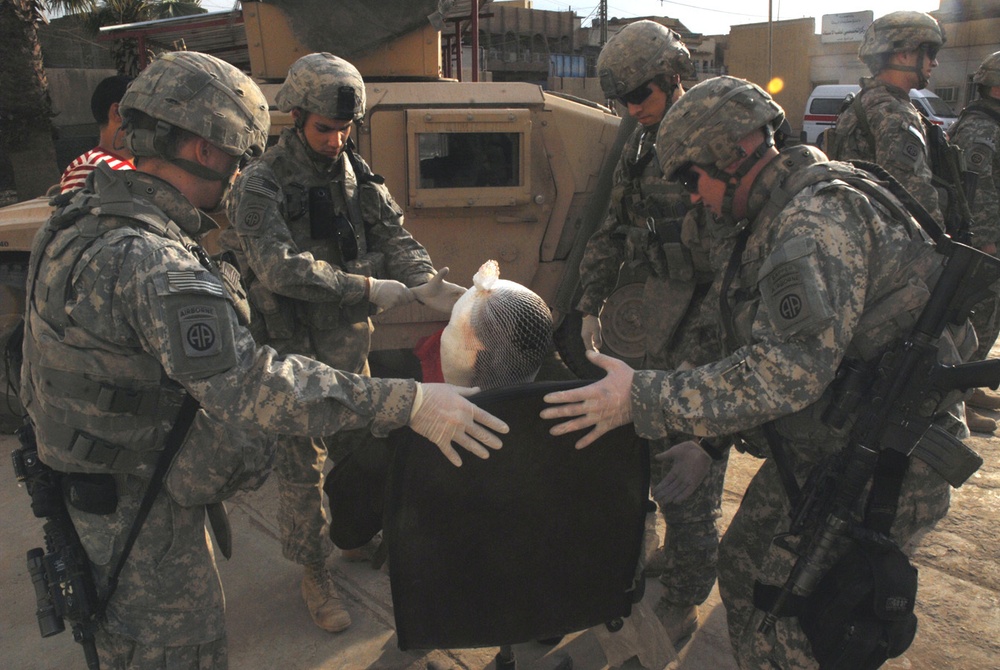
But they play a key role in the struggle to bring Iraq back to its former glory. Often unnoticed, they fight and suffer wounds and need treatment. On Oct. 19, Soldiers with Company A, 1st Battalion, 504th Parachute Infantry Regiment, ensured eight security volunteers received medical treatment in the International Zone following a firefight with insurgents in early October.
Capt. Mike Semmens, Company A commander, said Iraqi security volunteers are roughly analogous to neighborhood watch volunteers in the United States. Semmens, from Colorado Springs, Colo., was on hand when Company A Soldiers transferred the last of the eight wounded volunteers from the 28th Combat Support Hospital in the International Zone to the Fadel health clinic in eastern Baghdad on Oct. 19. The victim suffered third-degree burns over 35 percent of his body.
"We're taking him to the Fadel clinic for follow-up treatment," Semmens said. "He is the last of the eight to be returned to local national care."
According to Semmens, one of the brigade's Iraqi allies had asked for assistance in getting the wounded volunteers treated, and the 2nd Brigade Combat Team was happy to oblige.
"This definitely strengthens the bond between Iraqi security volunteers and coalition forces, and it strengthens reconciliation," Semmens said.
And by getting the volunteers to medical care at a coalition force hospital, it stresses to the volunteers that they make vital contributions.
Capt. Diana Jenkins provided part of the patient's care at the 28th CSH. Jenkins, of Spokane, Wash., serves as a critical care staff nurse at the hospital. Jenkins said the patient normally had his burn dressings changed twice a day and that he was making progress. "Burns take so long to heal from, but so far he's doing good," she said. "Our patients don't usually stay very long. We're a trauma hospital and don't usually do long-term care."
Jenkins said the patient still needed treatment, but that he was ready to be transferred to Fadel health clinic. At the clinic, Semmens and 2nd Lt. Stephen Abbott of Las Vegas, Nev., a platoon leader with Company A, spoke with the director about the patient in particular and the Fadel situation in general.
Abbott said al-Qaida in Iraq had temporarily caused disruptions in Fadel, but that coalition and Iraqi forces were pushing back. "We worked together and pushed out al-Qaida in Iraq," he said. "The Iraqi people are taking care of problems in the area. They were relying on coalition forces and the Iraqi army to provide security. Now they are providing security for their homes and families."
"It's part of the reconciliation process," Semmens added. Also, he said, residents are now feeling more secure and know coalition forces are there to work for their safety.
"We're happy to help out," Abbott said. "We've built a good relationship with them."
| Date Taken: |
10.22.2007 |
| Date Posted: |
10.22.2007 11:18 |
| Story ID: |
13176 |
| Location: |
BAGHDAD, IQ |
| Web Views: |
409 |
| Downloads: |
374 |
PUBLIC DOMAIN

This work, Paratroopers aid volunteers wounded fighting insurgents in eastern Baghdad, must comply with the restrictions shown on https://www.dvidshub.net/about/copyright.

 Subscribe





