By Spc. Courtney E. Marulli
2nd Brigade Combat Team, 2nd Infantry Division Public Affairs
FORWARD OPERATING BASE LOYALTY, Iraq — Soldiers face a myriad of threats and extreme circumstances in everyday operations in Iraq, but one thing they don't usually expect is the threat of a fire in their work or living space. On the forward operating base (FOB) in eastern Baghdad, however, one group of Soldiers has began learning to fight against the heat, destructive power and danger of fires on the FOB, which can be caused by both enemy action and unexpected forces.
More than 20 Soldiers have volunteered to undergo a 10-week firefighting certification course to serve FOB Loyalty as the fire rescue team. These Soldiers want to ensure they know exactly how to handle any emergency situation that may occur.
The basic firefighter and hazardous material level one course is taught to Soldiers from every unit on the FOB serving in the 2nd Infantry Brigade Combat Team, 2nd Infantry Division.
Capt. Justin P. Hurt, the Chemical and Force Modernization Officer for 2nd BCT, is coordinating the course. Before joining the military, he was a professional firefighter for four and a half years in Wisconsin and also served as a paramedic and a police officer. He taught Firefighter Level I and II courses and Hazardous Material Operations at a technical college in Wisconsin to more than 300 fire candidates.
"It's about helping people out," Hurt said. "There is nothing quite like the expression on somebody's face when you get in, put out the fire and save someone's child or loved one."
Hurt, a native of Menomonee Falls, Wis., said the response for the course was overwhelming. He initially sought out 16 volunteers, but ended up with 23.
"It is somewhat of a rush, it's exhilarating," Hurt said. "You are going up against one of the most destructive forces in nature. I think that draws a lot of people."
The idea to create a fire department and certify a group of Soldiers stems from several fires that have occurred on the FOB.
"We really started looking at having some kind of fire protection, or group, after the large U.S. Army Corps of Engineers electrical yard fire back in December," he said. "Since then we've had four other fires on the FOB that Soldiers have had to put out without any formal training."
Hurt received his training at the technical college where he taught. That is the same training the Soldiers are receiving now. The training comes from the doctrine of the International Fire Service Training Association, which is affiliated with Oklahoma State University and helps develop the standards for firefighting training in the United States, Hurt said.
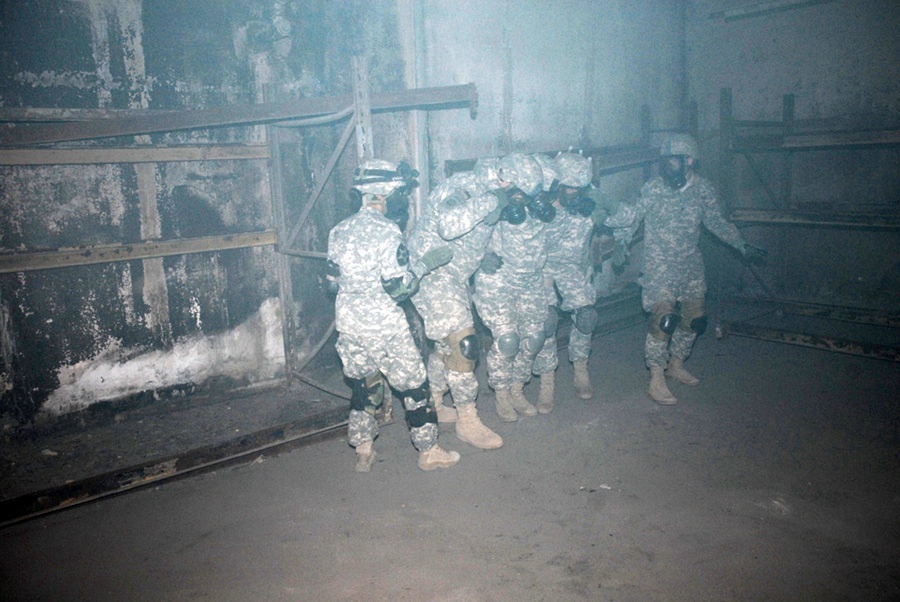
Soldiers in the course will learn how to conduct search and rescue missions, use proper ventilation for a smoke-filled building, and put out fires with hoses and extinguishers. They will also cover pump operations, ladders, hydrants, sprinkler systems, hazardous materials and decontamination, dealing with fire related injuries, overhaul and salvage, and arson and fire investigation. Some of these techniques may not apply in the Iraqi theater of operation, but they are integral to the knowledge of the average trained firefighter in America. All of this is undertaken in addition to their regular military work duties.
This experience, Hurt said, will prepare these Soldiers for volunteer firefighter positions when they return to the States and it is the minimum requirement to join a fire department. Additional training is required to become a professional firefighter.
"I think they have really enjoyed what they have learned so far," Hurt said. "We've done the classroom work and moved onto practical applications. Everyone has been doing a great job."
Hurt said the students listen to lectures and also carry out exercises, but also must pass tests and receive a passing performance evaluation to graduate.
Hurt's assistant instructors include Chief Petty Officer Jonathan D. Dupree, U.S. Army Corps of Engineers and a former Navy firefighter; Capt. David DeBlasio, a surgeon from 1st Battalion, 504th Parachute Infantry Regiment; and Chief Warrant Officer 3 John L. Blanton, 2nd BCT's aviation tactical operations officer, who will cover the aspects of extinguishing aviation fires.
Hurt said he is in the process of trying to acquire firefighting equipment such as the self contained breathing apparatus (SCBA), a fire truck, and other equipment. Hurt is working with Wackenhut Services, the group that runs the professional fire department on Victory Base Complex, to help with training.
"I am really looking forward to implementing this and hopefully we can get the firefighting equipment we need to protect the Soldiers and civilians on the FOB," he said. "It's going really well."
Capt. William C. Holley Jr., a Fire Inspection Officer with Wackenhut Services, has come to FOB Loyalty to help get the fire department running, and thinks the firefighting program is awesome as it enables Soldiers to be the first line of defense until a professional fire department is established.
Holley, of Fort Worth, Texas, has been a firefighter for 21 years and is a retired Air Force firefighter. For Holley, the thrill of firefighting is helping people.
"I love every aspect of it, but I really love the fact that when people are in trouble and need help, they call us to come and help out," he said. Holley is planning on educating military and civilian personnel alike in how to prevent fires and be prepared through educational programs.
"My goal is, through fire prevention programs, to increase the public education on fire safety and eliminate the fire risk in the buildings," he said. The prevention programs will be offered to all base agencies, including military, Army and Air Force Exchange, Kellogg, Brown & Root employees and local nationals.
Holley said the Soldier firefighters are getting great training but once a fire department of professional firefighters is fielded they won't have to be the primary individuals to combat fires. However, their training will enable them to be prepared for and assist in fighting fires, and is something they can take with them elsewhere.
"I think it's a great curriculum," he said. "I think Captain Hurt has done a great job getting this program up and running and getting support from the military to be able to do this."
Lt. Col. Dean C. Dunham, the deputy commanding officer for 2nd BCT, said firefighting training is a skill that will help in the future.
"It is a critical resource that we didn't expect to need," he said. Dunham, a Cottonwood, Ariz. native, said the firefighting course adds to the capabilities the unit already has on hand.
"Just like anything else, we have to continue training and add new skills to our quiver," he said. "And that is just what this is - adding new skills and new training."
Staff Sgt. Timothy C. Ullman, the nuclear, biological and chemical non-commissioned officer and a native of Kearney, Neb., is currently serving on his third deployment. He volunteered for the course because it was something different than he had done and it was a useful skill to have.
"My ultimate goal is to serve," he said. "I never saw myself doing anything but serving." Ullman is considering becoming a firefighter if he leaves the Army, and his brother is a volunteer firefighter in Kearney and his father used to volunteer at the factory he worked at in Kearney.
Ullman is also skilled in using the SCBA and will be helping Hurt instruct the class on the proper usage of breathing equipment. The training the class offers, Ullman said is good and as realistic as can be without setting fire to a building.
Capt. Daniel B. Dunn, the executive officer for Headquarters and Headquarters Company, 2nd IBCT, and a native of Aurora, Colo., is on his second deployment to Iraq and has been on the scene for several of the fires that have happened on the FOB.
One fire, he said, was at the interpreters' living quarters, and when he went in he found an interpreter lying on the floor unconscious. Dunn said the man had soot around his nose and mouth, which meant he had inhaled it.
He also knows first hand what it's like to be the victim of a fire since he lost everything when his room was engulfed by a fire several months ago.
"It's very important to get this program together so others wouldn't be affected," he said of the creation of the fire department. One appeal is the aspect of helping and protecting others, which Dunn said is something he takes to heart.
"It says a lot about people when they run into a building when everyone else is running out," he said.
Dunn said he enjoys the practical exercises and said if he had this training prior to helping the interpreter, he could have performed even better.
Pfc. Justine-Tea Phelan, a medic with Headquarters and Headquarters Company, 2nd Brigade Special Troops Battalion and a native of Plymouth, Mass., is on her first deployment, and said she volunteered for the course because it's an excellent training experience. She wanted to learn about firefighting and to help out on the FOB if any more fires occur.
"The class isn't easy," she said. "It's something you really have to pay attention to and study for the tests."
During a recent search and rescue exercise, she and fellow medic, Pvt. Heaven L. Gallop, brought the victim out, played by Dunn, and went into their medical role and evaluated the casualty.
Gallop, a medic who regularly works with Phelan, is a native of Winston-Salem, N.C., and is also on her first deployment. The hands-on-training is the best part of the course, Gallop said, as it enables the students to apply what they learned in the classroom setting. She said she also enjoys working with people who have prior firefighting experience.
"I was the first volunteer," she said. Hurt spoke with Gallop at the aid station after a fire. "He mentioned (the program) and I wanted to join."
Gallop said she isn't sure if firefighting is something she will pursue when she returns to the states.
"It's another notch on my belt, like First Aid," she said. "You can go anywhere and do anything with it."
Coming from a family of firefighters and paramedics, Gallop said she enjoys helping people regardless of doing First Aid or controlling a fire.
"You want to be there and not just waiting for casualties to come in," she said. "It brings you closer. It's the actual thrill of doing it."
Working alongside fellow Soldiers is what helps the students develop trust and camaraderie.
"Who better to trust than someone you work with everyday on doing this and giving treatment," she said. "You feel better because you know them."
Hurt continues to work with his students weekly. He looks forward to incorporating better equipment and hopes to eventually include professional firefighters in the department in the future.
"Ultimately, it's about Soldiers helping and protecting other Soldiers," Hurt stated. "I'm very proud how hard these guys are working to take care of their comrades. It takes a unique sort of person to do what they're doing."
| Date Taken: |
10.11.2007 |
| Date Posted: |
10.11.2007 08:34 |
| Story ID: |
12818 |
| Location: |
BAGHDAD, IQ |
| Web Views: |
558 |
| Downloads: |
454 |
PUBLIC DOMAIN

This work, Soldiers receive firefighting training at eastern Baghdad base, by SPC Courtney Marulli, identified by DVIDS, must comply with the restrictions shown on https://www.dvidshub.net/about/copyright.

 Subscribe






