By Spc. Wesley Landrum
50th Public Affairs Detachment
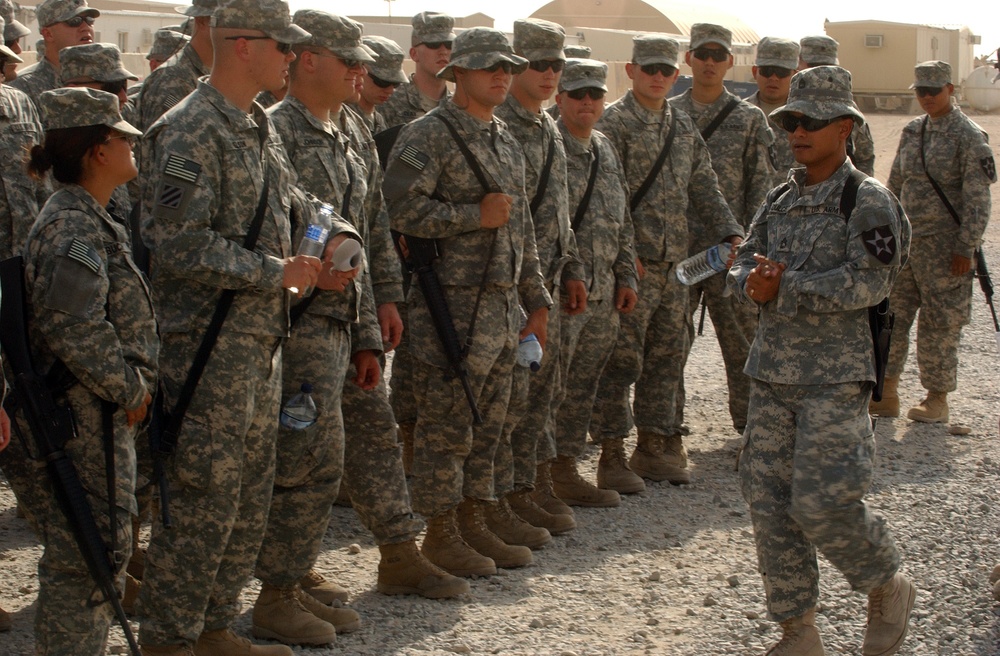
CAMP ARIFJAN, Kuwait -- Sergeant 1st Class Ramil Las Dulce, a liaison non-commissioned officer with 4th (Stryker) Brigade Combat Team, 2nd Infantry Division, stepped up to the formation and addressed the group of Soldiers standing before him.
"This week, it is my job to make sure you get the necessary training that will allow you to travel north," he told the formation. "If you do what you're supposed to, you will fly at the end of the week."
The job of an LNO is to train the Soldiers to standard, receive mandatory training, and resolve all combat equipment issues so they are focused and ready to accomplish the mission in Iraq. LNOs help conduct the Third Army/U.S. Army Central's logistical support mission by ensuring service members get up to Iraq and back. Las Dulce and his LNO team traveled to Camp Buehring, Kuwait, Aug. 12, to meet up with the latest 4-2 SBCT Soldiers going to Iraq. Without the LNO, the Soldiers are lost, Las Dulce said.
"We coordinate everything the Soldiers will do that week," he said. "We make sure their classes are set. We make sure the ranges are ready for them to go on. We do a lot of behind-the-scenes planning to help the Soldiers in their journey to Iraq."
Las Dulce said if the LNOs weren't on the ground with the Soldiers every step of the way, they would not know what to do or where to go. He said they would be unsure as to what steps they should take to get up north.
"They would take unnecessary classes and take part in ranges that aren't part of the guidelines the brigade has up for them," Las Dulce said. "If that were to happen, it would set them back weeks getting to their units."
Staff Sgt. Daniel Jolley, LNO for the 25th Infantry Division, said his job is difficult yet rewarding. He said the Soldiers become his top priority until they board the plane and go north.
"You have to devote a lot of time making sure (the Soldiers) are well cared for," Jolley said. "They depend on you to get them through that week of training so they can continue the mission."
Las Dulce said his typical week starts when he picks up the Soldiers at Camp Buehring.
He greets them and then takes them to the Personnel Support Battalion. There, they watch the welcome video and get the first in a series of briefings on the policies here in Kuwait. After the briefings, it's chow and then some much needed down time.
"After the initial briefings, I usually give them 24 hours to recuperate," Las Dulce said. "They've had a long flight and probably haven't slept. This time gives them a chance to acclimate to the climate."
While the group is resting, Las Dulce attends a training meeting to set up his Soldier's training needs. At the meeting, he coordinates the classes that are needed and the various ranges his group will fire on. Las Dulce said it's important to have someone present to confirm the training is set.
"Sometimes, the instructors cancel classes or ranges," he said. "If you don't go to the training meeting you're setting up your Soldiers for failure."
The next two days vary from either the classroom portion of the training or the weapon familiarization. Either way, that training gets done, Las Dulce said.
At that point, the Soldier's mandatory training is done, Las Dulce said. Next comes movement to the Area Support Group – Kuwait Life Support Area. The Soldiers board buses and are transported to the LSA to go through the Rapid Fielding Initiative.
At RFI, the Soldiers are issued their combat gear if they don't already have it. While the Soldiers go through RFI, Las Dulce said he coordinates flight times and informs the group leaders what time they need to have their Soldiers ready for transport.
"After RFI and flight coordination, my job is done," Las Dulce said. "I turn the Soldiers over to the officer in charge and the non-commissioned officer in charge at that point and let them run the show."
However, their job is not over. Redeployment is next.
"Depending on the circumstances, we could have a brigade on their way back to the U.S. in a matter of weeks," Jolley said. "Once one brigade is done, another one comes down from the north and we start the process all over again."
Jolley said he averages between 200 and 300 Soldiers coming through for refresher training before pushing onward into the 25th ID's area of operations. Las Dulce said he averages around 100 personnel coming through every month. Jolley said he could be pushing through Soldiers up to 30 days from redeploying back to the United States.
Las Dulce said the best part about of his job when he sees the Soldiers board the plane bound for Iraq confident that they are ready to do the job.
"I wish I could be there with them," Las Dulce said. "They're doing a job that is the greatest job in the world. I'm just doing my best to make sure they are taken care of prior to leaving for combat."
| Date Taken: |
08.26.2007 |
| Date Posted: |
08.26.2007 09:06 |
| Story ID: |
11978 |
| Location: |
CAMP ARIFJAN, KW |
| Web Views: |
306 |
| Downloads: |
139 |
PUBLIC DOMAIN

This work, To ensure Soldiers get to their destinations—LNOs step up, by SGT Wesley Landrum, identified by DVIDS, must comply with the restrictions shown on https://www.dvidshub.net/about/copyright.

 Subscribe






