By Spc. Nathan W. Hutchison
22nd Mobile Public Affairs Detachment
BAGRAM AIRFIELD, Afghanistan — In a country where there has been constant war for decades, it is easy for environmental issues to fall to the wayside.
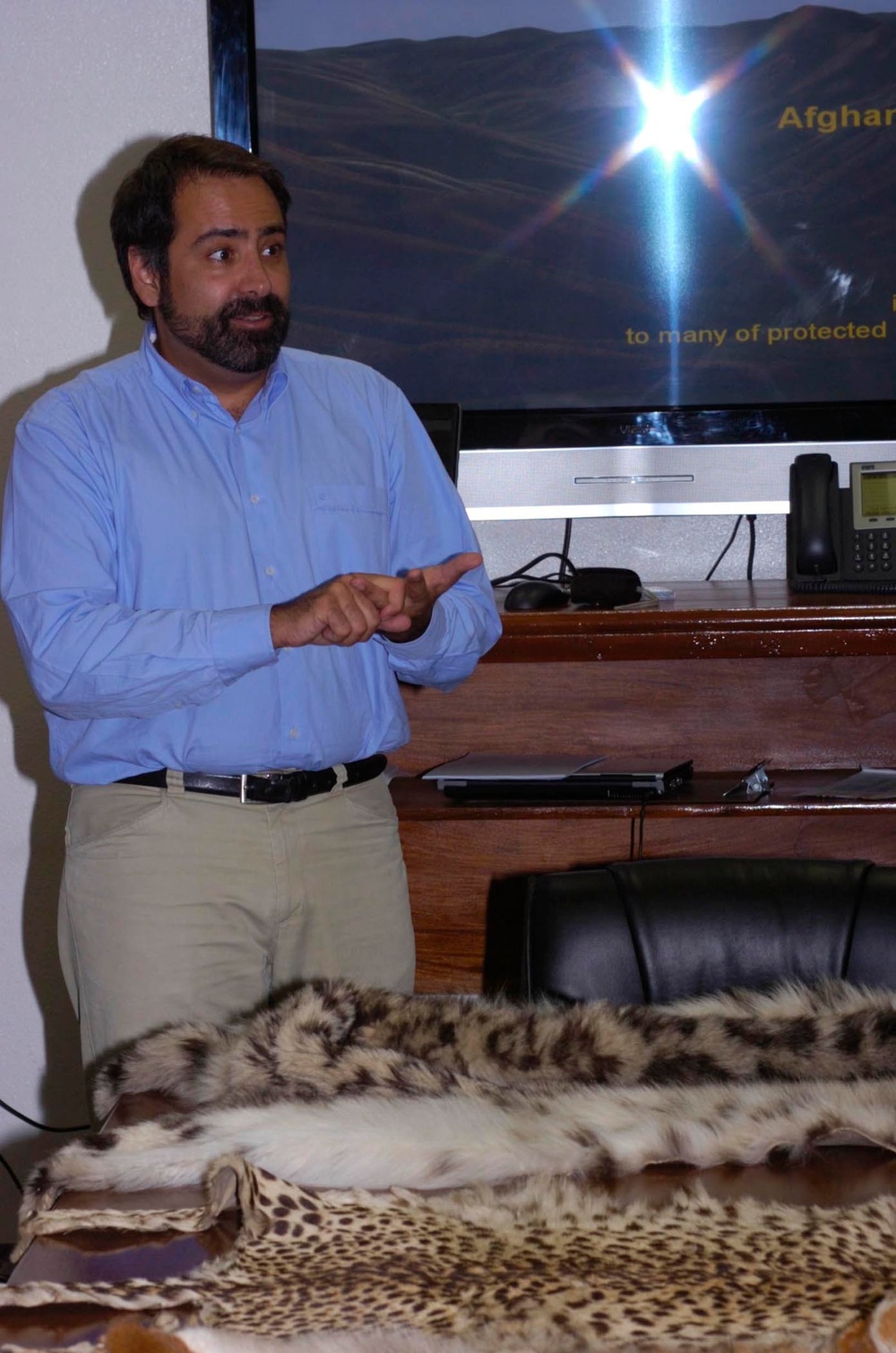
An environmental class was held here to raise awareness about illegal fur trading in Afghanistan Aug. 13. U.S. Embassy and Environmental Protection Agency representatives hosted the class.
Environmental and wildlife agencies are hoping to prevent further damage to the habitats and numbers of endangered species in Afghanistan.
"It all feeds into rebuilding the country and trying to establish some sort of rule of law within their government," said Army Sgt. 1st Class Thomas A. Lockhart, Combined Joint Task Force-82 Provost Marshal Office customs non-commissioned officer-in-charge.
After six years in Afghanistan, people are now looking at environmental issues while still implementing and executing tactical operations and reconstruction projects, he said.
In order to halt the production of illegal furs, steps have to be taken to decrease the market for them.
"I think people just don't know," said Dr. Alex Dehgan, country director for the Wildlife Conservation Society in Afghanistan. "They don't realize that buying one of these skins increases demand for the wildlife, and that means someone else is going to go out and hunt more of these animals."
"If we can get rid of the demand, we can actually reduce the dwindling numbers of these animals significantly," he said.
Some of the endangered animals native to Afghanistan include brown bears, leopards, snow leopards, Marco Polo sheep and wolfs.
These animals are protected under Afghanistan's constitution, in agreement with the 173 county member convention on International Trade in Endangered Species, and under several U.S. laws and military and postal codes.
"I think people don't realize the consequences," said Clay Miller, representative for the U.S. Environmental Protection Agency assigned to the U.S. Embassy in Kabul. "There's a $100,000 fine if you are knowingly bringing in or shipping endangered species to the U.S."
"Many people just don't know the U.S. laws and the trouble they can get in," he said. "They have never been exposed to furs before and just figure 'hey I'm in Afghanistan and (furs) are kind of cheap here.'"
Beyond the legal ramifications, Soldiers who know they can't get the items back to the U.S. will be more cautious with their purchases.
"Ultimately, what we're trying to do is get the Soldiers to realize they're wasting their money on this," Lockhart said. "Since they're focused on the Soldiers to purchase these furs, they will see the Soldiers aren't going to buy them anymore and try another avenue."
Along with decreasing the market for the illegal furs, the EPA has been working on informing the Afghan people about endangered animals.
"We have an education campaign working with the Ministry of Education where we've been writing articles for Afghan newspapers," Deghan said. "We have posters that we have been putting up throughout the country in English, Dari and Pashto."
"We've had a lot of support from the Afghan people," he added. "They actually want us to help protect their wildlife, and a lot of time they realize the plight that it's in."
| Date Taken: |
08.15.2007 |
| Date Posted: |
08.15.2007 14:01 |
| Story ID: |
11826 |
| Location: |
BAGRAM AIR FIELD, AF |
| Web Views: |
562 |
| Downloads: |
520 |
PUBLIC DOMAIN

This work, Environmental education for Afghans essential, by MSG Nathan Hutchison, identified by DVIDS, must comply with the restrictions shown on https://www.dvidshub.net/about/copyright.

 Subscribe






