By Spc. Courtney Marulli
2nd Brigade Combat Team, 2nd Infantry Division Public Affairs
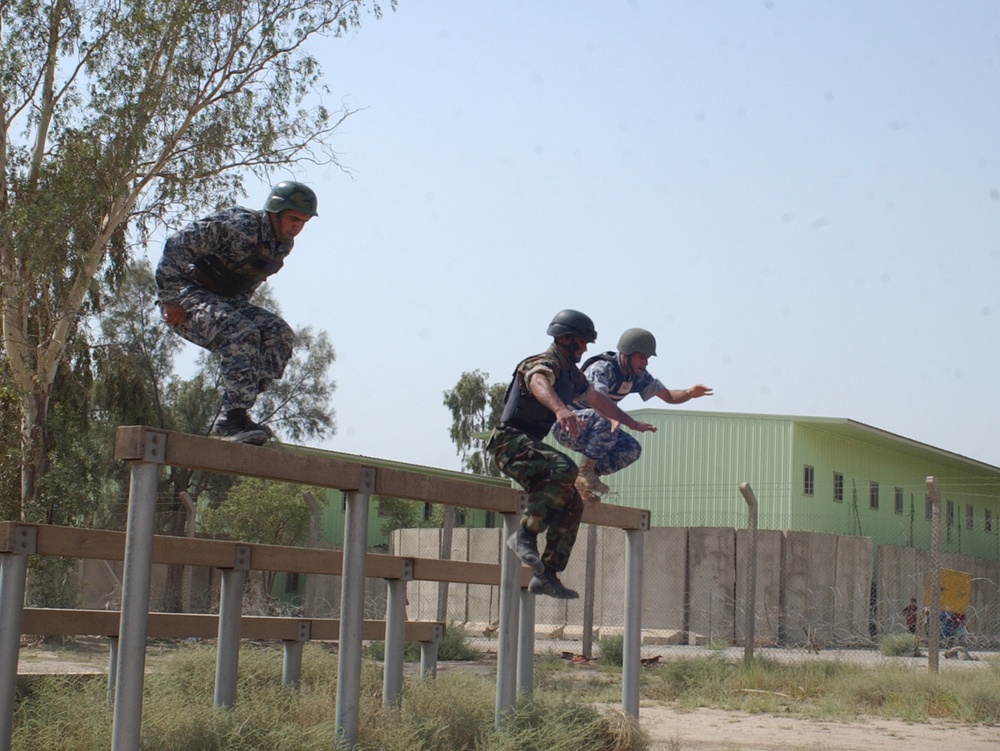
FORWARD OPERATING BASE RUSTAMIYAH, Iraq — Twenty members of the 1st Battalion, 4th Brigade, 1st Iraqi National Police Military Transition Team were sent to the Iraqi military academy at Forward Operating Base Rustamiyah where they trained alongside members of the Iraqi army military police detachment in July to become better leaders and better policemen.
The national police had a shortage of non-commissioned officers (NCOs) in their battalion. The twenty that were chosen had prior experience and had been police officers for about two years, but upon completing the leadership course they returned to their battalion better leaders and better policemen.
Maj. Robel Ramirez, 1-4-1 Battalion NPTT team chief, said the concept of sending the national police officers to the Iraqi army facility came about from the battalion's colonel.
"It's Iraqis teaching Iraqis to work for a more secure Iraq," he said. "It's a beautiful thing."
Ramirez, a native of Naranjito, Puerto Rico, said the idea came about from the commander of the 1-4-1 Iraqi National Police. The transition team was trying to organize a range for the police to practice basic tactics, when the leadership course was mentioned. The Iraqi leaders wanted their police officers to become better NCOs so they can in turn lead the lower enlisted police.
The training lasted for a month and enabled the different factions of the Iraqi security forces to learn to work together. The course took them through force protection and security procedures, firing ranges, obstacle courses and physical training such as running and road marching.
Ramirez said the leadership course is similar to what U.S. Soldiers undergo when they go to the Warrior Leaders Course (formerly known as Primary Leadership Development Course).
There has been a night and day improvement in the confidence level and leadership skills of the policemen who went through the course, Ramirez said.
All of the classes were taught by Iraqi army instructors, so there isn't a language barrier or a middle man, such as an interpreter, to slow things down or make it more difficult. They learned by their own people in their own language.
The only part the five American NCOs played was to help facilitate the ranges and physical training where arm movements and other ways of communicating can help, Ramirez said. They also took part in the behind the scenes logistics of providing water and other resources and enabled the Iraqi instructors to break down the students into smaller groups.
The Iraqi army students and national police students learned to work together and learned how to rely on one another, Ramirez said.
Ramirez and Capt. Woodrow D. Pengelly, operations officer for the 1-4-1 NPTT, said the course isn't perfect, but it never had a rocky point because the environment was one of professionalism.
Pengelly, a native of Portland, Ore., said the Iraqi military academy is similar to one in the U.S.
"They were in awe of the professionalism," Pengelly said. "Some were out of shape and they didn't have discipline and order in the forefront of their mind."
Working with the Iraqi army also enabled them to learn to treat each other as peers and not as competitors. They learned to rely on each other and work together to get through obstacle courses and to finish runs.
Pengelly said the national police officers responded better to the training because it was coming from a fellow Iraqi. It was also in part to the fact that they hadn't had the chance to learn in a training environment, which is free from distracting elements such as regular missions and other obligations that must be met out in the field.
"Out there it's like trying to read a book at a concert," he said. "Here it's like reading a book at a library or coffee house."
The national police officers' chain of command said they have seen a level of improvement in the morale of their policemen who went through the course. Pengelly said on graduation day they were very excited and happy with what they had accomplished.
The 20 police officers chosen were selected for their previous knowledge, but Pengelly said for the August course, there is going to be a selection board process in order to choose people who are prime to go and not people who are too old to be going through that type of course.
"We're hoping this course becomes like a Ranger or Sapper (U.S. Army training schools) tab so these guys can wear it with pride," he said.
National police officers are going to have to compete in order to attend the course. However, Pengelly said there needs to be flexibility to the course in order for it to work, such as ensuring that the focus isn't solely on the long-term, but also on the immediate and necessary.
The training was also valuable to the American Soldiers involved, Pengelly said, because it allowed them to learn what kind of instruction tactics work well with Iraqi Soldiers.
Some of the NCOs who worked with the Iraqi's were previous drill sergeants and Pengelly said that style doesn't work very well with new Iraqi recruits.
He said doing physical training with them was also beneficial. The training was not as physically demanding from the American standpoint, but many of the policemen were older and hadn't done regular physical training. However, they pushed themselves and built up to standards gradually. Pengelly noted, "There was a noticeable progression of their physical fitness."

 Subscribe






