CAMP ROBERTS, Calif. – Every soldier who attends Task Force Warrior’s Combat Lifesaver course is taught care under fire, the skills needed to provide lifesaving care to a person injured in a dangerous accident or combat event threatening not only the victim, but the rescuers as well.
Though TFW has taught care under fire to thousands of soldiers preparing for combat deployments during the Global War on Terrorism, two members of the California Army National Guard’s 349th Quartermaster Company, based out of Vallejo, put these skills to the test at a disastrous auto accident only days after completing their Combat Lifesaver class.
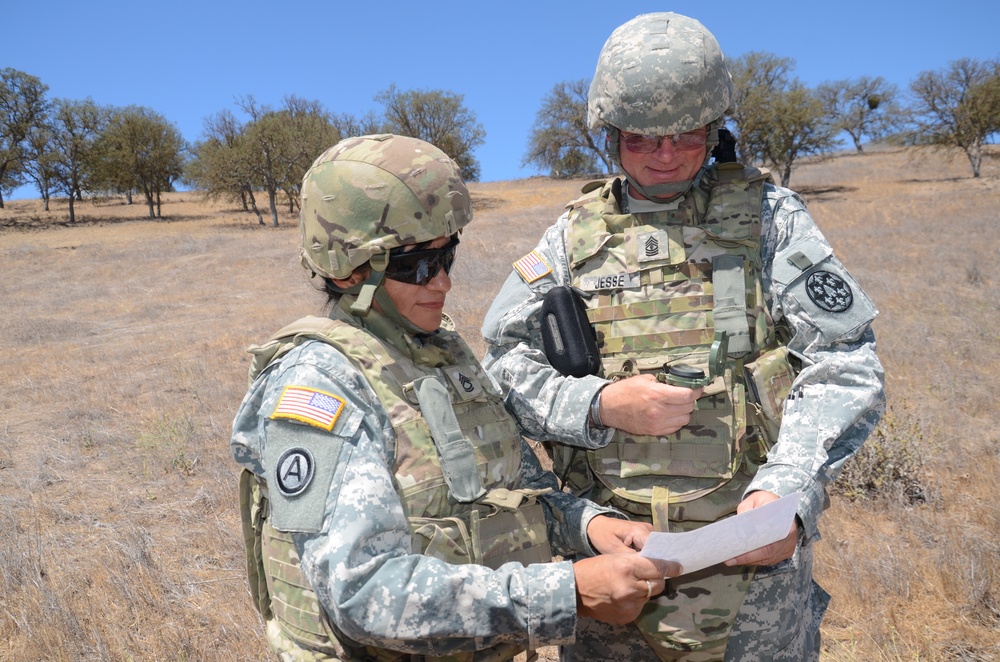
As 1st Sgt. Terran Jesse Jr. and Sgt. 1st Class Marsie Franco from the 349th were driving on Highway 101 toward the main gate of Camp Roberts, Calif., June 27, they witnessed a civilian vehicle flip over the fence on the side of the freeway and burst into flames.
“We were turning left towards the gate, and I saw this car flipping over and over again, metal flying everywhere,” Franco said.
“The car had just catapulted right over the wire,” Jesse added.
Jesse pulled over and the two soldiers carefully approached the burning wreck, which had set ablaze the surrounding grass and shrubbery, parched bone-dry by the searing summer sun. The car had flipped completely over a barbed wire barrier, requiring Franco and Jesse to climb under it.
“I don’t even know how we got through [the fence], but we managed it,” Franco said.
“My camelback kept getting stuck on the wire, so I had to take it off to get through,” Jesse said.
While Franco stepped back and called 911, Jesse helped the two occupants, a man and a woman, get out of the car. The man was not seriously hurt, but the woman had suffered an injury to her leg and was bleeding profusely. Though the situation was alarming, the soldiers kept their heads and knew their first priority was to move the two civilians and themselves away from the spreading fire. The man helped Jesse pick up the woman and move her a safe distance from the blaze.
“We did a two-person carry, just like what we were taught in the [Combat Lifesaver] class,” Jesse said. “The guy didn’t know how to do it, so I showed him.”
“All our CLS training kicked in,” Franco said.
After moving away from the accident site, the lifesavers started assessing their patient to determine the extent of her injuries. Jesse treated her leg wound by using his uniform jacket as a makeshift compress bandage. The woman started expressing pain from the afternoon sun beating down on her exposed legs, so Franco covered her uninjured leg with her own uniform jacket. The soldiers also removed their t-shirts and soaked them with water, to help moderate the woman’s temperature.
“The man was in shock, so I told him to sit down and give her [the woman] some shade,” Jesse said.
At one point during their treatment, the woman went pale and her chest stopped moving. Jesse applied two chest compressions, causing her to regain consciousness and start breathing again.
“I pumped her chest and said her name and she came back,” Jesse said.
Franco and Jesse continued talking to the woman and reassessing her condition while waiting for medical help to arrive.
“We took turns talking on the phone, or talking to her,” Franco said. “I would talk on the phone away from her, so she wouldn’t get upset.”
There was no time for the soldiers to stop and think, only to take action relying on their in-depth training and muscle memory.
“There’s still pieces I don’t remember,” Franco said. “But the training comes back to you. Everything started clicking.”
“It was a team effort,” Jesse said. “Franco did really well.”
Civilian paramedics arrived quickly and took the civilians and the soldiers to Twin Cities Community Hospital in Templeton, Calif. After being examined for fume inhalation, the soldiers were released, and they paid the two civilians a visit.
“We got to see them afterwards at the hospital,” Franco said. “We got to talk to them and their families and see how they were doing. It was awesome.”
Franco and Jesse do not see themselves as heroes, just as soldiers who acted when no one else would.
“Everybody was on their cell phones — one guy was even taking a picture, but no one was helping,” Jesse said. “We did what any other soldier would do, just helping out.”
The instructors at TFW congratulated their students on a job well done.
“[Franco and Jesse] did exactly what we train people to do,” said Sgt. John Gonsalves, noncommissioned officer in charge of Team Medical at TFW. “This is care under fire; they did exactly what they were supposed to do.”
Jesse not only attributes his training at TFW with the life saved that day, but he firmly believes every soldier, deploying or not, should receive the benefit of the training.
“The war might be ending, but this is training every unit should go through,” Jesse said. “You learn a lot. This is great training, and you never know when you might need it.”
| Date Taken: |
07.01.2013 |
| Date Posted: |
07.02.2013 18:41 |
| Story ID: |
109652 |
| Location: |
FAIRFIELD, CALIFORNIA, US |
| Web Views: |
374 |
| Downloads: |
1 |
PUBLIC DOMAIN

This work, Lifesavers, by SSG Ian Kummer, identified by DVIDS, must comply with the restrictions shown on https://www.dvidshub.net/about/copyright.

 Subscribe





