
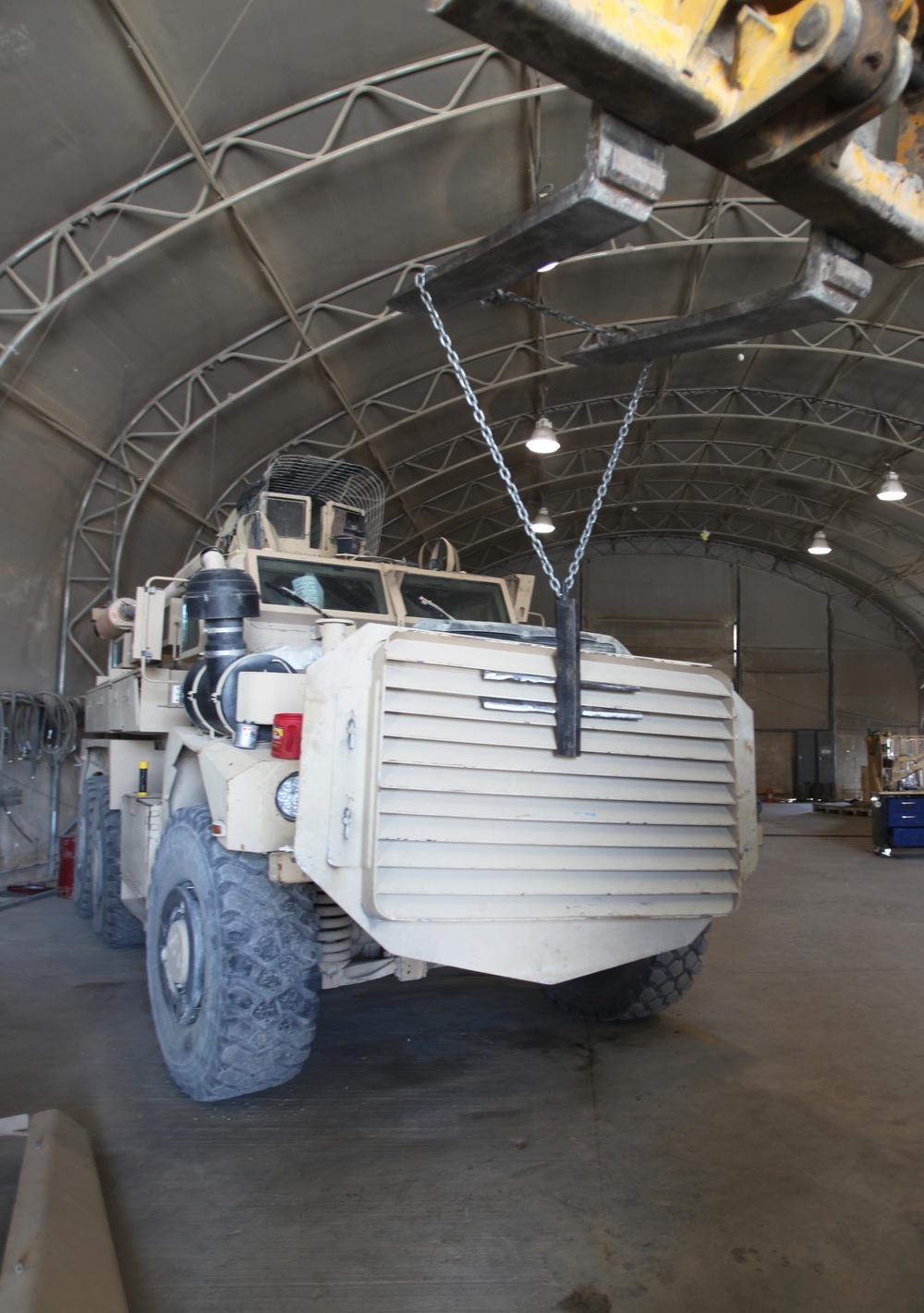
Photo By Master Sgt. Lia Aragon | The Mine-Resistant Ambush-Protected vehicle grill-lifting bracket is used to remove...... read more read more
 Subscribe
CAMP LEATHERNECK, Afghanistan - It’s as simple as it gets, just a few pieces of metal welded together. The modest innovation, however, has helped not only ease mechanics’ job of removing an armored vehicle grill but has also made the task safer.
Cpl. Jhancarlos F. Justiniano, a metalworker with Maintenance Platoon, General Support Combat Logistics Company, Combat Logistics Regiment 2, created a grill-lifting bracket to assist mechanics working on Mine-Resistant Ambush-Protected Vehicles at Forward Operating Base Shir Ghazay.
“The grill weighs about 400 pounds, and three Marines were (removing) it by hand,” explained Justiniano, who is on his second deployment to Afghanistan.
Justiniano designed the bracket using only three pieces of 1/2-inch steel, which had to be a specific length so the grill would not become unbalanced when moved. Each steel plate is angled at a certain degree so the lifting bracket will catch on the vents of the grill. The center beam has a cutout where a hook can be attached, allowing the lifting bracket to be used in conjunction with a crane or a forklift.
“It took me two tries to get it right,” said Justiniano, a Goose Creek, S.C., native. “The first time I spaced it too far apart to fit, but it worked great the second time.”
A job that once took three Marines lifting more than their combined weights now requires only two Marines, one to operate the machinery and another as a guide. Justiniano said removing an MRAP grill is now considerably safer than before.
“The [bracket] is as basic as it possibly gets, [needing only] three pieces of metal and a welder [to make], and it significantly increases the ability to pull off a grill,” said 1st Sgt. Michael E. Lambert, GS CLC company first sergeant.
Lambert, who is a motor transport mechanic by trade, said the need for up-armored vehicles has forced Marines to be creative and innovative.
“There was nothing on an old vehicle that we needed assistance pulling off,” said the Whitehall, N.Y., native. “We didn’t have the MRAP or the 7-ton. All of our equipment was rather light, and now these vehicles are seven to ten times the weight of the equipment we used to work on.”
Justiniano recently joined Cpl. Jason Cooper and Cpl. Robert C. Richardson III to brief their projects to Assistant Commandant of the Marine Corps Gen. John M. Paxton, Jr., May 4.
Cooper, whose story is highlighted in Part 4 of the series, is a data and circuit card repair chief. He briefed the amount of money the unit saved with the repair of Drivers Vision Enhancement monitors. Cooper is qualified as a micro-miniature repair technician and has helped repair 33 DVEs, saving the Marine Corps more than $100,000.
“Cpl. Cooper is electronically inclined beyond your typical Marine,” said Lambert. “He definitely has the ability to work outside our basic radio, computer and circuit board repair.”
Richardson is a machinist who briefed the sickle hooks he created for an explosive ordinance disposal unit. The sickle hooks, highlighted in Part 3 of the series, have assisted EOD Marines in the detection of command wires on improvised explosive devices throughout Afghanistan.
“[The brief] went phenomenal; the [assistant] commandant was thrown back. The Marines went in there and absolutely knocked it out of the park,” said Lambert.
Lambert explained, before now there was no need for equipment such as a grill-lifting bracket, sickle hooks or some of the other innovations Marines with his command have created. The DVE had “never even been thought of.”
“With technology and the sheer weight of armor, it is kind of a must for these younger Marines to come up with new ways of doing what we were already doing, just making it easier,” said Lambert.
Editor’s Note: This is the final article of a five-part series about projects initiated by Marines of General Support Combat Logistics Company, Combat Logistics Regiment 2, while deployed in Afghanistan.
| Date Taken: | 05.25.2013 |
| Date Posted: | 05.25.2013 07:07 |
| Story ID: | 107579 |
| Location: | CAMP LEATHERNECK, AF |
| Hometown: | GOOSE CREEK, SOUTH CAROLINA, US |
| Hometown: | WHITEHALL, NEW YORK, US |
| Web Views: | 365 |
| Downloads: | 2 |

This work, CLC gets creative, uses ingenuity in Afghanistan: Part 5, by MSgt Lia Aragon, identified by DVIDS, must comply with the restrictions shown on https://www.dvidshub.net/about/copyright.


No keywords found.




