
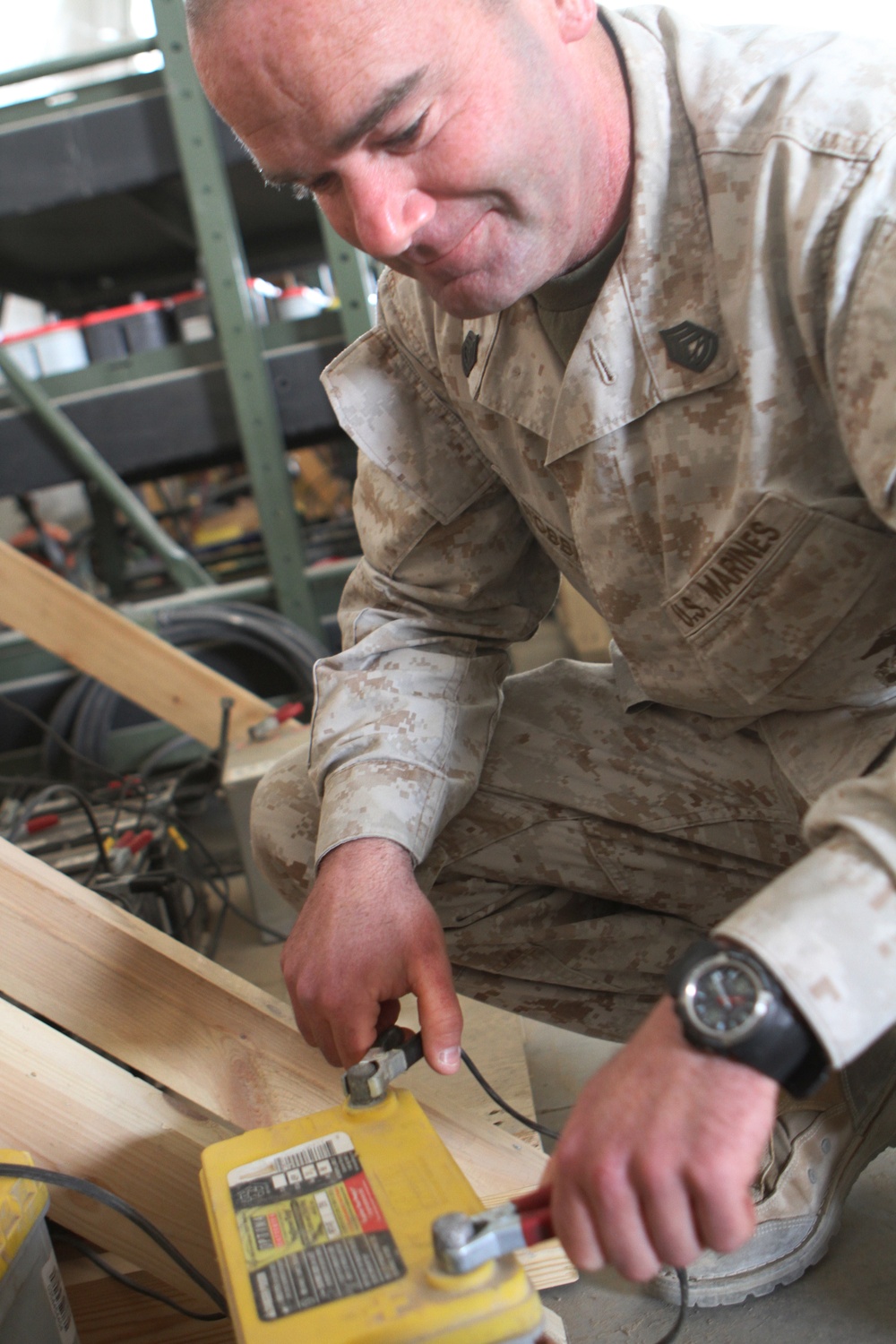
Photo By Master Sgt. Lia Aragon | Gunnery Sgt. Christopher D. Robbins, the staff noncommissioned officer-in-charge of...... read more read more
 Subscribe
Editor’s Note: This is the second of a five-part series about projects initiated by Marines of General Support Combat Logistics Company, Combat Logistics Regiment 2, while deployed in Afghanistan.
CAMP LEATHERNECK, Afghanistan – Aboard Camp Leatherneck, there was an entire lot of used and discarded 12-volt batteries waiting to be properly disposed.
Gunnery Sgt. Christopher D. Robbins, the staff noncommissioned officer-in-charge of the engineering section for General Support Combat Logistics Company, Combat Logistics Regiment 2, knew the batteries were expensive and thought there must be a way to repurpose them.
In an effort to save units money, he searched for and found two Auto Meter BusPro-660 AGM Optimized battery chargers and began recharging the discarded batteries.
Robbins enlisted the help of the Preservation, Packaging, and Packing section of the company to build wooden frames to house both charging stations, utilizing a similar design of a station built by the previous unit.
Each station is lightweight, can simultaneously charge up to six batteries and their base can be removed to make moving multiple batteries easier. It is constructed of 3/4-inch plywood, which makes it heavy-duty and durable.
“It was basically the same design, just new and improved,” said Robbins, a native of Knoxville, Tenn.
The chargers run off a standard power supply. The charge time for most batteries ranges from 12-36 hours depending on the charge each battery has remaining and how many batteries are plugged in to the machine simultaneously.
The two stations are currently posted inside the engineer’s maintenance bay and are primarily used for all the batteries from equipment being serviced during maintenance cycles.
When a vehicle comes into the Intermediate Maintenance Activity lot and will not start, the engineers use a jump box to slave start the vehicle and then put the battery on the chargers. In a typical week, 6-12 batteries are brought in to charge.
Robbins said the chargers have saved his unit money already. He said new batteries can range from $100 to $330 each, but they can be recharged up to four or five times. The unit has been very successful at recharging Hawker batteries in particular, and as a result the Supply Management Unit has not had to restock them.
“No one has been putting in requests for the batteries so we just don’t stock them,” said Kansas City, Mo., native, Cpl. Alexander P. Marshall, the supply admin clerk with Supply Platoon, GS CLC, CLR-2.
The recharged batteries have also been used in other projects, including a trickle-charge solar jump box, which was recently built by two Combat Logistics Regiment 2 Marines.
“It all comes back full circle,” said Robbins. “The ultimate end state is to return a better quality product back to the war fighter, and that’s what we are doing.”
| Date Taken: | 03.18.2013 |
| Date Posted: | 03.22.2013 06:54 |
| Story ID: | 103936 |
| Location: | CAMP LEATHERNECK, AF |
| Hometown: | KANSAS CITY, MISSOURI, US |
| Hometown: | KNOXVILLE, TENNESSEE, US |
| Web Views: | 213 |
| Downloads: | 4 |

This work, CLC Marines get creative, use ingenuity in Afghanistan: Part 2, by MSgt Lia Aragon, identified by DVIDS, must comply with the restrictions shown on https://www.dvidshub.net/about/copyright.


No keywords found.




