by Maj. John Heil, Task Force 3rd Medical Command public affairs officer
BAGHDAD – More than $250,000 has been provided to train Iraqi medical professionals on trauma issues experienced in the country. The Iraqi Healthcare Training Center is currently managed by Task Force 3rd Medical Command and operated by 28th Combat Support Hospital personnel at the Ibn Sina Hospital.
In an effort to help transition medical facilities to the Iraqis, "This center of excellence in trauma training provides enhanced training that will enable Iraqi medical providers to better treat trauma injuries," said Maj. Murray Kramer, program coordinator, Task Force 3rd MEDCOM. "We are enhancing their skills."
"The program originated through a collaboration involving the 10th Combat Support Hospital and Multi-national Security Transition Command-Iraq," said 1st Lt. Justin Kocher, public affairs representative with the 28th CSH, "Since its origin it has grown tremendously."
"Ibn Sina aims to become the 'National Trauma Training Center,'" for Iraq," said Sgt. 1st Class Janice Herbert, program coordinator, MNSTC-I health affairs.
Thursday, 27 Iraqi medical professionals graduated from the 12-week course. The Iraqi graduates were nurses, doctors, surgeons, medics, lab techs and radiologists. This was the fifth graduating class since the facility opened in August 2006.
Task Force 3rd MEDCOM is composed of over 30 separate medical units with more than 3,000 Soldiers and Airmen. Task Force 3rd MEDCOM is responsible for all medical care for service members throughout Iraqi.
"The 28th CSH, who runs the Ibn Sina Hospital in Baghdad, operates the busiest trauma center in the country," said Kocher.
"Most of the patients treated at Ibn Sina are American, coalition and Iraqi army Soldiers," said Herbert. "The goal is to transition the hospital back to the Iraqi army so that they will be able to treat their soldiers who are in need of medical care."
"The design of the program is based on a similar program that is providing emergency medical training and preventative medicine training to the Iraqi military but in a classroom setting only," said Kramer.
The training at Ibn Sina is complex and encompasses four weeks of didactic instruction, followed by four weeks of clinical rotations through emergency room, intensive care unit, intermediate care ward, lab, X-ray and the operating room.
"After graduation, 47 Iraqi Ministry of Defense personnel will have been trained," said Herbert. "The training program is also being used as a recruiting tool by the Ministry of Defense to obtain healthcare providers."
Kramer said that throughout the course history there have been lessons learned. "After this graduation, plans are to incorporate training modifications and add a new trauma care lab."
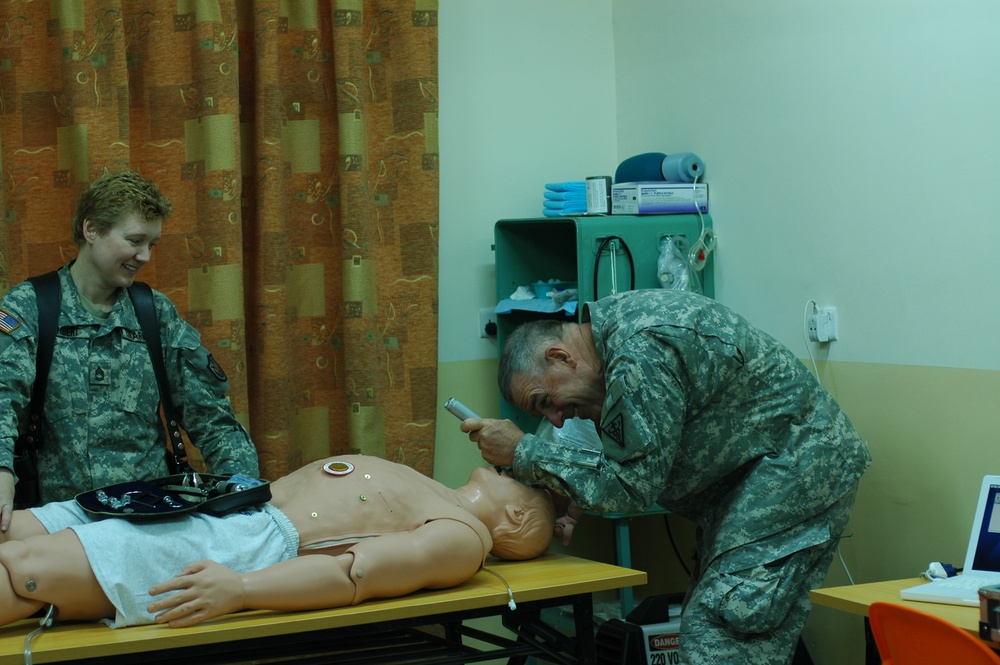
"The lab was constructed for the students," said Kramer, "All students will have computer access, a hands-on learning lab with equipment like two METI-Man patient simulators, intubation equipment, cardiac monitors and automatic external defibulators.
In the lab, students can practice real life skills by running through a multitude of medical trauma scenarios. The program is designed with fluidity in mind as the curriculum is flexible to meet the needs of each individual student.
"Pre-made modules are already prepared and translated into Arabic for the medics and the nursing students," said Kramer. The program is designed to be used at other medical facilities to enable the same training modules to take place at different sites within Iraq.
"The lab and equipment will stay at Ibn Sina, so the facility can continue to be a premier medical training center for the Iraqi military," said Kramer.
The program is now being used by the Iraqi Ministry of Defense as a recruiting tool to encourage more healthcare providers to join the MOD with the understanding that when Ibn Sina Hospital is turned over to the MOD they will have an opportunity to work as providers in this facility.
Speakers at the graduation included Iraqi Surgeon General, Brig. Gen. Samir, Deputy Commander Clinical Services, 28th Combat Support Hospital, Col. John Lammie and Surgeon of Health Affairs MNSTC-I, Col. Amir Edward.
Medical units operating under Task Force 3rd MEDCOM, have been featured on programs such as HBO's Baghdad E.R., 60 Minutes' A Fighting Chance, and CNN's Combat Hospital and in articles like National Geographic's, The Heroes and the Healing.
Maj. Gen. Ron Silverman, commander, Task Force 3rd MEDCOM, said we are providing America's sons and daughters the best medical care. Under Silverman's command medical unit capabilities include six combat support hospitals, one Air Force Theater Hospital, multifunctional medical battalions, pathology, dental, combat stress, preventative medicine, blood components and veterinarian services.
| Date Taken: |
05.14.2007 |
| Date Posted: |
05.15.2007 09:44 |
| Story ID: |
10381 |
| Location: |
BAGHDAD, IQ |
| Web Views: |
957 |
| Downloads: |
815 |
PUBLIC DOMAIN

This work, Transitioning healthcare to the Iraqis, by MAJ John Heil, identified by DVIDS, must comply with the restrictions shown on https://www.dvidshub.net/about/copyright.

 Subscribe






