KANDAHAR AIRFIELD, Afghanistan - Dining facilities feed thousands of service members and civilians every day. The Post Exchange offers goods for its customers, whether it’s soap, candy or electronic devices.
The weekly bazaar sells items that is sent to loved ones back home and gives soldiers a chance to get out of their work place, walk around and decompress from a long week. All have products that make their way onto Kandahar Airfield on a regular basis. One may ask, “How did all of these goods get on to base?”
Well, the route to Kandahar may differ, but if it came on a vehicle, it came through an entry control point - an area that allows vehicle and foot traffic to enter Kandahar Airfield. Anything coming in and out of that ECP has to be screened, searched and verified.
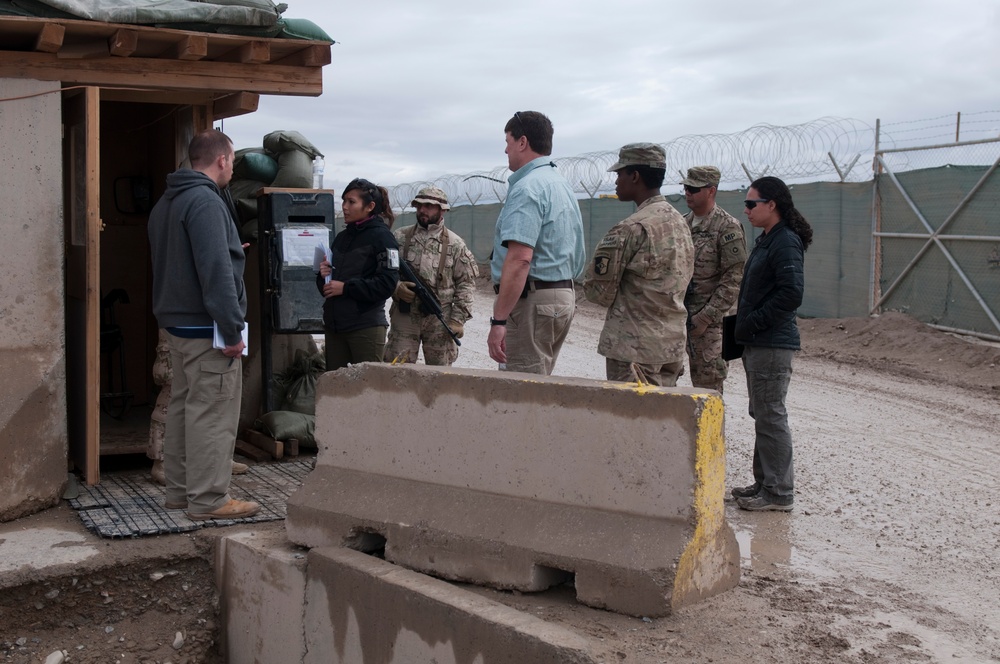
Maj. Casey Miner, command inspector general, and Sgt. 1st Class Manuel Cano, force protection noncommissioned officer, both assigned to the 311th Expeditionary Sustainment Command and civilians with the Army Audit Agency - Kandahar office, traveled to an ECP, Feb. 21, to check on those procedures. The audit agency was there to validate the processes of the entry control point and Miner was on site to help answer questions and coordinate with subject matter expert contacts as the 311th ESC continuously works to streamline the process without risking security measures.
First Lt. Syntesis Tucker, officer in charge, 632nd Movement Control Team, 49th Joint Movement Control Battalion, 311th ESC, gave the visitors a tour of the ECP and explained site procedures. She said sometimes entry operations can take time, and cause delay in the transport process. Miner reinforced the statement, but said this is to be expected.
“The procedures may delay the process, but it’s necessary for security,” said Miner. “Each driver has a bio-scan to verify who they are, and new drivers take longer, because they have initial processing that is very thorough.”
Tucker said they enforce their rules to keep everyone safe.
There is more to just checking the paperwork of the drivers and conducting searches. Staff Sgt. Gabriel Ramos, ECP noncommissioned officer in charge assigned to the 632nd MCT, said the drivers also had to be taken care of. “To get the trucks to the customers, we have to get them an escort.”
These escorts are trained South African civilians that have military or police background and have been trained for their mission.
“We’ve established a good relationship with the escorts, so we get the trucks out quick,” said Ramos.
Sometimes the drivers are delayed, but they are provided a safe location and have food brought to them as they wait.
The Army audit team and the 311th soldiers finished their assessment at the exit point of the ECP. They gathered information and will return to check other areas on another date. Their goal is to make the entry control point a safer and more efficient place for all.