
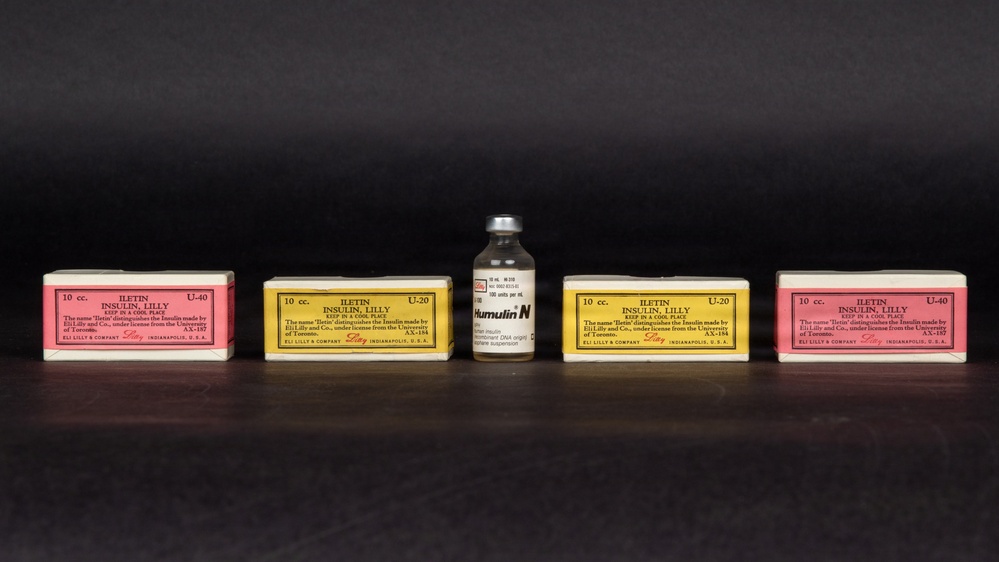
Insulin samples from the Historical Collections of the National Museum of Health and Medicine in Silver Spring, Maryland. The boxes contain different concentrations of insulin, circa 1930. The middle vial contains Humulin N, a synthetic form of insulin, circa 1989. [Left to right: M-660.27003,
M-660.2700, M-660.10046, M-660.27002 & M-660.27004] (National Museum of Health and Medicine Photo by Kevin Sommer Giron)
Extended caption: In 1921, Frederick Banting (1891-1941) and Charles Best (1899-1971) of the University of Toronto developed insulin, an extract from pancreas cells, which could reduce blood sugar as a treatment for diabetes. Eli Lilly & Co. of Indianapolis, Indiana, developed a process for the large-scale production of insulin in 1923. It was marketed under the name Iletin. A physician would determine dosage for treatment by the labels: the yellow boxes contained insulin at a concentration of 20 units (milligrams ) per cubic centimeter while the
pink-labeled boxes contained insulin at a concentration of 40 units, circa 1930 . The center vial contains Humulin N, a synthetic form of insulin manufactured by Lilly in 1989.
| Date Taken: | 10.27.2025 |
| Date Posted: | 11.26.2025 13:31 |
| Photo ID: | 9411631 |
| VIRIN: | 251027-D-FY143-1007 |
| Resolution: | 5339x3003 |
| Size: | 3.35 MB |
| Location: | SILVER SPRING, MARYLAND, US |
| Web Views: | 45 |
| Downloads: | 1 |

This work, Insulin vials, circa 1930, by Kevin Sommer Giron, identified by DVIDS, must comply with the restrictions shown on https://www.dvidshub.net/about/copyright.





