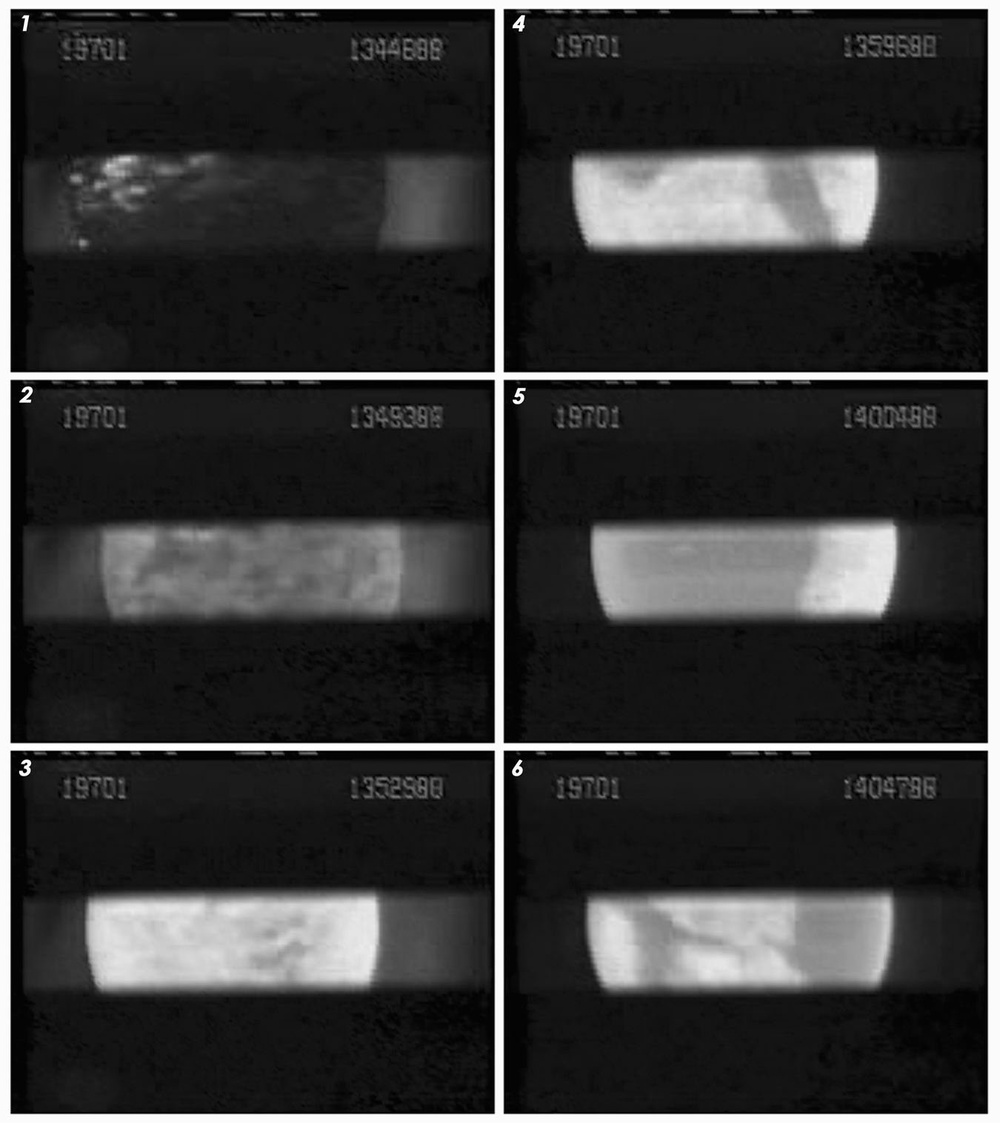
One of the final runs of the TEMPUS experiment shows heating of a sample on STS-94, July 15, 1997, MET:14/11:01 (approximate) and the flows on the surface. At the point this image was taken, the sample was in the process of melting. The surface of the sample is begirning to flow, looking like the motion of plate tectonics on the surface of a planet. During this mission, TEMPUS was able to run than 120 melting cycles with zirconium, with a maximum temperature of 2,000 degrees C, and was able to undercool by 340 degrees -- the highest temperature and largest undercooling ever achieved in space. The TEMPUS investigators also have provided the first measurements of viscosity of palladium-silicon alloys in the undercooled liquid alloy which are not possible on Earth. TEMPUS (stands for Tiegelfreies Elektromagnetisches Prozessiere unter Schwerelosigkeit (containerless electromagnetic processing under weightlessness). It was developed by the German Space Agency (DARA) for flight aboard Spacelab. The DARA project scientist was Igon Egry. The experiment was part of the space research investigations conducted during the Microgravity Science Laboratory-1R mission (STS-94, July 1-17 1997). DARA and NASA are exploring the possibility of flying an advanced version of TEMPUS on the International Space Station.(176KB JPEG, 1350 x 1516 pixels; downlinked video, higher quality not available) The MPG from which this composite was made is available at http://mix.msfc.nasa.gov/ABSTRACTS/MSFC-0300193.html.