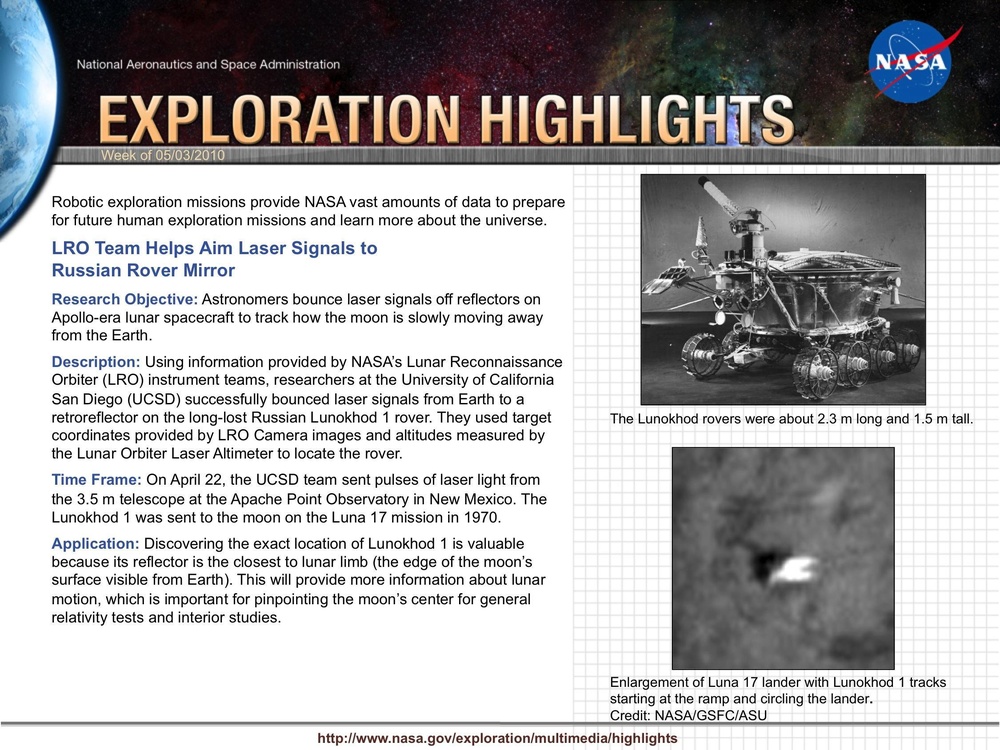
Robotic exploration missions provide NASA vast amounts of data to prepare for future human exploration missions and learn more about the universe. Research Objective: Astronomers bounce laser signals off reflectors on Apollo-era lunar spacecraft to track how the moon is slowly moving away from the Earth. Description: Using information provided by NASA's Lunar Reconnaissance Orbiter LRO instrument teams, researchers at the University of California San Diego UCSD successfully bounced laser signals from Earth to a retroreflector on the long-lost Russian Lunokhod 1 rover. They used target coordinates provided by LRO Camera images and altitudes measured by the Lunar Orbiter Laser Altimeter to locate the rover. Time Frame: On April 22, the UCSD team sent pulses of laser light from the 3.5 m telescope at the Apache Point Observatory in New Mexico. The Lunokhod 1 was sent to the moon on the Luna 17 mission in 1970. Application: Discovering the exact location of Lunokhod 1 is valuable because its reflector is the closest to lunar limb the edge of the moon's surface visible from Earth.