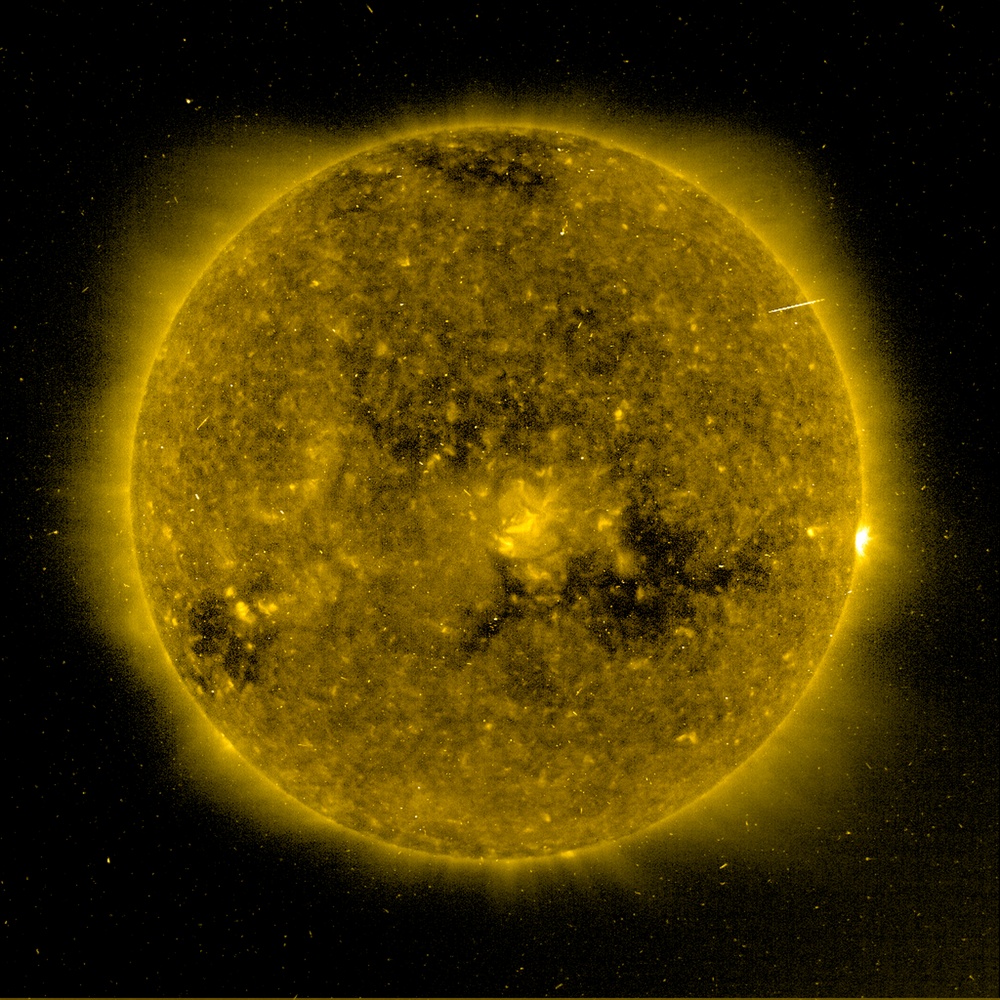
A well-positioned and substantial coronal hole can be seen (right of center) in this (November14, 2007) image by SOHO. Coronal holes appear as the dark areas when viewed in this wavelength (284 Angstrom) of extreme ultraviolet light and others as well. It has been rotating around towards the center of the Sun over the past week or so. Since coronal holes are 'open' magnetically, strong solar wind gusts can escape from them and carry solar particles out to our magnetosphere and beyond. Solar wind streams take several days to travel from the Sun to Earth, and the coronal holes in which they originate are more likely to affect Earth after they have rotated more than halfway around the visible hemisphere of the Sun, as it has here. The magnetic field lines in a coronal hole open out into the solar wind rather than connecting to a nearby part of the Sun's surface. High-speed solar wind can have a direct effect on "space weather" near Earth. As a result, people living at the higher latitudes have already seen intense and colorful auroral displays that should continue for several more days