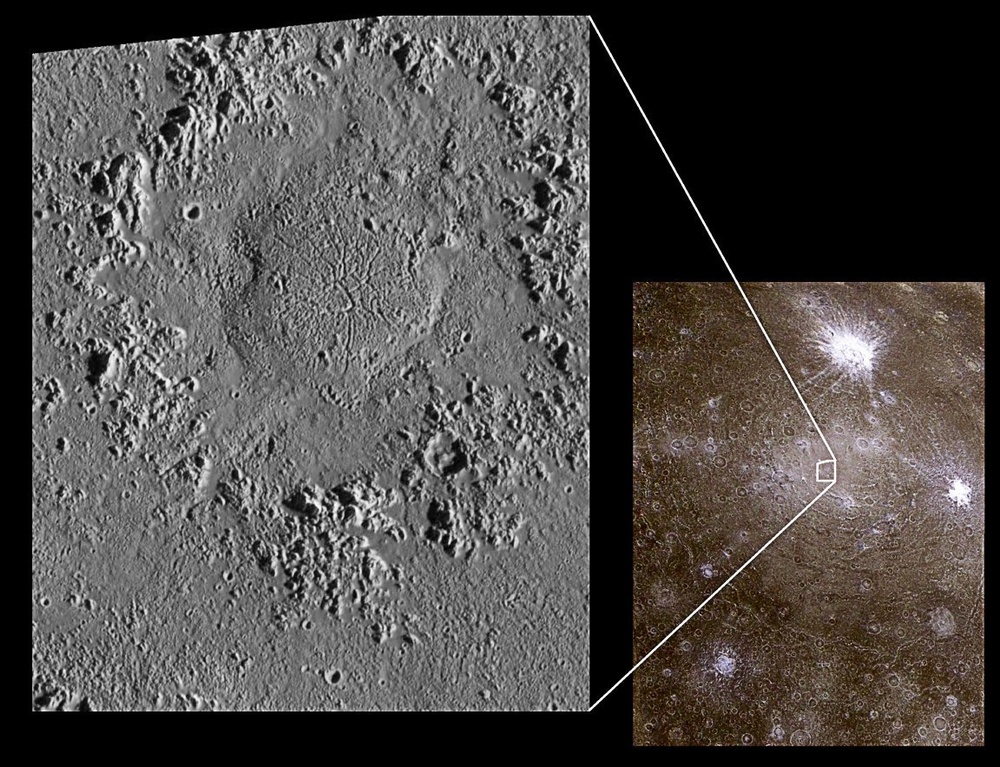
This composite of Jupiter's icy moon Callisto combines data from two orbits showing several types of impact craters. North is to the top of the picture; the sun illuminates the surface from the east. The global image on the right shows one of the largest impact structures on Callisto, the Asgard multi-ring structure located near 30 degrees north latitude, 142 degrees west longitude. The Asgard structure is approximately 1700 kilometers (1,054 miles) across and consists of a bright central zone surrounded by discontinuous rings. The rings include degraded ridges near the central zone and troughs at the outer margin, which resulted from deformation of the icy crust following impact. Smaller impacts have smashed into Callisto after the formation of Asgard. The young, bright-rayed crater Burr located on the northern part of Asgardis about 75 kilometers (46 miles) across. Galileo images show a third type of impact crater in this image, a dome crater named Doh, located in the bright central plains of Asgard. Doh (left image) is about 55 kilometers (34 miles)in diameter, while the dome is about 25 kilometers (15 miles) across. Dome craters contain a central mound instead of a bowl shaped depression or central mountain (peak) typically seen in larger impact craters. This type of crater could represent penetration into a slushy zone beneath the surface of the Asgard impact. The global image on the right was taken on November 4, 1996, at a distance of 111,900 kilometers (69,400 miles) by the solid state imaging (SSI) camera onboard NASA's Galileo spacecraft during its third orbit around Jupiter. The image on the left was obtained at a resolution of 90 meters (295 feet)per picture element on September 16, 1997 during Galileo's tenth orbit when the spacecraft was less than 9,500 kilometers (6,000 miles) from Callisto. The Jet Propulsion Laboratory, Pasadena, CA manages the Galileo mission for NASA's Office of Space Science, Washington, DC. This image and other images and data received from Galileo are posted on the World Wide Web, on the Galileo mission home page at URL. Background information and educational context for the images can be found at URL