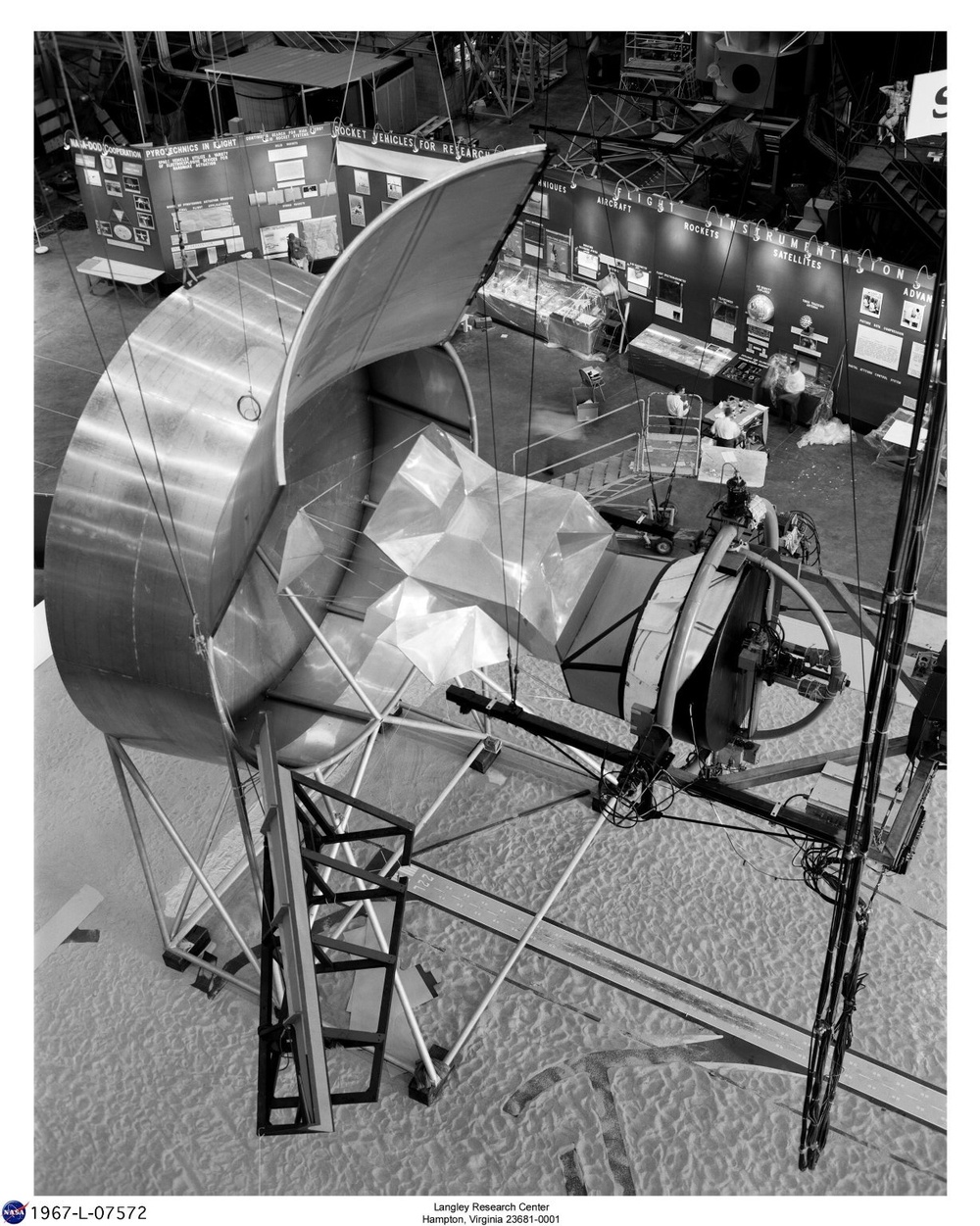
Originally the Rendezvous was used by the astronauts preparing for Gemini missions. The Rendezvous Docking Simulator was then modified and used to develop docking techniques for the Apollo program. By 1966, it was noted by A.W. Vogeley (in the paper cited below) that: "since emphasis on space docking is decreasing, the facility is being modified to serve as a closed-circuit TV carriage. It will view an HO-scale model of a Kennedy Airport runway in the study of Category II (break-out at 100 feet) landing problems. This simulation technique is considered adequate in this case because of the large model-scale and because visibility under Category II conditions is often rather poor. Peripheral vision will also be supplied in these studies (which is not generally the case) - an important requirement, particularly where rapid decisions (upon break-out) must be made." This last simulation application is shown as it was displayed for a public open house at Langley Research Center. From A.W. Vogeley, "Piloted Space-Flight Simulation at Langley Research Center," Paper presented at the American Society of Mechanical Engineers, 1966 Winter Meeting, New York, NY, November 27 - December 1, 1966. "The Rendezvous Docking Simulator and also the Lunar Landing Research Facility are both rather large moving-base simulators. It should be noted, however, that neither was built primarily because of its motion characteristics. The main reason they were built was to provide a realistic visual scene. A secondary reason was that they would provide correct angular motion cues (important in control of vehicle short-period motions) even though the linear acceleration cues would be incorrect.