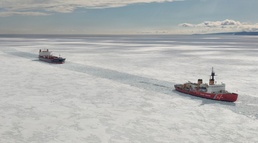
SOUTHERN OCEAN — The U.S. Coast Guard Cutter Polar Star (WAGB 10) departed McMurdo Sound, Antarctica, on March 1, after operating for 55 days below the Antarctic Circle and traveling 14,000 miles in support of Operation Deep Freeze 2026.
The cutter marked its 50th year of commissioned service on Jan. 17 while breaking free a cruise ship trapped in pack ice during a six-hour evolution. The Australian-owned cruise ship Scenic Eclipse II contacted the Polar Star for assistance after encountering denser ice than expected, roughly eight nautical miles from McMurdo Station. The Polar Star’s crew conducted two close passes to break the vessel free, then escorted it approximately four nautical miles to open water.
A few days later, the Polar Star and its crew finished establishing a seven-mile channel through fast ice, creating a navigable route for vessels to reach McMurdo Station. Shortly after its establishment, the Polar Star escorted the 600-foot fuel tanker Stena Polaris into and out of Winter Quarter’s Bay through the brash ice-filled channel to deliver more than 6 million gallons of fuel to McMurdo Station.
“I am so proud of how this crew, once again brought their best energy and worked together through every single challenge this year’s mission presented,” said Capt. Jeff Rasnake, commanding officer of the Polar Star. “Despite the heavy toll Operation Deep Freeze exacts on each individual, mentally and physically, our spirits remain high as we point our compass north and start our journey home.”
In late January, the cutter spent five days moored at McMurdo Station, where crew members helped onload 300,000 gallons of fuel.
After departing, the Polar Star removed the 4,200-ton floating ice pier from Winter Quarters Bay into McMurdo Sound during a joint operation with the National Science Foundation. This cleared the bay for the arriving vessel Plantijngracht to conduct cargo operations via a U.S. Army Modular Causeway System. Shifting ice floes necessitated the Plantijngracht requiring an escort from the Polar Star to reach the protected waters in Winter Quarters Bay.
After cargo operations were complete and the Plantijngracht departed, the Polar Star conducted its fifth and final escort of the season to bring the tug Rachel through lingering late-season pack ice to deliver the new NSF Discovery Pier to McMurdo Station.
“The delivery of the new NSF Discovery Pier is a landmark achievement that will significantly enhance the logistical support for the U.S. Antarctic Program for years to come,” said Cmdr. Samuel Blase, the Polar Star's executive officer. “This multi-year effort culminated this year with the remarkable trek of the pier from Oregon to the McMurdo Sound, and teamwork between the Coast Guard, National Science Foundation, U.S. Navy Seabees, U.S. Army Corps of Engineers, the New Zealand Antarctic Program, and Tug Rachel for its installation.”
The Polar Star departed Seattle in November for its 29th deployment to Antarctica in support of Operation Deep Freeze.
Operation Deep Freeze provides logistical support for the U.S. Antarctic Program, which is managed by the National Science Foundation. The mission includes strategic and tactical airlift, airdrop, aeromedical evacuation, search and rescue, sealift, seaport access, bulk fuel supply, cargo handling, and other transportation requirements. These efforts enable continuous critical scientific research in one of the most remote regions on Earth.
The Polar Star and its crew also demonstrated its continued support to the Convention on the Conservation of Antarctic Marine Living Resources (CCAMLR) efforts by safeguarding resources and U.S. national interests through monitoring activity on the high seas in the Antarctic region.
The Polar Star is the United States' only surface asset capable of providing year-round access to both Polar Regions. It is a 399-foot heavy polar icebreaker commissioned in 1976, weighing 13,500 tons and is 84 feet wide with a 34-foot draft. The six diesel and three gas turbine engines produce up to 75,000 horsepower.