CAMP VIRGINIA, Kuwait – “We began walking the next morning. It was about 80 miles from where we ended up. It doesn’t seem very far, but we were in such awful condition that 80 miles was a heck of a long way to walk. It took six days to get to San Fernando. There, the march ended and we got on board a train. But in that six days, a lot happened,” a survivor describes the march in a personal account on Bataan Death March – A Survivor’s Story.
Although this is only one survivor’s story, there were many more who suffered the horrors and excruciating battles of the Japanese Bataan Death March.
On April 9, 1942, after the three-month-long Battle of Bataan, 72,000 American and Filipino soldiers were forced to surrender to the Japanese army.
Upon surrendering, prisoners were stripped of their weapons and valuables and ordered to march. Many were beaten, bayoneted and executed. During the six-day march, somewhere between 18,000 and 20,000 prisoners died.
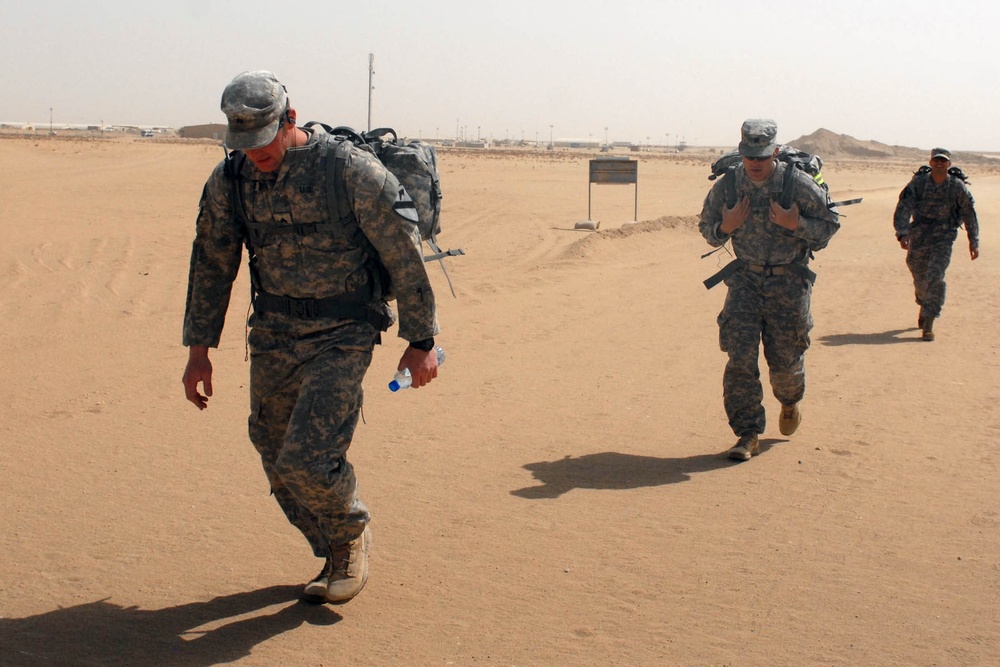
“The march I participated in was nothing like what the soldiers had to go through back in 1942,” said Cumming, Ga. native, Spc. Justin Larson, a medic assigned to Headquarters and Headquarters Company, 2nd Battalion, 5th Cavalry Regiment, 1st Brigade Combat Team, 1st Cavalry Division. “I grew a respect for the fallen soldiers of Bataan, the 26.2-mile march I did was difficult, but the conditions were much better.”
The memorial march was started in 1989 by the Army Reserve Officers’ Training Corps at the New Mexico State University.
Participants come from across the globe to commemorate this event for many reasons: personal challenge, the spirit of competition or to foster esprit de corps in their unit.
“I originally thought it was just a 26.2-mile ruck march,” admitted Park Rapids, Minn., native, Spc. Logan Carmichael, a medic assigned to the Lancer Battalion. “I was ready for the challenge, but after researching the history of it, it motivated me to complete it.”
It was early morning and the air was brisk and the sky was dark, but the 1,400 participating service members still gathered around the start line, patiently waiting for the march to start.
The 26.2-mile march consisted of five and a half laps around the camp. Participants were allowed to march, walk or run. With a steady pace, Eastland, Texas, native, Spc. James Garcia was able to complete the march in less than 10 hours.
“I was ready for a challenge,” explained Garcia, a signal support specialist assigned to Headquarters and Headquarters Company, 115th Brigade Support Battalion, 1st Brigade Combat Team, 1st Cavalry Division. “So, I signed up for the march. It wasn’t until afterward that I learned what the importance was.”
Although the soldiers had different reasons for completing the march, in the end, the motives were similar.
“I wanted to honor all those who fell during the march back in 1942,” Larson concluded. “I felt very humbled upon completing the march. I feel as though I honored those men, but wish there was more I could do.”
| Date Taken: |
03.03.2012 |
| Date Posted: |
03.10.2012 03:04 |
| Story ID: |
85037 |
| Location: |
CAMP VIRGINIA, KW |
| Hometown: |
CUMMING, GEORGIA, US |
| Hometown: |
EASTLAND, TEXAS, US |
| Hometown: |
PARK RAPIDS, MINNESOTA, US |
| Web Views: |
149 |
| Downloads: |
0 |
PUBLIC DOMAIN

This work, Ironhorse honors Bataan’s fallen Soldiers, by SGT Bailey Kramer, identified by DVIDS, must comply with the restrictions shown on https://www.dvidshub.net/about/copyright.

 Subscribe






