CAMP SHELBY, Miss. - Unmanned aerial systems, formerly unmanned aerial vehicles, are machines which function by remote control or autonomously based on pre-programmed flight plans.
The earliest attempt at a powered unmanned aerial vehicle was in mid-1910s with advances to follow that made the Remote Piloted Vehicles serviceable in World Wars I and II as training devices for anti-aircraft gunners and to fly attack missions.
Currently, the military utilizes UASs for reconnaissance, target and decoy, combat, logistics, and research and development.
UASs perform reconnaissance by providing battlefield intelligence through live video coverage.
“The [intelligence] collection capability of a UAS is one of the greatest assets we have in the field,” said Chief Warrant Officer 2 James P. Huck IV, unmanned aerial vehicle operator and platoon leader assigned to Headquarters and Headquarters Company, 37th Infantry Brigade Combat Team. “Anything you could ever want to see on the battlefield, as long as we have a clear enough chance to get it in the air, we can look for it.”
Huck has been working with UASs since 2002. He was a member of the first training class on the Shadow, trained in the winter of 2004 on the Raven and has spent the last two years working with the Gray Eagle, a larger UAS used for high-risk missions. He has had thousands of logged flight time hours and teaches all three vehicle systems.
The Raven, used mostly by the infantry, is a small, hand-thrown vehicle with approximately 90 minutes of flight time and limited altitude.
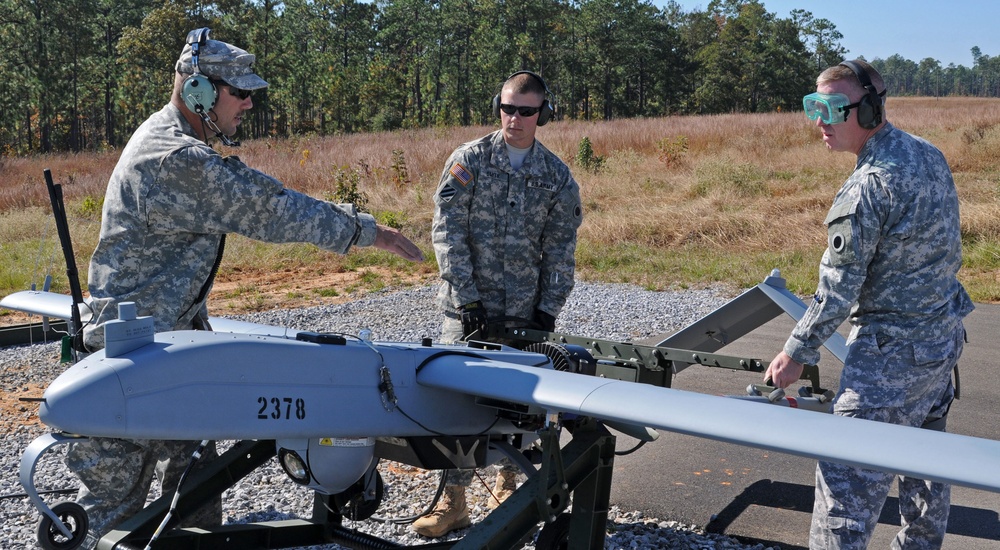
The Shadow will be utilized by the 37th IBCT during their upcoming deployment to Afghanistan. It is a mid-sized platform powered by a small, push-style prop engine. With a wingspan of 16 feet, the vehicle can reach heights of 15,000 feet mean sea level.
Equipped with an Electro-Optical/Infrared camera that can be moved independently of the vehicle, the UAS can be utilized at night to detect temperature differences.
The UAS can also provide distance and direction of the enemy, should a convoy encounter direct fire.
“Having someone be your eyes so you can keep your head down is a huge benefit,” said Huck.
The choice of which system to use is mission-specific as UASs can be used in both offensive and defensive strategies.
The autonomous technology of these systems will greatly increase its usage in other roles like search and rescue, transporting goods, and surveying.
“The capability of the system is only limited by the commander’s idea,” said Huck. “Whatever ways the commander can think to use, it can be put into effect.
| Date Taken: |
11.06.2011 |
| Date Posted: |
11.12.2011 12:01 |
| Story ID: |
79956 |
| Location: |
CAMP SHELBY, MISSISSIPPI, US |
| Web Views: |
136 |
| Downloads: |
1 |
PUBLIC DOMAIN

This work, Brigade deploys newest asset, by Kimberly Derryberry, identified by DVIDS, must comply with the restrictions shown on https://www.dvidshub.net/about/copyright.

 Subscribe





