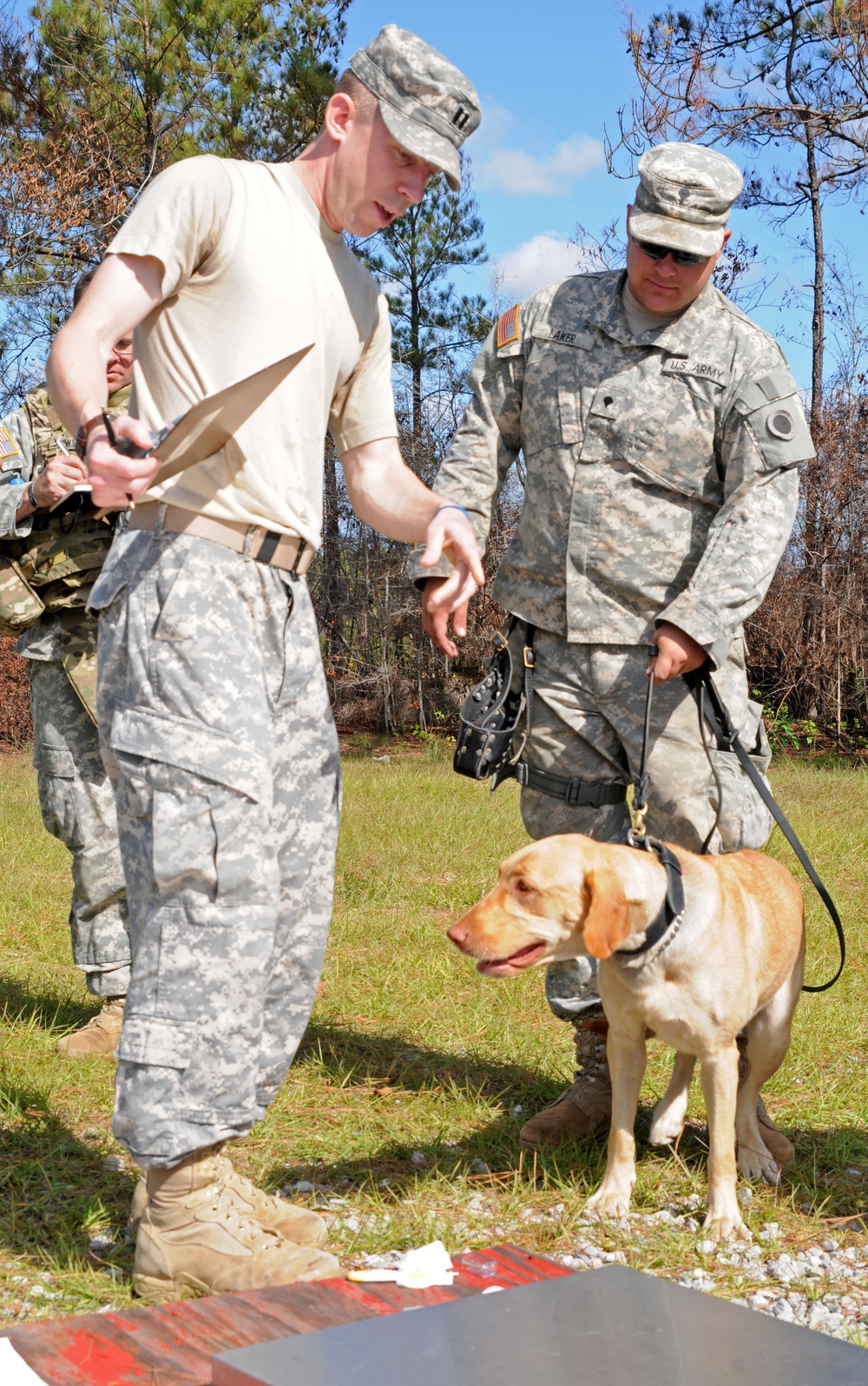
CAMP SHLEBY, Miss. - Like the Battle Buddy system used by the Army, these teams of two work hard, train hard, and look out for each other. Both soldiers are disciplined, well groomed, and physically fit for duty. Both follow commands explicitly. Unlike traditional Battle Buddies, this team has six legs instead of four. Tactical Explosive Detection Dog teams consist of a trained dog and a validated handler.
The TEDDs have been trained to sniff out explosives.
The 37th Infantry Brigade Combat Team will be the first in the National Guard to implement this latest resource.
“They are trailblazers,” said Sgt. First Class Greg Sewell, brigade operations non-commissioned officer assigned to Headquarters and Headquarters Company, 37th IBCT. “They are writing the [Standard Operating Procedures] for future National Guard units.”
The TEDDs and their handlers have joined the rest of their fellow 37th IBCT soldiers training at Camp Shelby Joint Forces Training Center, Miss., after eight weeks of hands-on training in Indiana and Yuma Proving Grounds, Ariz.
“The dogs are ready for explosive detection but now they need to incorporate the rest of this,” said Ben Martin, trainer and instructor of the TEDDs from Vohne Liche Kennels, Inc. The TEDDs are being integrated into their handler’s organic units and the units are now being introduced to the TEDDs roles in training and combat.
“The TEDD program is designed for combat arms folks to beef up the organic capabilities of a maneuver unit,” said Sewell.
“They are not attack dogs,” said Martin. “They sniff. That’s their only purpose.”
“If your dog shows a response and you trust that something’s there, your job is done. Contact [Explosive Ordnance Disposal],” said Spc. Mitchell A. Pupa, infantryman and dog handler for Headquarters and Headquarters Company, 1-125th Infantry, 37th IBCT.
The dogs serve as soldiers and are recognized as such. They hold rank one level above their handler’s rank.
“The Army does not have animal protection laws,” said Staff Sgt. Philip R. Haner, of Cadillac, Mich., a chemical, biological, radiological, and nuclear specialist assigned to Bravo Troop, 1-126 Cavalry, 37th IBCT, and handler of Rocky 53. “It prevents abuse and neglect. It is considered assaulting an [non-commissioned officer] if the dogs are not taken care of.”
Aside from receive regular veterinary check-ups, the handlers are in complete control of their dog’s care: feeding, walking, and grooming. The dogs also stay in the barracks with their handlers.
The TEDDs also receive vaccinations, including those required for deployment - just like their human counterpart soldiers.
The 37th IBCT and their TEDDs are deploying to Afghanistan in support of Operation Enduring Freedom.

 Subscribe






