
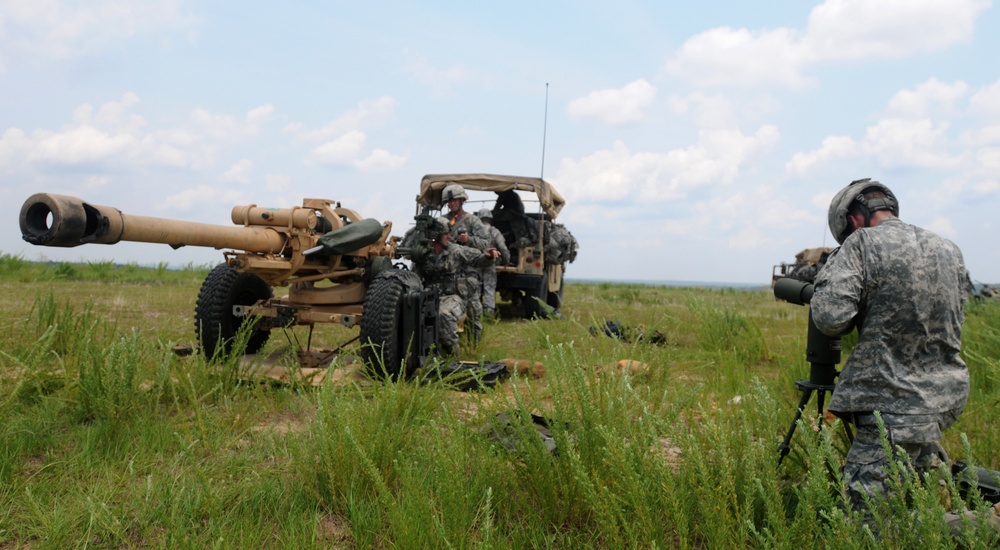
Photo By Sgt. Derek Kuhn | Field artillerymen with the Battery A, 3rd Battalion, 319th Airborne Field Artillery...... read more read more
 Subscribe
FORT BRAGG, N.C. - From its humble beginnings as small black powder cannons to the titans of devastation and lethal efficiency of today, field artillery weapons have always made an impact. Nowhere is that truth more evident than today in the U.S. Army.
From training Iraqi soldiers to providing steel rain in the most remote areas of Afghanistan, the Army relies on a group of highly trained and efficient artillerymen to provide the indirect fire it needs to accomplish its missions.
Recently, some of the 82nd Airborne Division’s field artillerymen showcased their skills in a Joint Operations Access Exercise at Fort Bragg, N.C., June 26-28. During the exercise, the artillerymen of 3rd Battalion, 319th Airborne Field Artillery Regiment displayed what they bring to the fight.
“We provide suppressive fire to effectively give lethal support to forward elements,” said Sgt. Caleb Sprayberry, a field artilleryman with Battery A, 3-319th Airborne Field Artillery Regt., 1st Brigade Combat Team, 82nd Airborne Division. “So the grunts make it back home,” the Clarksville, Tenn., native added.
Sprayberry, whose father was an Army field artillery officer, grew up in the field artillery community, and when the chance to become an artilleryman presented itself, he didn’t hesitate.
“I went to my recruiter, and he showed me a video of what the Army is working with now,” Sprayberry said. “I was sold.”
The Army works with many field artillery cannons like the M-777 Howitzer which is one of the newer models.
“The M-777 has many advanced features,” said Sgt. 1st Class John Glenn, the gunnery sergeant for Sprayberry’s team. “It is totally automated, all you have to do is type in all the coordinates, and the cannon moves into place. Then you just press enter and it fires.”
In the Army, the gunnery sergeant controls the advanced party of a field artillery battery. Though, it might seem like a front-line leader like Glenn would want the latest cannon to provide support for the infantry or cavalry, but that isn’t the case.
Although the M-777 is newer, all the extra technology weighs it down, which makes it of little use to the paratroopers of the 82nd Airborne Division, Glenn, a native of Paduka, Ky., said.
For the All Americans of the 82nd Airborne Division, “a lighter and more maneuverable cannon is needed,” Sprayberry said.
That is why they use the M-119 A2 howitzer.
“We have a lot of capabilities with the M-119,” said Sgt. 1st Class Terry Lenord, the smoke or fire chief of Sprayberry’s team. “We can drop it out of a plane and then we just follow it out of the bird.”
Glenn agreed and said the M-119 is easily the best choice for a military unit that is as mobile and lethal as the 82nd.
According to Sprayberry, who served with the 1st Infantry Division, one thing remains the same across the board for artillerymen.
“The dedication really sticks out to me,” Sprayberry said. “We practice crew drills day in and day out until we are able to set up and fire a cannon within twenty minutes.”
Sprayberry said this constant drilling brings everyone together like a family.
“The camaraderie is really my favorite thing,” Sprayberry said. “I know my teammates can set everything up without anyone saying a word. We all know what needs to be done.”
For a seasoned artilleryman like Lenord, passing on these skills and the rich tradition of the artilleryman is the most rewarding aspect of his job.
“When I see my guys doing as good or if not better job than me working with the cannons, I know I made my mark,” Lenord said.
| Date Taken: | 06.28.2011 |
| Date Posted: | 06.30.2011 10:26 |
| Story ID: | 73007 |
| Location: | FORT BRAGG, NC, US |
| Web Views: | 477 |
| Downloads: | 0 |

This work, Blown Away: Field Artillery impacts Army, by SGT Derek Kuhn, identified by DVIDS, must comply with the restrictions shown on https://www.dvidshub.net/about/copyright.


No keywords found.





LEAVE A COMMENT