
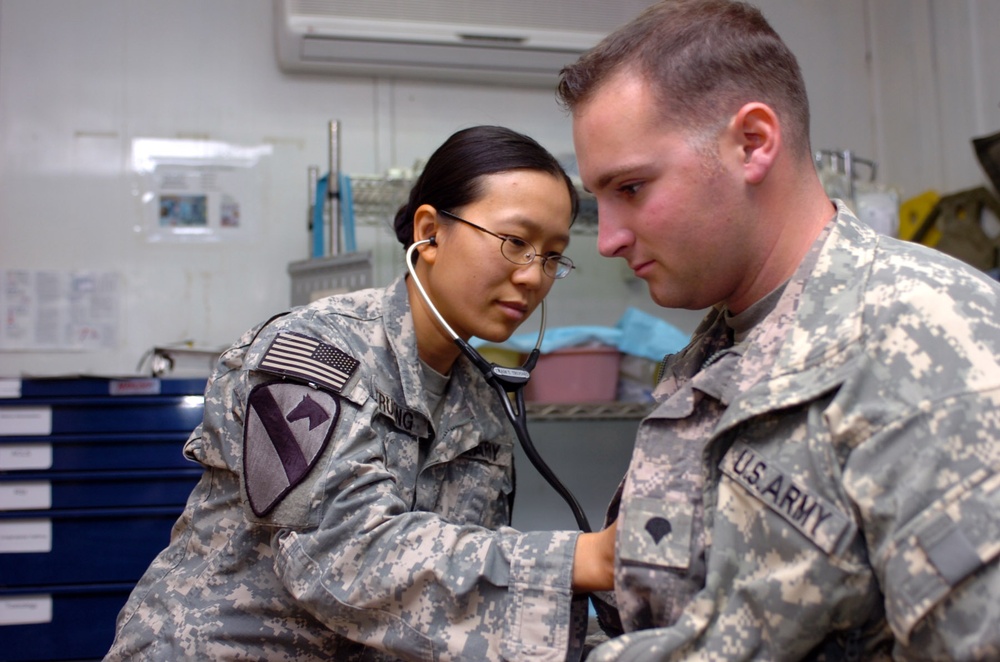
Photo By Alun Thomas | Capt. Tram Truong checks the heartbeat of Spc. Kevin Roberts, from Valley Center,...... read more read more
 Subscribe
CAMP TAJI, Iraq — Following the fall of Saigon in 1975, many Vietnamese immigrants saw the United States as a beacon of hope as they escaped their war-torn nation.
The family of Capt. Tram Truong was no exception, seeing little future in a country traumatized by years of fighting and hostility.
Luckily for Truong, now from Santa Clara, Calif., a flight surgeon for 4th Battalion, 227th Aviation Regiment, 1st Air Cavalry Brigade, 1st Cavalry Division, the U.S. turned out to be her family's savior and led to her serving in the U.S. Army.
Truong, who was born in Vietnam, said her parents witnessed the entire Vietnam War and were disillusioned with the outcome.
"They had three daughters and thought it would be a better life [in America], because we were growing up in the communist times," Truong, 32, said. "My dad doesn't talk much about [the Vietnam War]. He was in the Vietnamese Army fighting the [communists] and he was in the concentration camps for several years."
The communist environment stifled the chances of a good education, another factor in the move to the U.S., Truong said.
"My mother wanted to be a lawyer but never got to pursue it because she was restricted on what she could do education wise," Truong said. "She saw this as a limiting factor for us kids."
Truong said her grandfather was essential in the escape cause for many other Vietnamese citizens hoping to leave like her family.
"He was one of the people who helped [provide] money to build boats and coordinate boat trips so people could escape communism," Truong said. "Several boats that he funded carried families who eventually got rescued and either made it to the U.S. or Australia, where they remain today."
With the assistance of relatives already in the U.S., Truong's family managed to secure admission into their new country through a different method.
"My aunt's family sponsored my Mom so we could come to America," Truong said. "The process took several years and I came over with my family in 1985 when I was seven."
Initially things were difficult because Truong's parents were struggling to make ends meet; the language barrier was also a problem.
"It was tough as a kid because I didn't speak much English. Somehow I picked it up like all the other [Vietnamese] kids," she said. "I took English as a Second Language and in the 8th grade I finally passed the test and was glad I didn't have to go there anymore."
Things improved significantly for Truong's family, especially after they moved to California where job opportunities were greater.
"My dad was originally an engineer in Vietnam ... and when he came to the U.S. they didn't recognize his degree," Truong explained. "He eventually got his engineering degree in the U.S., and he and my mother got into the electronic field."
In the U.S., Truong also found the opportunity to chase other interests, such as Taekwondo, a long standing ambition of hers.
"I wanted to do it when I was younger, but never had the chance to, so I started when I was in college," she said, soon rising to the level of black belt.
"They [the school] needed some help so they promoted me—kind of like an accelerated program," Truong joked. "I've done a couple of tournaments, but I realized I didn't want to be kicked in the head. I need my brain as a physician."
Becoming a physician was Truong's desired career and she opted to join the Army through the Health Professional Scholarship Program, which would help pay for medical school.
"If you have some kind of merit they offer you a scholarship and I was offered one for three years," Truong said. "I trained with the military while I was doing this."
After graduating medical school Truong was promoted to captain and assigned to Fort Belvoir, Va., where she was told she would be deploying to Iraq with the 1st ACB.
"Wherever [the Army] are missing someone they grab whoever's available ... someone who hasn't deployed," Truong said. "I was pulled to Fort Hood and was attached to the 1st Cav."
The deployment has been good for Truong so far and better than she expected.
"You hear all the stories but I think it has changed here, especially from [Operation Iraqi Freedom I] until now," she said. "Things have developed in Iraq."
Truong's husband is a captain in the Army also and works at Walter Reed Army Medical Center in Washington, D.C., a situation which she finds difficult sometimes.
"My husband is also a physician, but I think it's just a little too hard being dual military," Truong said about being separated from her husband. "For officers it may be a little easier, but it's whatever works for the military and if they can accommodate you they'll try."
Truong said working with the 1st ACB and the Army as a whole has been more than positive over her four-and-a-half years of active service.
"It's been pretty good ... but as far as my medical career [goes] they've been very helpful," Truong continued.
As for her imminent future in the Army, Truong said she plans to leave the service eventually.
"I think one [spouse] at a time is enough," she said with a smile.
| Date Taken: | 11.19.2009 |
| Date Posted: | 11.19.2009 07:14 |
| Story ID: | 41770 |
| Location: | TAJI, IQ |
| Web Views: | 466 |
| Downloads: | 392 |

This work, Doc makes journey from Vietnam to U.S. Army, by Alun Thomas, identified by DVIDS, must comply with the restrictions shown on https://www.dvidshub.net/about/copyright.

No keywords found.





LEAVE A COMMENT