
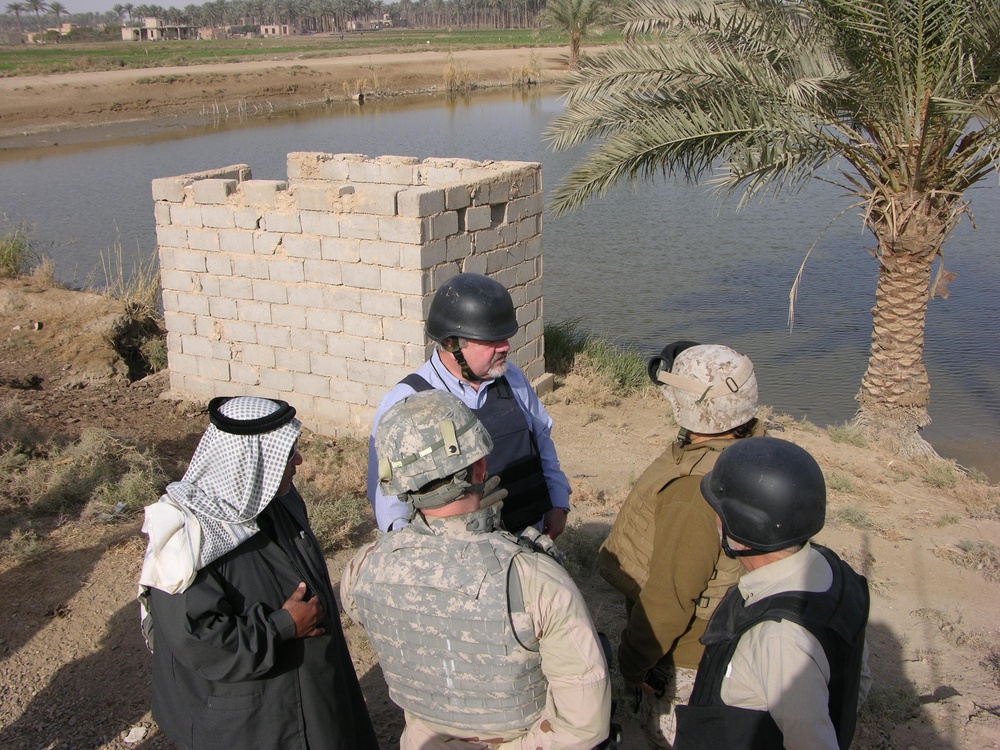
Courtesy Photo | Herschel Weeks, of the Inma Agribusiness Program; Navy Cmdr. Kevin Anderson; and a...... read more read more
 Subscribe
By Elaine Eliah
Special to American Forces Press Service
RAMADI, Iraq - Reviving agricultural enterprises that have deteriorated from years of sanctions, conflict and neglect is crucial to the economy in this region in western Iraq, U.S. and Iraqi officials said.
"I've seen several (poultry) growers who have returned to production during my seven months here, and more will return as things continue to improve," said Marine Maj. Daryl F. Remick, an agricultural planner with the Fallujah-area provincial reconstruction teams.
As a farmer's son and poultry specialist, Remick is keenly aware that raising chickens is but a single link in a complex chain of activities that can make or break farmers. "We have to evaluate the entire agricultural value chain for al Anbar," he said.
Assessing a value chain means considering not only what is taking place on the farm, but also looking at how farmers receive inputs, such as seed, fertilizer or poultry feed, and how they market the products they produce, he said. Identifying weak links in each agricultural product's value chain is critical for making that industry profitable.
U.S. military civil affairs personnel and civilians embedded with provincial reconstruction teams interact with local communities, investigate where the value chains need upgrading and recognize restorable agribusinesses. When several enterprises fitting this description were identified by the Ramadi PRT's embedded personnel, Navy Cmdr. Kevin Anderson, detailed to the State Department, and Marine Maj. Lee Suttee, a Marine Corps civil affairs specialist, requested members of the Inma Agribusiness Program visit the area. Inma is an Arabic word meaning "growth."
The program, funded by the U.S. Agency for International Development, is working to restore Iraqi agribusiness, a sector estimated to support 27 percent of the population. During a recent two-day tour in and around Ramadi, the Anbar provincial capital, Anderson and Suttee escorted USAID's Ron Curtis and David Smale and Inma party chief Herschel Weeks to several private-sector agribusiness investment opportunities.
The group listened as three farmers described the same "weak link" problems. Day-old chicks are expensive and often require costly shipping. Farmers must use costly imported feed of unknown quality. Immunizations and veterinary care are expensive, and disease-testing labs are unavailable.
"Inma wants to make sure that the feed and other needs are in place for the farmer to make money," Weeks said, "and that there is a market for the products."
During the summer, the provincial sheiks council requested PRT assistance in re-establishing a competitive local poultry industry. Available, affordable feed looked like the best first step in the process. Inma's maize-growing demonstration project introduced hybrid seeds and precision planting to local farmers. Iraq's traditional maize yield tripled, and by planting between the annual wheat crops, farmers used their fields off season and produced much-needed animal feed, Inma officials said.
Availability of Ramadi-grown feed strengthens the poultry value chain. As increased poultry production expands the market for feed, further grain production is encouraged. Inma officials said they want to improve other links in this chain by developing feed-mill capacity to prepare grains and legumes for chicken feed and improving hatchery operations to supply young chicks.
The commitment that Anderson and Suttee's team have to revitalizing Anbar's economy was evident in the two-day assessment tour of Ramadi's Zangora and Jazeera districts. In addition to all the poultry interests, they also had identified a potentially profitable fish pond and a mushroom farm that in 2003 employed 80 workers. At one local market, Iranian mushrooms sell for $2.50 a pound.
"Private industry can flourish," Weeks said. "Agriculture can become profitable and provide food for the Iraqi people."
"Our goal," Anderson added, "is to see Iraqi-grown produce in not only the local markets, but also in markets of Jordan and Syria."
| Date Taken: | 01.22.2008 |
| Date Posted: | 01.22.2008 19:03 |
| Story ID: | 15693 |
| Location: | RAMADI, IQ |
| Web Views: | 960 |
| Downloads: | 920 |

This work, Farm Business Revival Holds Key to Anbar's Economic Recovery, must comply with the restrictions shown on https://www.dvidshub.net/about/copyright.


No keywords found.





LEAVE A COMMENT