By Spc. Anthony Hooker
215th Mobile Public Affairs Detachment
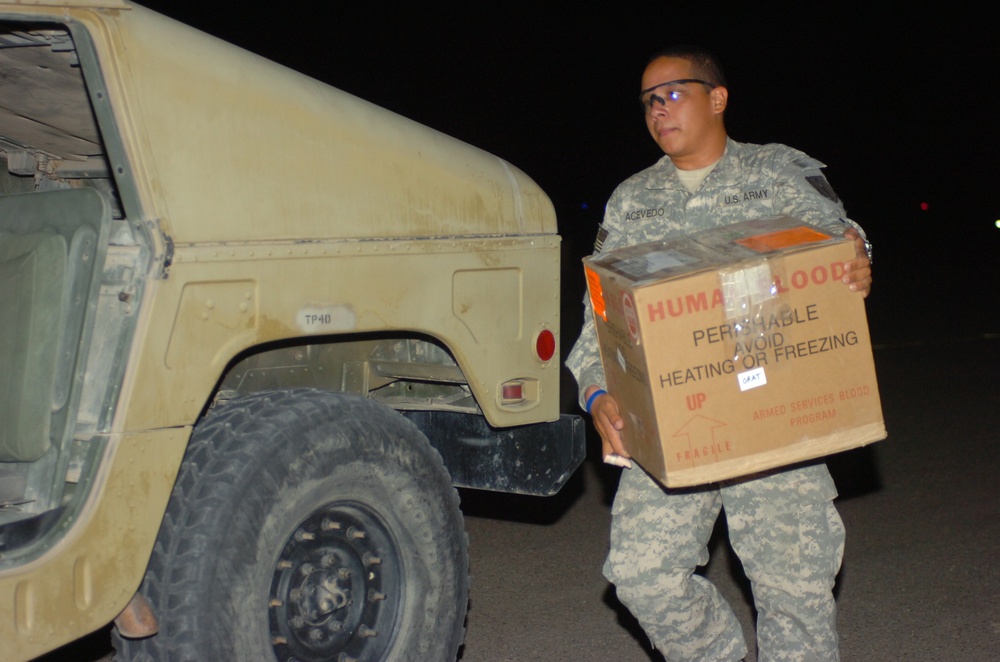
FORWARD OPERATING BASE AL TAQADDUM, Iraq – The 383rd Movement Control Team, part of the 330th Movement Control Battalion, serves at Marine Base Al Taqaddum as a receiving, shipping and release point for Multinational Forces-West. The unit is one of 21 teams dispatched throughout Iraq to provide air, ground and rail support to Coalition forces. Most teams are located at an Army-run facility, but the 383rd has to follow Army procedures while operating in another branch's battle space.
Deploying from Ft. Polk, La., the 23-person team is divided into two groups: a ground element which handles convoys traveling in and out of the base, and the flight group, which oversees any cargo that is delivered through air transfer. MCTs have gone from units that are responsible for manning one type of movement control to handling multiple sites. In theater since last August, each of 383rd's groups have faced challenges that can quickly stunt the daily movement of materials across theater.
AIR GROUP
The air group works at the Joint Air Cargo Operations Terminal, the base's main passenger terminal. The primary duties are tracking and tracing all cargo going in and out of Al-Taqaddum, commonly known as "TQ", handle missions that are run by Sherpas, a light fixed-wing aircraft managed exclusively by the Army, and to assign Army personnel on outgoing flights. While observing cargo, the group must distinguish Army products from other services' products. Supplies designated for Army, Navy, Air Force, Marines and commercial groups need to be separated regularly. Any delay or displacement can cause a mission to be in jeopardy.
With major suppliers such as United Postal Service and DHL, 'TQ" can see as many as 20 to 30 commercial planes a day, in addition to military loads. That means workers must be able to answer phones, document items and resolve discrepancies in a short time period. "We are challenged to multitask without losing quality of service," said Sgt. William Lee, the non-commissioned officer in charge of air cargo operations.
Complicating this task is the variety of receiving stations on the ground. "The team is able to monitor any Army movement but we are unable to control any from the other branches," said Lee.
"We especially have trouble identifying material when personnel from other bases would re-sort cargo en route to TQ."
Arriving in theater with only one officer in the unit, Sgt. 1st Class Jesse Johnson, the 383rd's senior non-commissioned officer, was forced to decide who would best handle a responsibility that required strong customer service and experience in tracking and transportation. With so many of his troops newly arrived from advanced training, Johnson went with two junior NCOs, Lee and Sgt. Shameka Givens, to manage the office.
Having served with Johnson since 2006, the two offered the team experience and technical proficiency. Givens was assigned as the officer-in-charge and combined with Lee to construct a standard operating procedure.
The two took on two major issues: authentication of materials on the ground and tracking reliability. Lee said when the unit arrived, cargo took an unusually long period of time to be shipped out when it reached the JACOT, so he decided highlighting items and their designation would speed up the movement. Secondary checks by the MCT would lower the margin of error for item loss.
The 383rd was the only unit on site that tracked detailed information such as class and supply, weight and a brief item description. Lee figured the detailed and continuous attention given to items would check any glitch that hit the system. "Multiple systems would have to fail for us to lose track of equipment," he said.
The team got a huge test in November. Two Stryker engines were scheduled to move from "TQ" to Baghdad. The person who produced the paperwork for the mission incorrectly filled out the order, which had the engines being flown to Dover Air Force Base, Delaware.
"The warrant officer responsible for shipment came into our office assuming we were the one who made the mistake," said Lee. "By having an updated file stored on our computer, we were able to show where the discrepancy was made."
Lee's homework allowed him to rein in the misdirected cargo.
"We were able to track the cargo down just as it was about to go on a C-5 aircraft at Ramstein Air Base [Germany]," Lee said. "[My soldier] contacted the PAX [terminal] in Delaware, who rerouted the cargo back to Baghdad, preserving a pretty important mission."
Lee said the effort helped stop what would have been a $1.4 million-dollar mistake. It also gave the 383rd a new believer in their system. "The warrant officer was so pleased with the unit's service," Lee said, "he wanted us to personally handle his shipping."
Johnson said the unit routinely assumes a lot of implied tasks when working with other armed forces. One major task is taking the initiative to build a working relationship with the other branches stationed at the JACOT. Because other services' deployments are shorter, standards are constantly relearned. Since the 383rd set up operations at "TQ", four Air Force and three Marine rotations have occurred.
"As an Army asset on a Marine base – you know Marines run [most operations]," Johnson said. "We must have a joint mentality. Every branch of service here brings different intelligence reports, different types of airlifts, different procedures."
Johnson said that the group's ability to endear itself to incoming units help eliminate any awkward moments that occur while the units try to coexist.
"[Units] know they need to work with other forces," Johnson said, "but may not know how to approach the issue."
The 383rd established weekly meeting with the other branches and KBR to discuss changes in policy or identify discrepancies. Their actions have given the group a stellar reputation.
"When someone is tracking an item," said Lee, "people say, 'speak to the Army – they know everything.'"
Givens said occasionally some customers challenge their authority because they don't see many high-ranking personnel.
"[A customer] wanted to talk to someone higher," said Givens. "I said, 'Fine, I'm the OIC'''.
Givens said her leadership is confident she can handle any discrepancies.
"My commander and NCOIC know I won't put myself in a predicament of being disrespectful," she said, "When customers can't find cargo, they get frustrated. People come in agitated . . . you just have to present a professional approach."
Capt. Reginald Mitchell, the commander of the 383rd, echoed full confidence his troops can manage almost any problem without his input.
"I'm the commander," said Mitchell, "but I tell customers I can't tell you any more than has already been explained."
Givens said rank is not the determining factor for quality service. "If you're doing the right things, abiding by the standards you put out," she said, "things will be okay."
With only a few months remaining in their deployment, Johnson said the group is mainly concerned with maintaining and building upon its SOP.
"We just want to make our TOA [transfer of authority] as smooth as possible," said Johnson. "We are making sure that the incoming group has the maximum training and resources."
"You never know, we may have to come back here," Johnson said. "We want the standards in place that are effective to still be used if we return."
GROUND SIDE
The ground team is responsible for ground operations, convoy clearance, tracking convoy numbers as vehicles move in and out of battle space. The team also provides technical guidance for personnel at "TQ's" central receiving and shipping point.
"The focus is on movement [and] keeping supplies up," said Mitchell. "Getting beans and bullets to people who are on the front line, [to people] who are walking along the streets on patrol."
"If we don't effectively track the assets that are needed, the mission will suffer as a result."
There is a marshaling yard where military vehicles stage before moving and a yard designated for third-country nationals. Johnson said the group pushes more than 500 convoy vehicles in a week. There are convoys providing theater support (moving products down to South Iraq and Kuwait), units that are redeploying or moving retrograde equipment, and military transition teams who travel back and forth daily to nearby forward operating bases.
"Everybody has to come through us," said Johnson. "We give them the convoy clearance to travel the road."
Group members coordinate daily with various military units, contractors, as well as foreign and local nationals. Mitchell said he spent the first five to six months of the deployment actively meeting with other base tenants to let them know what the 383rd was able to provide.
"The higher headquarters does a great job trying to predict what to anticipate," said Mitchell, "which helps us more efficiently assist our customers get checked in to complete their mission."
Air Force Staff Sgt. Joseph Villamayor, an assistant convoy commander preparing to leave "TQ", said moving pieces out of 'TQ' is much easier.
Deployed during the first three Operation Iraqi Freedom campaigns, Villamayor said today's convoy personnel are involved in any setup for movement. "The sand's still here, but the processes are different," he joked. "The service here is more convoy friendly. When I was here before, there was no support; we barely knew what MCTs were."
Sgt. Shannon Lincoln, a movement control technician, is on his second deployment. Only 24 years of age, he said no one should dismiss the sort of responsibility people in his position hold.
"We are responsible for hundreds of thousand of dollars of equipment, for several thousand movements a year," said Lincoln. "It's a big deal."
"When a convoy misses a [start point]," Lincoln continued, "it influences all the movement in the area. Your small part plays a big role in convoy operations."
The 383rd's primary customer is the 129th Combat Sustainment Support Battalion, but "TQ" is the logistical headquarters for the Marines. That means any actions taken by the 383rd must be passed up to the Marines.
With the Marines' approval needed for any movement in and out of the base, Sgt. 1st Class Gregory Hopkins, 129th's NCOIC of support operations, said a tight relationship between his unit and the 383rd needed to be formed to avoid any delay of movement.
The units created what Hopkins called a 'transfusion cell,' where key leaders gained a better understanding of each element and how to assist each other.
Hopkins said the groups get together weekly and the meetings have benefited everybody. "We are able to reinforce each other statuses," he said. "That's very important when people want to increase or remove cargo at the last minute."
"The 383rd has a huge responsibility," Hopkins added. "When you're able to put a name and a face together, the connection is stronger," he said.
That connection tightened after a recent mishap occurred at the 383rd's marshaling yard. Local nationals started an effort called the Iraqi Trucking Network, where local drivers move equipment unassisted to different bases in the Anbar province. The 383rd was told the system was currently in place, but still had a miscommunication occur.
Base security was scheduled to meet the truckers at the marshaling yard but a senior base contractor erroneously intercepted the group and assumed the role as a guide. The contractor was a daily visitor to the 383rd's location, so the 383rd didn't recognize the contractor's action until the truckers had left the yard.
When the truckers arrived at 129th's headquarters, Hopkins recognized the mistake, contacted Johnson and redirected the group back to the marshaling yard to be properly screened and escorted in.
After a lengthy discussion with the contractor and base security, Johnson determined that the truckers could inprocess their loads and place their vehicles in the TCN yard after drop-off.
Hopkins stated afterwards that if the error involved anyone than the two units, solving the problem would have taken much longer.
Johnson said trust in the system, along with verification, are two things that he must have when making any decision.
"Interacting with the [Iraqi] customers on the ground helped us find info we previously didn't know," Johnson remarked, "which helped us make adjustments."
"If something goes wrong, they won't go to the contractor. They will contact us because we are the authority."
Although he makes the on ground call, Johnson said it's just as important to alert the higher ups of any significant events.
"If we kick out any convoys without letting the 330th or the Marines know, it could lead to congestion at the gate or on the road," Johnson said. "Providing [intelligence] is important because [higher authorities] get a better sight picture of what is on the roads."
Staff Sgt. Damien Watts, the night operations manager for the marshaling yard, said shoot-from-the-hip decisions reinforce the attitude that his soldiers remain flexible and that subtle changes can become benchmarks for progress.
"Some people may see the mission as just one mission," Watts said, "but we see it as one step forward."
"I don't know if it was a test or the real thing," Watts said, "but either way, it's a step forward."
Johnson said it was motivating to witness the changes that appear to be taking place. "We're on the ground every day," he said, "so we can see the process develop."
Johnson added he was a big fan of the little things. "We've come from a time where Iraqis traveling unescorted wasn't even a thought to what happened with (the 129th issue). Iraqis moving cargo without an escort turns on a light because it sticks out. "
"Now we know it's an emerging way to travel, entrusting locals to move equipment that previously couldn't be moved without an escort."
Mitchell said because his personnel doesn't do a lot of physical labor, people perceive that they have an easy job.
"This job requires computer skills, [for] decisions to be made quickly," said Mitchell. "You must be able to adapt to changing environments and new challenges.'
In an ever-evolving theater, Mitchell said no one should presume anything. "Nothing will stay the same from day to day except certain timelines. Changes can occur because of weather, road situations . . . an IED can push back a deadline."
"We have to be flexible, yet proficient."
| Date Taken: |
08.30.2008 |
| Date Posted: |
08.30.2008 15:22 |
| Story ID: |
23043 |
| Location: |
AL TAQADDUM, IQ |
| Web Views: |
260 |
| Downloads: |
88 |
PUBLIC DOMAIN

This work, Movement Control Team learns to serve all customers in shared battlespace, must comply with the restrictions shown on https://www.dvidshub.net/about/copyright.