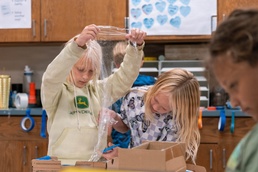
FORT HOOD, Texas — School districts across the Fort Hood community and surrounding areas are back in session, and parents and educators hope to work collectively to help students reach their greatest potential.
For the next nine months, the community will collaborate to support the overall well-being of students, not just academically but socially and emotionally, especially military students who are new to the area.
Melanie Mahoney, school liaison officer with School Liaison Office, Fort Hood Child and Youth Services, and Holly Griffith, principal of Lakewood Elementary in Belton, Texas, shared their advice for a great school year.
Their number one tip: teachers and parents must have a strong, communicative relationship.
“Introduce yourself early,” Griffith said. “Let the teacher know about the student or even about the family. Military families, they’re transitioning a lot and that can affect those students in different ways, and I think that having that understanding with the teacher allows us to be more intentional on how to meet those kids’ needs.”
Mahoney emphasized a parent is a child’s biggest advocate. Maintaining a strong relationship with the teacher is made easier using available apps provided by the schools. She also suggests reviewing assignments sent home for insight into your child’s day, allowing parents and teachers to work together to correct issues as they arise.
“Maybe the child had a rough night … and it can be something as easy as that parent sending a quick email to the teacher, preparing them,” Mahoney said. “It’s really about building that foundational relationship between the parent and the teacher so they’re both on the same page.”
This trust is especially vital for the emotional and social well-being of military children, who frequently face the stress of relocating. Before a student can focus on grades, they first need to feel secure in their new environment. To help with this, Mahoney and Griffith both promote the peer-to-peer program available in multiple school districts.
“We have great partnerships with our local school districts, and each campus has a youth sponsorship program,” Mahoney said. “When a new child comes in — even if they aren’t military-affiliated — a student ambassador will spend the day with them.”
Ambassadors give new students a campus tour, act as their lunch buddy and ensure they do not feel alone.
“Relationships are the foundation,” Griffith said. “The faster we can have that student feel connected and part of our school culture … the faster (they can) be successful.”
Griffith added she often reminds her enthusiastic student ambassadors to calm down so they do not overwhelm new peers. She also highly recommends students be involved in the various extracurricular clubs available at their schools.
However, it is not just transitioning students who may feel overwhelmed; new elementary, middle and high schoolers face similar pressures.
Sunny Patel of the Substance Abuse and Mental Health Services Administration noted in the administration’s blog, “Back to School and Mental Health: Supporting Our Children for a Successful Year Ahead,” that mental health challenges can considerably impact a child’s ability to learn. Research confirms a link between students’ mental health and their academic success.
“Encourage your child to express their feelings about going back to school,” Patel wrote. “Acknowledge their fears, make them feel understood, and reassure them that it’s perfectly normal to feel anxious about these changes.”
Patel emphasized creating at-home routines fosters a sense of security and consistency.
Patel also encourages educators to support student mental health by spotting warning signs, creating a safe space to “explore and express their feelings,” and integrating mental health into the curriculum. This in turn “promotes understanding and empathy, fostering a supportive environment for all students.”
Once communication and emotional well-being are secured, academic success is easier to establish. However, if a student still struggles, Griffith and Mahoney agree parents are the biggest resource and must act as their children’s best advocate.
“The districts have really good intervention periods, and intervention skills teachers who are going to identify those students who are seeing those academic gaps,” Mahoney said. “They try to do it rather quickly so students are not struggling for half the year before we’re identifying that, oh, they might need a little bit more help.”
Mahoney also highlighted free military resources for families, such as http://tutor.com/.
For more information about resources and services, families can reach out to the School Liaison Office located on the first floor of the Shoemaker Center at Fort Hood or call 254-288-7946.