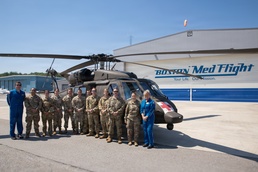
BEDFORD, Mass – When a life is on the line, experience and practice matter. That's why Soldiers from Det 1, Charlie Company, 3rd Battalion, 126th Aviation Regiment, General Support Aviation Battalion, spent two weeks training with flight Paramedics at Boston MedFlight at Hanscom Air Field.
As part of their certification and sustainment training, Army flight Paramedics must complete a series of training and continuing education courses at a higher level than the average Army medic.
“Army Air Ambulances are routinely assigned to the most critical medical missions,” said Cpt. Patrick Foley, Commander, Det 1, C Co. 3-126 GSAB. “We provide rapid air evacuation and life-saving care to patients in the most severe conditions,” he added.
That high level of care means high levels of training, and who better to learn from than medical experts who do flight medicine every day.
That’s where Boston MedFlight comes in.
“They do this every day and are able to give us perspective that we may not have thought about,” said Sgt. Ethan Baush, a Flight Paramedic with Det1. “Civilian flight medics/nurses are extremely knowledgeable and are able to correlate medicine with military operations and procedures well,” he added.
Learning from civilian flight medics working together fosters a sense of partnership and shared expertise among Soldiers and civilian professionals.
“Military flight medics often receive excellent instruction at schoolhouses,” said Jamie Eastman, a flight nurse, paramedic, and staff educator with Boston MedFlight. “But they may lack frequent patient contact, without these 'sets and reps,' medics experience 'skill fade,' where the space between their knowledge and their ability to apply it in the field grows wider,” he added.
Eastman, who is also a captain in the Army Reserve serving as a critical care nurse and the commander of the 912th Forward Resuscitative Surgical Detachment (FRSD), was a flight medic in the Vermont National Guard and has perspective on both the military and civilian sides.
"Army medicine recognizes the 'Walker Dip', which references that lack of patient care in real life results in a lack of proficiency amongst surgeons, physicians, and all medical providers, including Flight paramedics,” he said. “By allowing the military- civilian partnership to occur, we are able to fight this and have our soldiers prepared for any environment,” he added.
The normal pipeline for a Flight Paramedic is 68W Combat Medic training (3 Months), then paramedic school (8 months), then Critical Care training (2 Months), then a Flight Paramedic school at Fort Rucker (1 Month). When they complete all their required training, they'll be awarded the "F2" additional skill identifier. In October 2024, AR 95-1 was updated to require all medics assigned to medevac units to hold an F2 ASI to fly as aircrew members.
There is, however, another path for critical care training, which puts military flight medics side by side with their civilian counterparts.
The Rush program is a 6-week clinical rotation in an intensive care / burn unit in Chicago, where flight medics are exposed to a variety of trauma. This puts Soldiers inside a trauma center where they will gain real world experience they can’t get in a classroom.
Before Rush, Soldiers need to complete a 16 day critical care training to obtain a Critical Care Paramedic Card. Normally, this is done in Chicago, but leadership from Det 1 saw an opportunity to enhance their training and build upon a partnership.
“Instead of sending out Soldiers to Rush’s academic program prior to doing their clinical rotation, Boston MedFlight stood up the same training for us here in Massachusetts,” said Foley. “The course that Boston MedFlight set up for us meets the academic requirement for them to attend Rush and work toward their F2 ASI,” he added.
Using congressional funds for trauma training, the Soldiers at Det 1 received invaluable training close to home from flight medics and nurses who practice flight medicine every day.
Lead by Boston MedFlight staff including Jamie Eastman, a Flight nurse, Paramedic, and staff educator, Tammi Wallace Wood, Flight nurse and education manager, and Widmac Laterion, Flight Paramedic, and staff educator, Soldiers had two weeks of classroom and simulation training including: STABLE (Sugar, Temperature, Airway, Blood pressure, Lab work, and Emotional support), NRP (Neonatal Resuscitation Program), Difficult Airway, RSI (Rapid Sequence Intubation), PFCCS (Pediatric Fundamental Critical Care Support Course), FCCCS (Fundamental Critical Care Support), mechanical ventilation, ultrasound, radiology, and flight physiology. They also had the opportunity to do two ride along shifts with Boston Medflight to observe how they operate and do patient care.
“The students were very hands-on and energetic to learn,” said Eastman. “Their passion and commitment to bettering themselves made it fun to train and allowed for a positive learning environment," he added.
Bringing together military and civilian professionals allows them to share experiences and learn from each other, ensuring that when they get the call, they are ready.
“This was the best training I’ve had. The professionalism, experience, and willingness to teach from Boston Medflight was incredible. I was extremely impressed and hope that there is more similar opportunities in the near future,” said Baush.