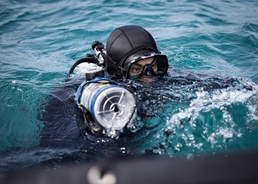
Thirty minutes earlier, the event was running exactly to plan. Explosive ordnance disposal (EOD) technicians from 15 nations gathered on a hill overlooking Weymouth Bay, England, to unload gear, wrap detonation cord, fill scuba tanks, don wetsuits and check their explosive payloads one more time before they embark their vessels. The mission was a carefully orchestrated operation – in a tactical zone three nautical miles wide, concrete blocks simulating sea mines were scattered throughout. Each nation, tasked to clear their assigned mine, had a different purpose for joining exercise Sea Breeze 26-2. Some were familiarizing themselves with foreign gear, others training on tactics learned from a partner nation: each their own agenda and goal for the day. Planned months before, the tactical teams executed their operations, and one by one, simulated mines were cleared from the sea.
Inside a repurposed port lobby, Sailors from the U.S., U.K. and Ukraine watched the operation unfold on a digital map. Together, the Ukrainian command-and-control, fleet battle staff and exercise control team formed the command network responsible for every decision made throughout the exercise. Each of the units in the chop of Weymouth Bay were experts in their field, but only the command network could see the whole picture, and they were receiving a message. An EOD team had an unlucky tide knock them away from their mine, and missed the detonation window and wanted another attempt. Their first step is to request another try through Ukraine's (UKR) 1st Mine Countermeasure (MCM) Squadron, the command-and-control for mine countermeasure operations during Sea Breeze 26-2. That request set in motion the command-and-control process underpinning every operation during Sea Breeze 26-2.
Ukrainian Command-and-Control
When the EOD team sent their request, four other rigid-hull inflatable boats were conducting operations in the vicinity. Alone, they are effective, but together, they bring robust capabilities to the mine countermeasure mission. The coordination and direction to create that robust capability is where UKR 1 MCM Squadron command-and-control comes in. For the EOD detonation event, UKR 1 MCM Squadron understanding’s and analysis of their mission is to find and designate areas in the waters off of Portland, England that may hold sea mines; dispatch orders to five multinational EOD teams to search their zones, locate the mines, and safely detonate errant ordnance; receive confirmation that sea mines were safely detonated and removed; and report up the chain mission-success. This sequence of events meant creating and maintaining a real-time picture of the operation, issuing orders through unfamiliar NATO channels to EOD teams that do not speak the same language, and dealing with the myriad of issues that arise from a complex, robust operation. Yet, all but one mine was cleared, and the Ukrainian command-and-control had a choice: change the mission and accept a simulated mine remains in the water, or create a new plan to allow the EOD team to clear the mine.
For Lt. Serhii Tsylke, chief of staff for the UKR 1 MCM Squadron, mission planning is a collaborative process. Once training is complete, commanders, operators and technical experts come together to map out how to achieve the overarching goal of keeping sea lanes safe. The final plan is then translated into detailed orders, assigning each unit a specific window of time, route or operating area, and mission.
A hallmark of Sea Breeze 26-2 is the participation of Ukraine, with NATO Allies and U.S. 6th Fleet forces. Previously hosted in Ukraine, and moved to the U.K. due to the ongoing conflict in the region, what started as a regional exercise has grown to an international endeavor. When asked if his unit’s role as command-and-control during the exercise was novel, Tsylke shook his head.
“To be honest, in this exercise, there is no complication [for us],” said Lt. Tsylke. “We do this same work in the Black Sea, under missile and drone attacks. There are many rules for us in the exercise but we take our experience [in the Black Sea] to [Sea Breeze 26-2]. It is a great opportunity to teach each other because [Ukraine] knows based on our experience, and the U.S. knows much from their experiences, and U.K. from their [experience], and so on, so that exchange of information is really important, especially for us.”
As in any coalition, different command structures expect different solutions to warfighting problems. In Sea Breeze 26-2, there are many stakeholders leaning on command-and-control, and the job of UKR 1 MCM is to take those expectations and braid them together into a single, effective warfighting plan. That plan is driven almost entirely by the fleet battle staff, also called Commander, Task Force (CTF) 365.
Fleet Battle Staff
To find the solution for the EOD team’s errant tide, the Ukrainian command-and-control analyzed and proposed a solution up their chain of command, to CTF 365. On receipt, the CTF staff begin the meticulous work of deconflicting; ensuring another run wouldn’t put any of the other operators at risk, that it was necessary for the training objectives to be met, and that doing so would not violate any of the pre-set rules and boundaries made for this event. If all criteria are met, the CTF staff green lights the second attempt.
The CTF’s multinational staff is made up of planners with a broad range of experience in integrating coalition forces to work together effectively and efficiently. Accustomed to deconflicting competing priorities, they maintain their own operational map and direct communications with subordinate commands. Beyond managing the operational elements of the exercise, CTF 365 also has their own training objective: helping build the Ukrainian Navy's command-and-control capability into an efficient, functional battle staff. During Sea Breeze 26-2, that development is a two-way street, with Ukrainian and allied personnel learning from one another while refining the processes needed to operate as a cohesive multinational headquarters.
“We always learn things working with other nations,” said Capt. Bill Williams, commander of CTF 365. “As the Ukrainians are maturing in their role as an MCM battle staff, we’re learning from them… We’re stronger together, and that is definitely the case for Sea Breeze because we have so many different partners here with their own ways of doing MCM, their own ways of conducting command-and-control, their own ways of executing tactical level objectives of mine countermeasure. It’s a learning process for everybody.
The multi-tier command-and-control is intentional. The majority of participants in Sea Breeze 26-2 are NATO Allies, used to working on NATO systems and NATO hardware. Now, working alongside partners like Ukraine and Georgia, and allies far afield like Japan, the multinational task force is forced to use unfamiliar but shared systems. This challenge is not a bug in the exercise – it’s a feature.
“No country in the world does mine countermeasure operations by themselves,” said Capt. Williams. “With the overwhelming capability our NATO Allies and [partners] bring with regard to tactical level mine countermeasure assets – ships, divers, unmanned underwater vehicles – it allows me astheexercise task forcecommander to bring in NATO assets, or a coalition of the willing to do future mine countermeasure operations.”
Exercise Control
Thirty minutes later, another request comes in, this time from the U.S. Navy EOD to CTF. Their ordnance detonated, but they want to conduct another dive run, to train their capabilities while in the water. Their proposed location, an hour ago clear and safe, was now within one nautical mile of the EOD team’s explosion radius. This time, the decision lies outside of both the Ukrainian and Fleet command-and-control. They’re not asking to change the plans to complete the mission, they are asking to expand the mission to include additional training opportunities. Royal Navy Cdr. Alasdair Magill, an EOD diver by trade and now director of the exercise control team, jumps in.
“They need to move that dive, we’re not putting a diver within a nautical mile of a detonation. [With] both underwater, that’s asking for a problem.”
They discuss, deconflict, run the checklist again for a new area and issue guidance: move the dive to a lower grid, three nautical miles away from the detonation. Once deconflicted, green light to dive.
The exercise control team, or EXCON, has a very different role in Sea Breeze than both the Ukrainian and Fleet command-and-control. They do not task or route decisions, nor do they claim responsibility over individual units. Instead, their job is to manage the foundation of the exercise itself, building scenarios, inserting variables, and green lighting decisions to both ensure all participating nations get the training they joined the exercise for, and embrace new opportunities to grow as a coalition.
“Our job as EXCON is to make sure all levels of the exercise get the training they need, depending on what the objectives are, and to smooth over those ripples that occur when you have multiple nations with their own training objectives,” said Cdr. Magill. “All while ensuring everything occurs in as realistic a way as possible.”
In a small-scale event, smoothing those ripples is relatively simple: move the dive spot, good to go. But Sea Breeze 26-2 is not a single event – its dozens, often happening simultaneously, across an entire sea area. And each year, those ripples compound as the scale of the exercise grows.
This scale, in both participants and the complexity of the exercise, comes with greater challenges. The most obvious can be planned for in advance: bringing in interpreters to overcome language barriers between nations, contingency planning for poor weather, preparing units and contracts to recover simulated mines should the primary vessels reroute, and managing water space to ensure the right unit is conducting the right training at the right time. But the integration of national identities into a single coalition is the true challenge and the primary objective of the mine countermeasure exercise.
“Being able to bring mass [capabilities] to the problem, means speed,” said Cdr. Magill. “That’s the one thing mine countermeasure lacks – it’s speed. It’s a slow method of warfare… either you need a long time, or you need a lot of [units] to do it quickly. That’s where being able to work together, having practice working together, comes to the [front]. You can clear your own waters, but if you look at [the Black Sea], where they reckon there’s somewhere between 900 and 1,300 square kilometers of mined waters, [a single nation] could take 10 to 20 years… Where if [many] go, it might take 3-5 years, depending on how many participants there are. That’s the kind of dramatic shift we’re talking about. If we practice it now, we’ll be that much better at it when it comes time to do it for real.”
Throughout exercise Sea Breeze 26-2, the EXCON will receive dozens of problem-sets and challenges – wrinkles in the plan that require smoothing out to ensure the safety and effectiveness of participants. But the challenges and problem sets are intentional. Experiencing challenges as a multinational team is why exercises are worth the cost of time, resources, and workforce to pull off. Those challenges are what make the participants sharper, more agile, and more effective when conducting mine countermeasure operations, both alone, and alongside one another.
Sea Breeze 26-2
“Exercises are to get everybody together, work together, communicate amongst each other, and learn from each other,” said Capt. Williams. “You’re always getting fresh ideas, a diversity of opinions, tactics, tools and procedures, learning from each other and seeing how people do things better than you, and taking those nuggets to make yourself better. Being able to work together to accomplish a shared goal is really what exercises are about.”
For the EOD team, it was one more successful demolition. For the headquarters watching from shore, it was only a moment in an otherwise full day of problem-set’s waiting to be solved.
Sea Breeze 26 is an annual exercise co-sponsored by U.S. Naval Forces Europe-Africa and Marine Corps Forces Europe-Africa, designed to develop interoperability of maritime and ground forces in the Black Sea Region through combined NATO deliberate planning, integration, and command and control of Marine Amphibious Forces.