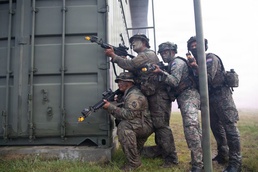
KOTA BELUD, Malaysia — Deep in the jungles and mountains of Malaysia, the Joint Pacific Multinational Readiness Center is proving to the U.S. Army leaders that the future of combat readiness is mobile, multinational and exportable.
During Exercise Keris Strike 26, JPMRC deployed its advanced resources to validate a crucial strategic objective: establishing a permanent Regional Combat Training Centre in Malaysia. Featuring the U.S., Malaysian, and Australian forces, this trilateral exercise showcases the Army's capability to project elite combat training center doctrine directly into the Indo-Pacific theater.
U.S. Army Lt. Col. Joseph Palilo, a commander within the 196th Infantry Brigade who serves as the task force senior leader on the ground, emphasized that JPMRC offers many of the same capabilities provided by fixed installations like the National Training Center in California or the Joint Readiness Training Center in Louisiana.
"There are more tools, gizmos and toys at NTC and JRTC, but they don't really go anywhere," said Palilo. "We can literally pick this up, find a place on the ground, and execute a [Combat Training Center] for the training audience."
This exportable capability provides data integration, instrumentation gear and self-assessment tools anywhere in the world, ensuring theater-specific training feels authentic.
A key driver of this regional optimization is the Joint Readiness Reserve Initiative, an effort that integrates active-duty, National Guard and Army Reserve components into a unified front. At Keris Strike 26, units like the Oklahoma and Guam National Guard as well as a U.S. Army Reserve Public Affairs Detachment are training alongside international allies to further strengthen America's diplomatic and military influence.
"It just strengthens the fact that you need to fight multinationally," said Palilo. "You just can't fight alone.”
Beyond high-level strategic alignment, the exercise provides invaluable tactical feedback. Rather than facing a predictable opposition force, U.S. Army Soldiers must adapt to tactics of their regional partners. Malaysian and Australian forces bring unparalleled jungle warfare expertise that American units are learning to master.
"[The Malaysians] just do things differently,” said Palilo. They solve problems differently, and that makes our forces better. It teaches us to think more complex and creatively."
For Army leaders looking to operationalize integrated deterrence, Keris Strike 26 is the ultimate proof of land power capability. By embedding high-tech training systems directly into partner nation, JPMRC ensures the joint force does not just train in the Indo-Pacific—it thrives in it.