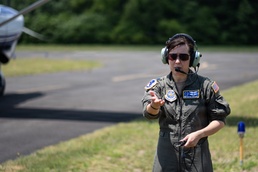
U.S. Air Force Airmen assigned to the 818th Mobility Support Advisory Squadron, 621st Contingency Response Wing, tested the adaptability expected of Air Advisors during Exercise Fold’Em, June 15-26.
The two-week exercise linked air movements, ground reception and follow-on transportation across multiple austere locations. The training tested the unit’s ability to execute recovery procedures, implement emergency action plans, conduct rapid exfiltration and complete airfield assessment tasks amid changing conditions.
“The amount of coordination that it took, with all the players coming together, stood out,” said U.S. Air Force Lt. Col. Christina Norbygaard, 818th MSAS commander. “Everyone was prepared and adapted, which goes to show you how Air Advisors can really bring everyone together.”
For the Silverbacks of the 818th MSAS, the exercise carried additional significance. As the squadron moves toward inactivation, Exercise Fold’Em served as one of its final major operational milestones while supporting the certification or upgrade of eight advanced advisors and four team sergeants.
The exercise challenged Airmen to apply mission-essential tasks across a scenario built around uncertainty and changing conditions. Events included simulated chemical, biological, radiological and nuclear conditions, airfield assessment tasks and other scenario injects designed to require Airmen to interpret evolving information and apply appropriate tactics, techniques and procedures.
“Recoveries aren’t necessarily always smooth,” said Staff Sgt. James Orr, an 818th MSAS survival, evasion, resistance and escape specialist and one of the exercise coordinators. “There are a lot of things that happen and a lot of variables that change.”
Orr said the scenario was designed to replicate the “gray zone” in which air advising missions can unfold, requiring Airmen from different functional specialties to coordinate, adapt and sustain the mission. The exercise also evaluated how MSAS capabilities could contribute to the broader contingency response mission.
“We wanted to test MSAS capability within the [621st] Contingency Response Wing, and also air advising as a whole,” Orr said.
At one of the exercise’s receiving locations, Tech. Sgt. Garrett Wyatt, 818th MSAS vehicle maintenance noncommissioned officer in charge, helped connect air operations with ground transportation. Acting as part of the ground reception element, Wyatt authenticated arriving personnel and coordinated their follow-on movement through staged vehicles and drivers.
For Wyatt, the scenario highlighted the logistical planning required to move personnel through a recovery operation. “For me, it’s mostly the logistical aspect — getting the drivers and vehicles staged in certain locations and figuring out how we’re going to transport people to the next spot,” Wyatt said.
He said the scenario reflected the embassy coordination Air Advisors may encounter during real-world missions. “We work pretty directly with the embassy on most of our missions,” Wyatt said. “Being picked up by somebody from the embassy would probably be a likely scenario for us.”
Norbygaard said the exercise’s focus on recovery operations, emergency action plan implementation, rapid exfiltration, airfield assessment and CBRN injects reflected the range of environments Air Advisors may encounter.
“We never know the environments we may deploy to, so it’s good to be ready for everything,” Norbygaard said. “Our Air Advisor schoolhouse focuses a lot on armed conflict contingencies, but we need to be able to survive without all that equipment too. That’s the modern reality of Air Advisors now that we’re not focused on the Global War on Terrorism.”
Though the squadron is preparing for inactivation, Norbygaard said maintaining a strong pool of qualified and experienced advisors remains important to the Air Force.
“The formal structure of an Air Advisor squadron may be gone, but the mission will keep going,” Norbygaard said. “The Air Force will need a strong bench to pull from, and having experienced team leaders like ours will be key.”
Norbygaard said the Silverbacks’ adaptability and ability to integrate with allies and partners are among the qualities that should continue within the broader Air Advisor enterprise.
“We will never be able to fight and win a war without our allies and partners,” Norbygaard said. “We are force multipliers. Not by technology or equipment, but by leveraging the military’s most important asset, the people.”