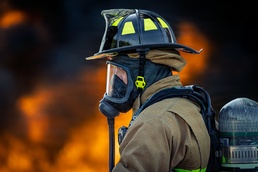
NEW LONDON, N.C. - In an era where technology has transformed the way people learn, work, and connect, some skills are still best learned the old fashioned way: face to face and hands on.
For firefighters assigned to the 158th Fighter Wing, Vermont Air National Guard, this meant traveling to North Carolina over the spring to train on live jet fuel fires. This training brought a level of realism many of them had never experienced before despite years of protecting aircraft at the Burlington International Airport and surrounding communities.
"Frankly, I would say 95% of our department has never, ever burned with actual jet fuel," said Blake Lahue, assistant chief of training at the 158th Fighter Wing. "It's always been propane fires."
And this difference matters.
According to Zachary LeBlanc, the interim captain for B Shift at the 158th, a lot of the aircraft flown in and out of the BTV carry 60,000 to 80,000 pounds of fuel on them.
"When you're fighting one of these fires, you're most likely going to be fighting a fuel fire and you need to be able to fight fuel fire in a very specific way to be able to fight effectively."
Unlike traditional propane based training the 158th Fighter Wing firefighters have received over the decades, at the North Carolina Emergency Training Center in New London, they were able to extinguish actual jet fuel fires using the department's fluorine-free firefighting foam.
The difference between propane based training and live fuel training is more than just a nuance.
In traditional propane fueled training environments, firefighters experience the heat, the smoke and the visual conditions of an aircraft fire, but they are not actually putting out the fire.
"You're not actually extinguishing the fire," said Shane Smith, the acting assistant chief on B Shift at the 158th. "Really all that you are doing is you're going in, you're spraying water and running through the tasks that you need to do.”
Essentially, what propane training systems use are sensors which measure temperature reduction. Once enough heat has dissipated, the system automatically shuts off the flames, signaling a successful evolution.
While propane systems can simulate the heat and appearance of an aircraft fire, they cannot replicate how liquid fuel reacts, spreads and responds to firefighting agents during an actual emergency.
This is where using real jet fuel as a training aid instead of propane requires firefighters to properly apply foam to extinguish the flames.
"When you're dealing with a fuel fire, the only determining factor of you putting out the fire is you actually applying foam correctly to the fuel fire to extinguish it," LeBlanc said. "So you know right off the bat if you're doing it right or if you're doing it wrong."
This training also allows firefighters to gain experience with the department's fluorine-free firefighting foam, which is an eco-friendly foam effective on Class A and B fires, and behaves differently than water when applied to burning fuel.
"If you were to just use water on a fuel fire like that, it doesn't have the extinguishing capabilities. It'll just kind of push the fuel away and spread it out and you'll have fire going every which direction." Smith said. "With the foam, you build a blanket and it kind of rolls over the top of it, essentially smothering the fire."
For firefighters tasked with protecting military and passenger aircraft carrying tens of thousands of pounds of fuel, the opportunity to train with both real jet fuel and the foam they would use during an emergency provides and unmatched level of training realism.
"It's really cool to be down in North Carolina at a facility like this that could give us the chance to really practice those techniques to be able to control a fuel fire," LeBlanc said.
While this training focuses on aircraft emergencies, the skills gained extend well beyond the flightline.
According to Lahue, the 158th Fighter Wing’s fire department responds to approximately 1,000 calls each year and provides mutual aid throughout Chittenden County, Vermont, assisting local communities with emergency medical calls, structure fires and tanker task force operations.
"If we did not have the flying mission, the fire department would not exist," Lahue said. "The airport would have to have a fire department to meet FAA requirements."
Without the military fire department, Burlington would likely bear the cost of maintaining a full-time airport firefighting force, a service Lahue estimates at roughly $4.5 to $5 million annually in salaries, benefits, equipment, and training.
The responsibilities of the 158th Fighter Wing’s fire department extend well into the Champlain Valley of Vermont, where they routinely assist neighboring communities by responding to structure fires, medical emergencies and tanker task force activations.
"We will pretty much go anywhere in Chittenden County that we are requested," Lahue said, pointing to the strong culture of service before self at this department.
This willingness to respond wherever and whenever they are needed reflects a tradition of abnegation that has long been associated with the fire service.
It is the nature of this job, where firefighter’s routinely place themselves in difficult and sometimes dangerous situations in service to their communities.
According to the U.S. Fire Administration, in 2024, 72 U.S. firefighters died while on duty, and during the same year, an estimated 53,575 firefighters suffered line-of duty injuries.
Taken together, these figures highlight the hazards inherent of the firefighting profession.
Yet despite these dangerous, for the firefighters at the 158th Fighter Wing, this commitment to serving others is main reason for doing this job.
LeBlanc said it is the opportunity to help others that gives the profession lasting meaning.
"It's a unique position in the fire department to be able to be involved in your community and help someone on a bad day," LeBlanc said.