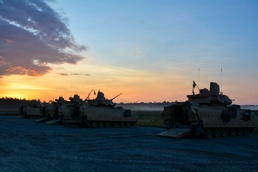
CAMP SHELBY JOINT FORCES TRAINING CENTER, Miss. – As the sun rises over the Multi-Purpose Range Complex (MPRC) at Camp Shelby, Miss., Monday, May 11, 2026, a thick blanket of fog covers the rolling landscape, birdsong fills the air, and a rooster crows in the distance. Mostly oblivious to the natural beauty around them, Soldiers of the 1st Battalion, 155th Infantry Regiment tumble out from their hammocks, cots, and Bradley Fighting Vehicles, beginning day two of gunnery training and qualification.
Breakfast consists of bacon, sausage, oatmeal, and fresh fruit brought to the range from the Camp Shelby dining facility. The Soldiers say this is the best Army chow in recent memory. With limited access to hot coffee, today’s caffeine fix comes from energy drinks. One enterprising Private First Class sells ice cold Monster drinks from the back of a Bradley, capitalizing on his compatriots who lacked the foresight to bring their own.
Over two miles long and a quarter mile wide, the MPRC consists of six training lanes suitable for Bradley Fighting Vehicles, Abrams tanks, and dismounted infantry patrols. With targets resembling troops, trucks, and armored vehicles at his disposal, Sergeant First Class Aaron Shivers, the B Company master gunner, sits in a 40-foot observation tower. Tasked with training the Bradley crews below, SFC Shivers controls the hydraulically lifted targets and orders the crews to find and engage them.
Seventeen Bradley crews training on the MPRC hail from the Headquarters and Headquarters Company, A Company, and B Company, all from the 1-155, known as the Mississippi Rifles. Over the course of four days and three nights, each of these crews execute four runs of the training lanes. Soldiers first execute training scenarios during both the day and night. Next, the Bradley crews complete day and night runs which serve as a crew qualification. Each run down the lane includes ten engagements, courtesy of the Bradley’s 25mm main gun and the M240 coax weapon systems.
On nearby training ranges, sniper and mortar platoons from HHC and M1A2 Abrams tanks assigned to C Company conduct their own gunnery training.
As the hot sun burns fog off the range, the first crew of the day begins at Battle Position 1 on Lane 5. Machine gun fire punctuates the mockingbird warbling, and any deer grazing at the far end of the range quickly run for cover as deafening main gun booms echo across the landscape.
Lieutenant Colonel Kevin Grace, commander of the Mississippi Rifles, has been up since before sunrise, circulating with his soldiers and solving any problems they face.
“Our Soldiers are slow out the gate,” says Lt. Col. Grace, “but start gaining momentum on day two as they start brushing the rust off and finding their rhythm.”
Within minutes of live fire beginning, the Bradley is a mile down range, continuing its kinetic action.
Sergeant First Class Sheldon Roberson serves as the beach master. Much like a baseball manager, he tells one crew that it is in the proverbial batter’s box, and another is next up after that.
“For the infantry, our role is decisive action on the battlefield. Gunnery enables us to exercise the equipment we have and gives us an opportunity to test and gauge our lethality,” says SFC Roberson. “As the beach master, my role is to maximize efficiency on the range so these crews can take full advantage of the limited time we have.”
When training this many crews, range throughput – the rate at which crews train with minimal downtime between each run – is of utmost importance. A fire on the range, loss of communications, or crew mistake can delay training for minutes or even hours.
After 13 consecutive hours of gunnery, the smell of gunpowder lingers in the south Mississippi humidity, and a truck delivers the second hot meal of the day. Tonight’s supper is a chicken breast smothered in barbecue sauce with sides of vegetables and rice. All this is washed down by the third or fourth energy drink of the day.
As the sun sets, a rainstorm approaches and delays training a few hours. The rain impedes range throughput, pausing gunnery until the storm subsides.
As training resumes at 11 p.m., the unmistakable pop of an energy drink opening cracks through the control tower and the smell of taurine fills the air. The range is live again, and soldiers of the 1-155 will train nighttime gunnery until 4 a.m., May 12, sleep a couple of hours, then start crew qualifications with the sunrise.
All told, the most lethal fighting force in the Mississippi Army National Guard will train gunnery around the clock over four days – until the early morning of May 13, when gunnery training and crew qualification is complete. After a day of resting and refitting and a night of sleeping on a warm bed in Camp Shelby’s garrison, the 1-155 will return to the training area for six days of maneuver training.
“Everything that you see here is about preparing for war,” Lt. Col. Grace points out. “We are training so that we will be prepared to answer the nation’s call. The Mississippi Rifles work hard so that we can fight and win wars on behalf of the United States at a time and place of her choosing.”