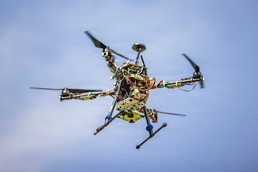
As unmanned aerial vehicles continue to shape the landscape of war, a team of cadets collaborated at the cutting edge of autonomous study through the Swarm Troopers research project in the lead-up to the Projects Day Research Symposium, April 23 at the U.S. Military Academy. This research aims to use drones to conduct intelligence, surveillance and reconnaissance to determine the location of mines with acute accuracy.
Team Swarm Troopers consists of nine cadets pursuing different STEM majors under the guidance of assistant professors Dr. Josiah Steckenrider and Mr. Dominic Larkin. Leadership rotates among team members, allowing each cadet to spend time monitoring progress, managing schedules and ensuring members are meeting their respective deadlines. Currently, Class of 2026 Cadet David Liu acts as team leader.
“The idea is that we can give a Soldier a swarm of drones and a mobile device to specify a fly zone where they want to search,” Liu said. “Then we use a custom algorithm that’s able to generate a flight path. The drones will then go out and conduct the mission.”
Rather than being directed to specific target locations, the drones will autonomously determine where to go before searching the field of interest. The project focuses on two primary aspects of autonomy: coordinated swarm behavior and perception-based target identification.
“On the perception side,” Steckenrider said, “the first piece is where the drones fly and how they do so efficiently. Then, once we see things on the ground, how do we intelligently process that information into a probabilistic heat map for the user?”
The term “heat map” refers to hot spots, or specific landmine locations. The perception software that identifies hot spots was custom-built, which involved training artificial intelligence to observe landmines on the battlefield through fitted cameras.
“It’s one thing to say, ‘I see a landmine.’ It’s another thing to say, ‘What are the coordinates of that landmine?” Streckenrider said.
He explained that detecting a landmine is only part of the challenge—accurately determining its location is more complex. Using the drone’s coordinates alone can be unreliable, especially when targets appear at the edge of the drone’s field of view at higher altitudes.
To address this, the team incorporates information about the drone’s altitude, orientation and camera angle to calculate a much more accurate estimate of a landmine’s location. This autonomy is also intended to reduce the cognitive burden on Soldiers.
“A single Soldier can organize a swarm of drones quite manageably as they all fly autonomously,” said Class of 2026 Cadet Matthew Wanta. “All they really need to do is find the search area where they’ll send the drones to look. They don’t have to micro-manage each drone.”
This is meant to supplement the rigor involved in assigning multiple Soldiers their own drones and having them work in tandem to perform synchronized maneuvers over the battlefield.
“The algorithm that we used is more efficient than an individual getting trained on the drone,” Wanta continued. “This way one person defines a mission for the drones and the deconfliction of the drones is handled well by the algorithm.”
Steckenrider added that while the specific use case focuses on mapping out minefields, the technology can also be applied to finding any high-value targets or other points of interest within a defined area. That can extend to search-and-rescue and reconnaissance missions, among others.
“Right now, we’re using a camera that’s trained for a landmine with an AI model, but it could be ground-penetrating radar, a thermal sensor…it could be anything,” Steckenrider said. “We’re working at a level of abstraction that’s higher than just the type of sensor.”
In terms of vision, Class of 2026 cadets William Preston and Nathaniel Obeng and Class of 2027 Cadet Patrick Mills worked together to integrate the mathematical research behind camera optics into the drone system. Initially, during the first half of the research, Preston worked individually on the research and design of the camera.
“In the second half, I paired up with Patrick and Nate, and Nate helped us integrate the system,” Preston said. “Patrick focused on the computer vision side, working with the AI detection. I worked with him on recognizing the landmines and then annotating the effectiveness of the camera and the model paired together.”
During the process, the sub-team sought instruction from advisers to acquire a lens capable of adjusting to the quick movement of drone flight.
“We needed a global shutter camera sensor. With a rolling shutter, the fast movement of the drone causes a distortion effect on the camera and the way cameras sense,” he said. “But a global shutter takes the whole frame at once. That was the big difference from difficulties last year to success this year.”
The team also worked through technical challenges integrating cameras with onboard systems, adapting software and hardware to ensure reliable communication between components.
Meanwhile, Class of 2026 cadets Joshua Creque and Kiran Goldstein partnered to develop and integrate software.
“We were the connection between the Soldier and everything else,” Creque explained. “If the Soldier wanted to see drone activity or send information, they would use our software. And so, we built and programmed it and used a set of software tools and libraries that allow us to write code to communicate with the software ecosystem. It is essentially the connective tissue that allows the drone’s brain to share data with the maps Team Swarm Trooper utilizes.
The system allows a Soldier to connect with any device, giving them the capability to pinpoint where they want the drones to fly, define search areas and establish designated no-fly zones.
“We allow Soldiers to define a search area, send it through the system, and the drones will fly that area,” Creque said. “And then afterwards, once the drones have made the heat map, that heat map will be displayed on our software for the Soldier to see.”
Obeng believes this experience has refined his understanding of what it means to communicate, understand and lead a team with efficiency and humility.
“If you’re talking about research to people who aren’t technically adept, you need to translate technical material at their level,” Obeng said. “Serving on this team has also allowed me to identify my flaws, make connections and find ways to compromise where we can better aid each other.”
For Class of 2026 Cadet Elizabeth Joo, it is about understanding what drives purpose and the work it takes to reach a conclusion that informs one’s vocation.
“Dr. Steckenrider introduced me to Gaussian distribution and probability metrics, which links back to my systems engineering background,” Joo said.
She said the project introduced her to stochastic modeling, how to map probabilistic concepts and then project them into current states and estimate and predict the next step. That process “is something that I’m really interested in, and I have found my passion in it,” Joo said.
In the four years Steckenrider has worked on this project, he has watched many cadets refine their technical and leadership skills, and he observed that one of the main aspects guiding cadets toward successful completion of research is passion for the craft.
“The cadets that leave with the strongest leadership skills are the ones that embrace that process, the teamwork, the independent thinking, and the intrinsic motivation, regardless of how well they’re doing in their classes academically,” Streckenrider said. “It just goes into that nuanced framework of a not-one-size-fits-all ordeal when it comes to seeing excellence unfold.”
“Swarm Troopers” is an interdisciplinary project that brings together cadets from the Departments of [Electrical Engineering and Computer Science](https://www.westpoint.edu/academics/departments/electrical-engineering-and-computer-science), [Mechanical and Aerospace Engineering](https://www.westpoint.edu/academics/departments/mechanical-and-aerospace-engineering), [Mathematical Sciences](https://www.westpoint.edu/academics/departments/mathematical-sciences), and [Systems Engineering](https://www.westpoint.edu/academics/departments/systems-engineering). The project is being presented at West Point’s 27th annual [Projects Day Research Symposium](https://www.westpoint.edu/about/academy-events/projects-day-research-symposium/2026), which showcases hundreds of cadet-led research projects. Learn more about select project features and how to partner with West Point at [www.westpoint.edu/werx](http://www.westpoint.edu/werx).