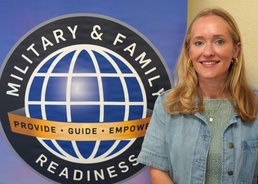
On a Unit Training Assembly weekend, the flightline and the briefing rooms aren’t the only places where readiness is built.
Sometimes it starts with a small question: How do I write a resume that translates my military skills? And then it can turn into something bigger: a reservist landing a better civilian job, a spouse finding community, or a family feeling steady before deployment.
That’s the lane of the 403rd Wing’s Military and Family Readiness program, a “one stop shop,” according to April Lee, the Wing’s Military and Family Readiness director, who stepped into her role in November 2025 and wants wing members to know she is here to help.
Her job, she said, is to connect Airmen and families to the right resources, whether that’s on base, in the community, or in whatever state a reservist calls home.
Military and Family Readiness Centers help commanders identify and reduce personal and family challenges that can impact unit cohesion and operational readiness, and these services help develop and sustain resilient, ready Airmen and families, according to Department of the Air Force Instruction 36-3009.
Many 403rd Airmen balance military duty with civilian careers, family schedules, and employer expectations. When stress hits, it often doesn’t wait for a UTA weekend.
“Life happens,” Lee said. “You have your two UTA days, but you could have a million things going on during the month.”
Lee’s focus is intentionally broad: the member, the spouse, the children, and the support network around them. The Department of the Air Force describes the M&FR program’s purpose as empowering the Air Force community to stay ready and adaptable while navigating the unique challenges of military life.
At the 403rd Wing, Lee said one of the biggest priorities has been strengthening the family connection piece, especially through the Key Support Liaison program, part of the Commander’s Key Support Program.
“We talk about all the things available for the Airmen,” she said. “But what about spouses and family members?” Since arriving, Lee said the wing has grown the number of certified Key Support Liaisons to eight, expanding a capability that helps families get connected to information, resources, and a real person who can answer questions.
In DAFI 36-3009, the Commander’s Key Support Program is described as a commander’s program designed to improve communication flow to family members, with volunteers, Key Support Liaisons, helping families access the M&FR center and other resources to increase readiness, connectedness and resiliency.
Key Support Liaison works alongside the unit and commander, checks in with spouses and families, and connects them to support early, before problems become crises, said Lee.
“They would talk to members like, ‘Hey, are you married? Do you have any children? Are you getting the childcare that you need on your drill weekends?’” Lee said. “Are you guys set up for this deployment?”
For Airmen or family members who want to volunteer, Lee said the first step is simple: reach out to her office or connect with the CKSP Key Support Mentor Meredith Siekle-Meade at 403wg.cksp.keysupportprogram@us.af.mil. The goal, Lee added, is to pair volunteers with their own squadron whenever possible so support stays local and familiar.
A major part of M&FR support is helping reservists and families prepare for deployments and the transition periods that come with them. Lee said her office focuses on practical preparation so members can step away from their civilian routine with fewer unknowns, and families at home feel informed and supported.
One vital tool for reservists is the Yellow Ribbon Program. Lee said she works closely with Yellow Ribbon events and partners, both to connect families to the right information and to make sure they know where to go for help before, during, and after deployment.
“These events prepare them for that separation, and then that reintegration,” she said.
That support doesn’t stop with a single brief or an event. Lee said the goal is to give reservists and their families a clear path to the right answers, whether they need help building a plan before deployment, navigating benefits while they’re gone, or re-centering routines when they return.
The support she can provide ranges from preparing a spouse for time apart to childcare during drill weekends and resume reviews to finding resources that vary by state for a part-time force spread across the United States.
Lee is also building support aimed at first-term Airmen, especially around the challenge of balancing civilian life with military service. For that, she working with the Wing’s resiliency team, which includes the Resiliency First Sergeant Master Sgt. Jared Bryant and the Director of Psychological Health Mary Ruffin, to line up briefings and workshops, including a financial readiness session planned for September to help Airmen and families. She also wants Airmen to know that asking for help won’t be used against them.
“One misconception I’d like to correct is that it’s going to be looked at in a negative way, or that we’re going to tell somebody,” Lee said. “We’re genuinely just here to help.”
She shared examples of the kinds of calls she gets when people wait too long: job loss, housing instability, and families reaching a breaking point. Her goal is to shift that pattern, so Airmen come in early, not only in emergencies.
“I don’t want people to get to that point,” she said. “I want them to know we’re here. Readiness isn’t only checklists and training lines. Sometimes it’s knowing who to call before things get heavy, and trusting that help is part of the mission, too.”
For more information, contact Lee at 228-377-8253 or email her at april.lee.12@us.af.mil.