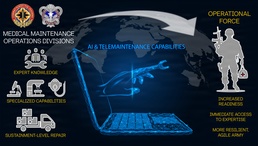
FORT DETRICK, Md. – U.S. Army Medical Logistics Command is embracing the use of artificial intelligence and advanced telemaintenance to ensure life-saving medical devices are ready for the next generation of warfare, where troops may be more isolated and support less accessible than ever before.
AMLC operates three Medical Maintenance Operations Divisions, or MMODs, where small teams of expert technicians are transforming sustainment-level maintenance operations to provide critical remote support to the warfighter.
The shift addresses the challenges of potential future conflicts in geographically vast areas, for example, such as in the U.S. Indo-Pacific Command area of operation.
“If we have a new one spring up, like in the Pacific, [we're] talking about lots of small island chains and isolated areas that are not easily accessible,” said Ian McNesby, chief of operations at AMLC’s MMOD in Tracy, California, or MMOD-CA. “A lot of these guys are going to be on their own or cut off from major resources ... unless we can provide remote support.”
In that scenario, a unit-level medic with a broken diagnostic machine can’t wait days for a replacement part or a fly-in technician to address the issue. To bridge that distance, the MMODs are moving beyond traditional support methods.
“We’ve always done some form of telemaintenance, but in the past we didn’t have visual capability,” McNesby said.
Now, using platforms like Microsoft Teams, technicians can visually diagnose equipment issues and assist Soldiers downrange with repairs, a major leap from simply talking over the phone.
Leading this change is AMLC’s Medical Maintenance Management Directorate, or M3D, which oversees the three MMODs in California, Pennsylvania and Utah. The directorate is carefully charting its course to align with the AMLC’s higher headquarters, U.S. Army Communications-Electronics Command.
MMOD-CA Director Isaac Newman emphasized a strategic, forward-looking approach when it comes to AI.
“Modernizing sustainment is a key part of the Army’s mission, and we are watching the development of CECOM’s Artificial Intelligence-Assisted Maintenance (AIAM) platform with great interest,” Newman said. “While it’s not part of our daily workflow yet, we are actively exploring how we can best leverage it in the future.”
The integration of AI is already showing promise. MMOD personnel are using it for administrative tasks but also considering ways to directly assist technicians.
“As the program matures, we see tremendous opportunity to contribute our specialized medical equipment data into the learning model,” Newman added. “This will ensure the platform is finely tuned for the unique needs of Army Medicine, ultimately benefiting the Soldiers who rely on this equipment.”
This technological leap is being driven by the teams at each MMOD, comprised of military, civilian and contract technicians, many of whom are prior military as well. Their deep, hands-on knowledge is M3D’s greatest asset, McNesby said, but also its greatest challenge as some seasoned experts near retirement.
“It takes time to grow a subject-matter expert … you can’t just grow that overnight,” McNesby warned, highlighting the need to capture their institutional knowledge.
AMLC is supporting modernization efforts at all three MMODs, which also includes facilities at Tobyhanna Army Depot, Pennsylvania, and Hill Air Force Base, Utah.
Each facility supports a different geographical region, serving as a center of technical excellence for different types of equipment. The MMODs are staffed by expert technicians who can service unit-level equipment shipped to their shops, as well as deploy to provide direct support to operational units or National Guard units in their respective regions.
MMOD-CA primarily supports medical imaging systems and specialized calibration equipment, while MMOD-UT specializes in pulmonary and oxygen-generation systems, and MMOD-PA focuses on clinical lab equipment.
In addition to technological advances, MMOD-PA recently completed a major renovation that doubled its warehouse space to 60,000 square feet and added a new training room dedicated to telemaintenance support.
“Our modernization efforts are in lockstep with CECOM’s strategic vision,” M3D Director Jorge Magana said. “This innovation isn't happening in a silo; it's a deliberate, directorate-wide effort across our MMODs. By empowering our teams to embrace technologies like AI and remote support, we are building a more resilient sustainment enterprise that directly contributes to CECOM's goals and delivers readiness for the entire Army.”
A key part of this digital transformationis M3D’s effort to digitize its equipment manuals and build out a searchable dashboard that will give maintainers instant access to everything from parts lists to data on average repair times.
As the Army prepares for an uncertain future, the work being done to modernize medical maintenance operations is a critical part of ensuring overall medical readiness. By embracing new technology, AMLC’s MMODs are working to guarantee that no matter how remote the battlefield, the American warfighter will have the support they need.
“We’re all in and fully on board to make that leap,” McNesby affirmed. “It’s our main mission. We’re here to support the warfighter above all else.”