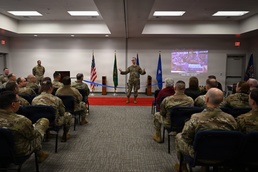
“The idea of having this brand new facility for a guard installation like this is mythical,” said Col. Travis Hartzel, 194th Air Support Operations Group commander.
The 194th ASOG marked the completion of its new complex with a ribbon-cutting ceremony at Camp Murray, Wash., Jan. 9, 2026.
The $34.6 million, 56,000-square-foot facility consolidates units that were previously scattered across Camp Murray.
The process leading up to the ribbon-cutting ceremony began roughly eleven years ago, although the brainstorming behind it started years before between then Col. Jeremy Horn, 194th ASOG commander, and Col. John McKinley, 248th Civil Engineering Flight commander.
“It's nice to start the programming of the project way back in the day for conceptual, to get it to design, and now to see it finally here,” said McKinley. “Most people don't get to be here for cradle to grave, and I got to be here for the whole thing.”
The 194th Civil Engineering Flight oversaw the project from initial programming through construction, ensuring the contractor met the budget and quality control standards.
The complex is configured for efficient coordination and response. At its core is a large simulation area for Joint Terminal Attack Controller training. Surrounding the simulation suite are mission planning and briefing rooms. The layout allows Airmen to plan operations, rehearse, execute simulations and debrief in a single, secure environment.
Drive-through bays enable personnel to dispatch rapidly — streamlining response for domestic operations.
“If we have large-scale flooding in Washington state, for example, and we need X number of trucks and X number of folks, and then this amount of equipment,” said Hartzel. “The design of that building is to pull the truck in, load the equipment, and do your inspections. You've got everybody loaded up and they just drive out the other side.”
The ASOG complex will currently house the 194th ASOG, 116th Air Support Operations Squadron, 116th Combat Weather Flight and the 194th Human Performance Optimization Team. Plans are being discussed to move a component of the 242nd Combat Communications Squadron and the 194th Electromagnetic Spectrum Operations Task Force into the facility in the future.
“We can integrate our training,” said Hartzel. “If it is with the Weather Flight, if it is with the EMSO Task Force or Combat Communications, having that centralization gives us more time, which equals a more ready and highly trained force.”
As the ASOG and partner units consolidate, other squadrons and flights are relocating into the newly available space. McKinley described the project as the “first domino” in a broader reorganization that will better align facilities with unit size and mission requirements.
While the reorganization reshapes the installation, its true value lies in the people who operate from it.
“This is a team of problem solvers, and this is a team of very committed individuals, whether it is supporting operations here within the state of Washington or abroad in combat,” said Hartzel. “Ultimately, I just want to say thank you to everyone who is making this investment. You are investing in the mission, in the people of this organization, and we will not let you down.”